Within the Frame #03: The Intersection of Intention, Chance, and Serendipity
A series on learning to read photographs
About Within the Frame — This series is an invitation to slow down. Each instalment offers a single photograph and asks you to sit with it — to look, to think, and to articulate what the frame is doing on its own terms. Composition, emotion, gesture, rhythm, tension, atmosphere, narrative suggestion — all of these become part of the language you’re learning to read.
Over time, these small exercises sharpen your instincts. You begin to notice what you once overlooked. You start to recognise the quiet architecture that holds an image together. And gradually, you learn to trust your own way of seeing — not by memorising rules, but by paying attention with patience, curiosity, and care.
In this post we will also discuss Luck & Serendipity and we’ll take a closer look at the term Proscenium Arch.
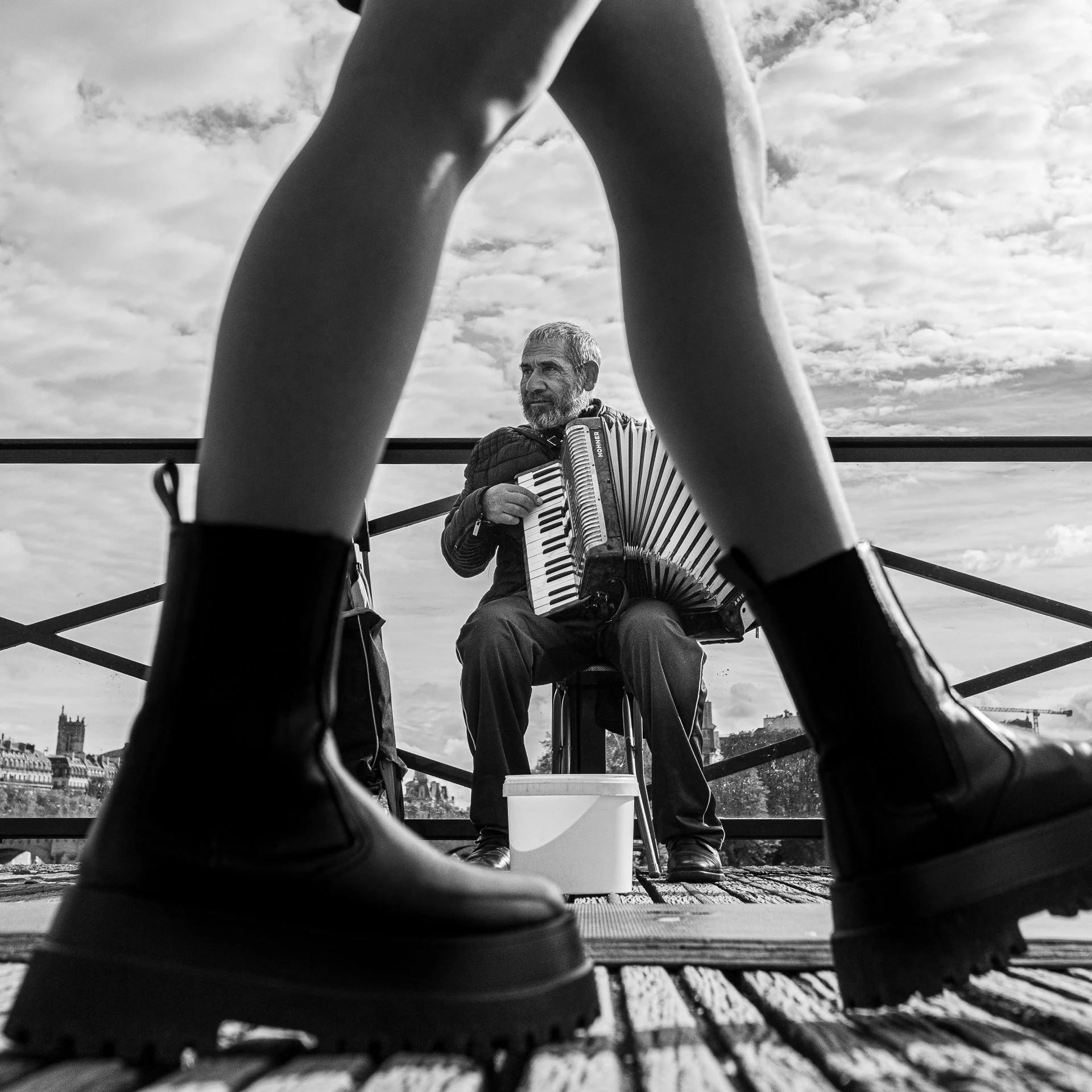
Music Between Footsteps - © 2026 Jean-François Cléroux | Paris, France
Pen and Paper Exercise
Before you read my critique and observations, I want you to spend a few quiet minutes with the photograph on your own terms. This series is built on the belief that looking is a form of practice — a slow, attentive act that deepens your ability to read the world. When you pause long enough to articulate what you see, you begin to uncover the patterns, preferences, and sensitivities that shape your way of seeing.
This exercise is not about getting it “right.” It’s about noticing what draws you in, what unsettles you, what feels intentional, and what lingers after you look away. Over time, these small acts of attention become a kind of visual literacy — a language you learn by using it.
Take out a pen and paper. Sit with the image. Let your eye wander without rushing to conclusions.
What to Do
Move through these steps slowly, in your own words:
Describe what you notice first The element that catches your attention often reveals the photograph’s centre of gravity for you.
Trace how your eye moves through the frame Follow the path your gaze takes. Where does it land? Where does it return? What pulls it forward or slows it down?
Observe the relationships between elements Look at how shapes, lines, tones, or subjects interact. Notice any patterns, contrasts, or echoes.
Attend to gesture and mood What does the posture, movement, or stillness of the scene suggest? What emotional tone emerges?
Consider the structure of the image Without naming specific techniques, simply note how the frame holds together — its balance, its density or spaciousness, its sense of order or tension.
Notice what remains unclear Ambiguity is part of the language of photography. What questions does the image raise for you?
Write down what lingers After looking away, what detail stays with you? That lingering point often reveals the photograph’s emotional or narrative anchor.
Why This Step Matters
This step matters because writing first helps you discover your own visual instincts before you encounter mine. It turns looking into a conversation between you and the image — one shaped by your curiosity, your language, and your way of paying attention. When you’re ready, compare your notes with the critique below.
Once you’ve completed your written observations, continue through the rest of the post — the critique, the background, and finally the afterthoughts. When you reach the end, you’ll be invited to return to your notes and reflect on how your first impressions align with, differ from, or deepen in light of what you’ve read. That return is an essential part of the practice.
The Critique
What arrests me first is the vantage point — a low, ground‑level perspective that turns an ordinary moment into a small theatre of contrasts. The frame is built around a single, deliberate choice: the street musician seated on a stool, playing his accordion, is seen entirely through the negative space created by a passerby’s stride. That decision — to let one figure become the aperture through which we witness another — gives the photograph its tension, its humour, and its quiet sense of choreography.
The passerby’s boots dominate the foreground: heavy, assertive, mid‑stride. Their presence is both literal and symbolic — a reminder of the city’s constant motion. The legs and boots together form a single architectural unit, slicing the frame into two dark pillars that anchor the composition. Yet they are not merely structural. Those boots are not neutral. They’re stylish, deliberate, expressive. They hint at the identity of the passerby — someone with a sense of fashion, someone moving with purpose, someone whose presence adds a layer of contemporary urban character to the scene.
This secondary story enriches the photograph without distracting from the primary subject. It’s a quiet subplot: the musician’s stillness framed by the stride of someone who belongs to a different rhythm of the city. Between these pillars, the musician appears almost suspended — a still point in the city’s restless rhythm. This is where the photograph finds its balance: the dynamic weight of the stride against the anchored calm of the performer.
The layering is elegant. Foreground: the boots, blurred just enough to suggest movement. Midground: the musician, sharply rendered, his posture relaxed yet focused. Background: the bridge’s wooden planks, the railings, the soft architecture of the city beyond. Each layer contributes to a sense of depth without clutter. The frame breathes.
Perspective does much of the emotional work. Shooting from below eye level elevates the musician — not in a heroic sense, but in a way that honours his presence. He becomes the gravitational centre of the image, even though he occupies the smallest physical space. The passerby, though larger and closer, becomes a framing device rather than the subject. This inversion is subtle but powerful: the city’s noise becomes the border; the quiet becomes the core.
There is a triangle implied here — the two boots forming the base, the musician rising as the apex. It’s not a geometric trick but a compositional intuition: the eye moves upward through the stride toward the musician’s face and instrument. That triangular pull stabilises the frame and gives it a sense of inevitability, as though the moment could not have been composed any other way.
Natural framing is the photograph’s most striking device. The legs create a proscenium arch, turning the musician into a performer on a stage within a stage. Yet the mood is not theatrical. It’s tender, observational, almost amused by the city’s ability to compose itself when we’re paying attention.
The overall balance is quietly assured. The dark boots anchor the bottom of the frame; the musician’s lighter tones draw the eye upward; the sky and architecture soften the top edge. Nothing feels accidental, even though the moment itself was surely fleeting.
What lingers is the contrast between motion and stillness — the city passing by, indifferent and hurried, while the musician remains rooted in his craft. It’s a photograph about coexistence: art and transit, solitude and crowd, the seen and the overlooked. And it’s a reminder that sometimes the most compelling stories unfold in the narrow spaces between other people’s steps.
Background: The Intersection
I first introduced this photograph in Working a Block: Repetition and Variation back on May 13th, 2026. That afternoon, as I approached the Pont des Arts, I heard the accordion before I saw the man playing it. The music didn’t push or demand attention; it drifted across the bridge in a simple classical line, turning what could have been noise into something soft, calm, and unexpectedly tender. I let it settle over me.
When I stepped onto the bridge, I finally saw him: an elderly gentleman seated on a small stool, playing with a quiet steadiness that felt almost devotional. I had already walked close to seventeen kilometres by then, and fatigue had begun to gather in my legs, but the scene held me. I made several photographs — the musician alone, the passersby who paused, the children who shyly offered coins. Small gestures, each carrying its own gentle weight.
Eventually I crossed to the opposite side of the bridge and let my back rest against the new railing. From there, I simply listened. People streamed past, and as I watched their movement, I began to notice something: every so often, a stride would open just wide enough to reveal the musician perfectly framed between two legs. It was a fleeting alignment — here for a heartbeat, gone the next — but it felt promising.
So I stayed with it. For twenty minutes I watched the rhythm of footsteps, camera held to my eye, waiting for the right cadence, the right spacing, the right moment when the city would compose itself. Most attempts missed. A few came close. And then, finally, one stride opened, the shutter clicked, and I felt that unmistakable internal certainty — the quiet yes that arrives when a frame lands exactly where it needs to.
I knew I had it. And not just the moment — but the perfect pair of legs and those wonderfully stylish boots. Many passersby wore wider trousers that closed the gap and obscured the musician entirely. These boots, with their clean lines and narrow silhouette, created the exact opening the photograph required. I couldn’t have asked for a better frame.
In the end, the photograph became a small intersection — not just of subjects, but of intention and chance. I had positioned myself for the moment I hoped might come, but it was the city that delivered the perfect stride, the perfect legs, the perfect pair of boots to complete the frame.
“Luck is what happens when preparation meets opportunity.” — Seneca
Afterthoughts: Reflection, Chance & Serendipity
This photograph is a reminder of how often street photography lives at the intersection of intention and chance. I positioned myself for the moment I hoped might come, but it was the city that delivered the perfect stride — the narrow opening, the clean silhouette, the stylish boots. It was a small act of serendipity, the kind that arrives only when attention and readiness meet in the narrowest of openings.
People often call moments like this “lucky,” but I’ve never believed that luck appears out of nowhere. The Stoic philosopher Seneca said it plainly: “Luck is what happens when preparation meets opportunity.” And in street photography, preparation is everything. It’s knowing your camera so well that settings become instinct. It’s understanding aperture, shutter speed, and exposure deeply enough that you can work without hesitation. It’s carrying the film, the spare batteries, the memory cards. It’s recognising how point of view shapes meaning. It’s being willing to take chances, to experiment, to fail repeatedly without losing patience.
All of that was present on the Pont des Arts that afternoon. The long walk, the fatigue, the music, the decision to sit, the noticing, the waiting, the twenty minutes of missed attempts — each one was a form of preparation. Without them, the moment would have passed unnoticed. The frame would never have opened. The boots would have been just boots, the stride just another stride, never to be witnessed.
Serendipity may have delivered the final piece, but everything leading up to it was earned. That is the quiet truth of street photography: the world offers its gifts freely, but only to those who are ready to receive them.
And this brings us to an important teaching moment — one that reaches beyond this single image. A photograph can hold more than one story, and the secondary story often amplifies the primary one. The boots in this frame are not neutral. They’re stylish, deliberate, expressive. They hint at the identity of the passerby — someone with a sense of fashion, someone moving with purpose, someone whose presence adds a layer of contemporary urban character to the scene. This secondary story enriches the photograph without distracting from the main subject. It’s a quiet subplot: the musician’s stillness framed by the stride of someone who belongs to a different rhythm of the city.
And the contrast between these two stories strengthens the image. The musician is timeless, almost archetypal. The boots are modern, specific, embodied. That tension — between the universal and the particular — gives the photograph depth and emotional resonance.
You might be wondering whether noticing these secondary stories actually makes the photograph better. In my experience, it does. When a viewer recognises not just the primary subject but the quiet subplot unfolding around it, the image becomes richer, more dimensional. The musician alone is timeless; the boots are contemporary and embodied. Together, they create a tension that rewards slow attention. This is why layered seeing matters. It helps you understand not only what the photograph shows, but how it works, and why it lingers.
It teaches the viewer that photographs are not flat. They are layered, relational, and alive with subplots.
This is the heart of the teaching moment. When you begin to notice:
the universal vs. the particular
the timeless vs. the contemporary
the stillness vs. the motion
the subject vs. the frame that holds it
… you begin to understand that photographs are not just taken — they are read. And when you learn to read these layers, you begin to make better photographs yourself.
Before you leave this post, return to the notes you made at the beginning. Lay them beside what you’ve read here. Notice where your instincts aligned with mine, and where they diverged. Notice what you saw immediately, and what revealed itself only after reading the critique and the background.
If you missed something important, that’s not a failure — it’s a signpost. And if you noticed something I didn’t name, trust that. It means your way of seeing is beginning to take shape: personal, distinct, and quietly your own.
This is how visual literacy grows. Not through correctness, but through reflection.
Flâneurs’ Lexicon — Proscenium Arch
A proscenium arch is the architectural frame that separates the stage from the auditorium in a traditional theater. Acting as a giant picture frame, it establishes the "fourth wall," allowing the audience to view the performance as if looking through an invisible window into another world.
Key Characteristics & Functions
Visual Framing: It directs the audience's focus onto the stage and hides the backstage, wings, and lighting equipment from view.
The "Fourth Wall": It serves as an invisible barrier between the performers and the audience. When an actor steps in front of the arch (onto the apron or forestage), they are metaphorically stepping out of the play to address the audience directly.
Curtain Placement: The main stage curtain is typically hung directly behind the arch, which hides the stage changes from the audience when lowered.
Design: It can range from a simple rectangular border to highly ornate, gilded plasterwork in classic opera houses and historic venues.
In Street Photography
A proscenium arch refers to a compositional technique where a photographer uses urban architecture to create a "frame within a frame," treating the public street exactly like a theatre stage. Instead of looking at a sprawling city scene, the viewer watches human interactions play out inside a strictly defined, head-on visual "window".
This concept bridges the gap between candid real life and theatrical performance, turning everyday pedestrians into unwitting actors stepping onto a stage.
Coming Up in The Flâneur’s Journal
Next week, we’ll continue the Creative Growth and the Art of Seeing series with Part V — Refining Your Visual Voice, exploring how the editing process reveals your themes, patterns, and direction as a street photographer.
Move at the pace the street allows. Notice what changes, notice what stays, and let your vision deepen in the slow, generous rhythm of everyday life.