Refining Your Visual Voice
The Evolving Photographer - Part V on Creative Growth and the Art of Seeing
In Part IV, we turned our attention inward and spent time recognising the quiet architecture beneath our photographs — the patterns that repeat, the instincts that guide us, and the visual habits that quietly shape our emerging voice. By looking closely at our own images, we began to see the traces of our sensibility with greater clarity, and perhaps even noticed how certain choices have been present all along, waiting to be named.
Now, in Part V, we step into the next stage of that evolution. This chapter invites you to move from recognition to refinement — to understand not only what your images reveal, but how the editing process can help you shape those revelations into a clearer, more intentional voice. Editing becomes the place where instinct meets understanding, where your photographs begin to speak back to you, and where the deeper threads of your seeing start to gather into something coherent and distinctly your own.
Before your voice can grow, it must be heard. And editing is where your listening grows more precise, more patient, more your own.
Now the work turns toward refinement
There comes a moment in a photographer’s evolution when instinct alone is no longer enough. You’ve spent time tracing your influences, studying the work that shaped you, and recognising the quiet patterns that run through your own images. You’ve begun to see the architecture beneath your seeing — the tendencies, the rhythms, the unconscious rules that guide your decisions on the street.
Refining your visual voice is not about polishing or perfecting. It is about learning to recognise the deeper threads running through your work and choosing, with intention, which ones to strengthen. It is about understanding what your images are already trying to say — and helping them say it more clearly.
And the place where this understanding emerges most vividly is not in the act of photographing, but in the act of editing. Editing is where your voice becomes clear.
The Quiet Mirror of Editing
When you photograph, you move through the world with instinct, curiosity, and a kind of embodied attention. But when you edit, you step back from the flow of experience and look at what remains. Editing is the moment when your images speak back to you, when the noise of the street falls away and only the essential gestures remain.
Give yourself a deliberate gap between shooting and your first edit — hours, days, or even a week. That distance lets the immediacy of instinct settle and invites a quieter, more considered response; it is a small discipline that prevents reactive curation and allows hindsight to inform selection.
It is here — in the quiet of choosing — that your voice begins to show its shape. You start to notice the kinds of moments you return to, the light that feels like home, the distances that feel honest, the emotional temperature that feels true. You begin to see the threads that tie your images together, even when you didn’t realise you were weaving them.
Remember that curation is an ethical act: the images you keep and the ones you release shape how people are seen. They also shape how people come to understand you — your values, your boundaries, your way of paying attention.
Editing is not simply the act of selecting photographs. It is the act of recognising yourself.
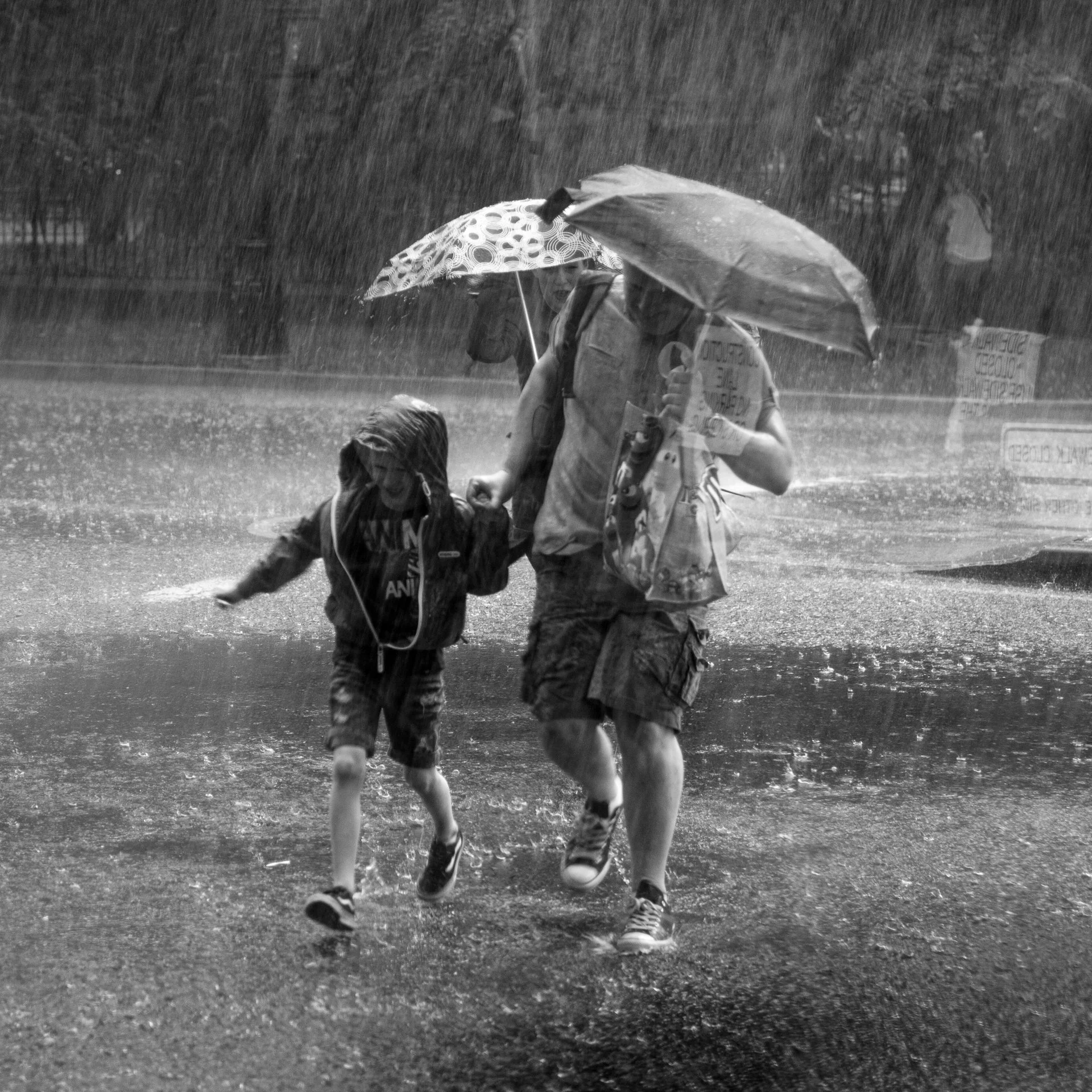
The Dash for Cover
© 2015 Jean-François Cléroux | Paris, France
A strong, kinetic street photograph that captures the urgency of weather and the intimacy of two figures moving through it. The diagonal sweep of the rain adds energy, while the umbrella’s patterned surface becomes an anchor point in the frame. The contrast between the adult’s steady stride and the child’s hurried posture gives the image its emotional centre. The wet pavement reflecting light adds texture and depth, grounding the scene in a specific moment of shared motion and shared shelter.
What Your Selections Reveal
When you lay your images out — whether on a screen or in prints scattered across a table — patterns begin to surface. You notice that you linger in certain kinds of light, or that you move toward particular gestures, or that you stand closer than you thought. You notice the moods that recur, the atmospheres you trust, the kinds of tension that draw you in.
These are not accidents. They are the early signs of a voice.
A practical habit helps this work: make contact sheets or printed grids so you can see sequences and repetitions at a glance. Export thumbnails from your editing software, arrange them on a single page, or use a simple contact‑sheet generator; Lightroom’s print module is a straightforward way to produce a grid, and there are free tools that do the same if you prefer a quick digital layout. Seeing many frames together — not one at a time — reveals rhythms and echoes that single images hide.
Editing reveals your sensibility in a way shooting never can. Shooting is possibility; editing is clarity. Shooting is instinct; editing is understanding. Shooting is the world as it unfolds; editing is the world as you interpret it.
And interpretation is where authorship begins.
The Slow Work of Shaping Your Voice
Refining your visual voice is not a single decision. It is a slow accumulation of small recognitions. You begin to see which images feel alive and which feel merely competent. You begin to understand why certain frames stay with you while others fall away. You begin to sense the emotional register that feels most like your own.
Part of this practice is keeping versions. Hold multiple edits and experiment with sequencing; sometimes your voice is revealed not by a single picture but by the way images sit next to one another. Try different orders, let sequences breathe, and allow a sequence to suggest a theme you hadn’t named. These experiments are not wasted work — they are the laboratory where coherence is discovered.
Gradually, you start to choose with more intention. You lean toward the qualities that feel true. You let go of the ones that feel borrowed or forced. You allow your instincts to deepen rather than scatter. This is not about narrowing your possibilities; it is about clarifying your direction.
A voice is not something you invent. It is something you uncover — and then refine.
Editing as a Conversation With Yourself
When you edit, you are not simply evaluating images. You are listening. You are listening to what your work is trying to tell you, to the themes that keep resurfacing, to the emotional tone that feels most honest, to the photographer you are becoming.
Sometimes the images you choose surprise you. Sometimes they confirm what you already sensed. Sometimes they reveal a direction you didn’t know you were moving toward. Editing becomes a form of self‑discovery — a way of understanding your own sensibility with more clarity and compassion.
It is not a test. It is a conversation.
Letting Go as a Form of Refinement
One of the most difficult parts of refining your voice is learning to let go — not out of judgement, but out of recognition. You begin to see which images belong to you and which belong to your influences. You begin to see which images carry your sensibility and which carry someone else’s. You begin to see which images are honest and which are clever but empty.
Remember that curation is an ethical act: the images you keep and the ones you release shape how people are seen. Editing can protect dignity or expose vulnerability; the choices you make in cropping, sequencing, and captioning have consequences beyond the frame.
Letting go is not a loss. It is a refinement. Every image you release sharpens the ones you keep. Every decision you make clarifies the next. Every choice becomes a small act of authorship.
This is how a voice becomes coherent — not through perfection, but through intention.
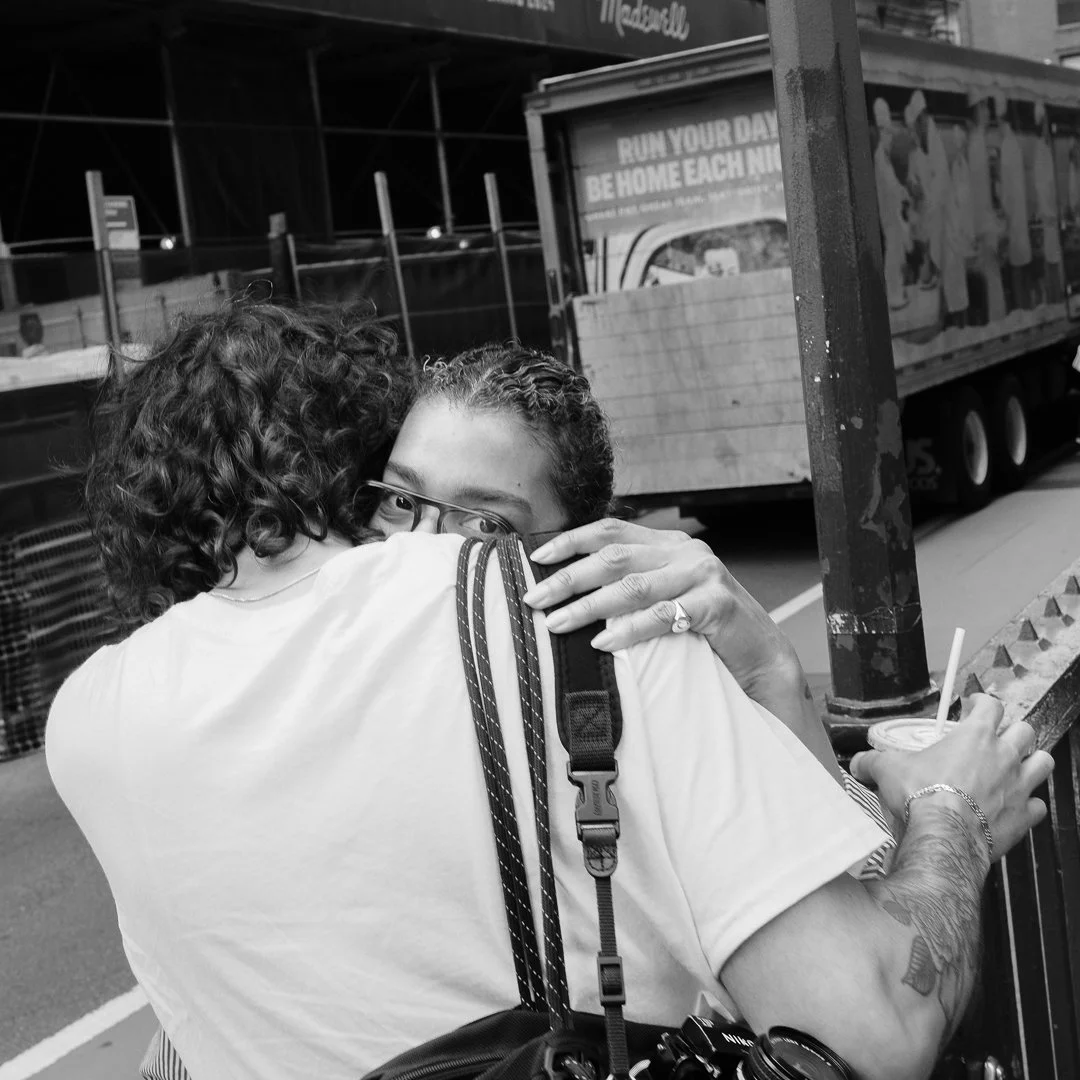
The Moment of Return
© 2026 Jean-François Cléroux | New York, NY, USA
A tender, unguarded moment held in the middle of a busy street. The embrace becomes the visual anchor, drawing the eye to the quiet intensity of connection while the city continues its indifferent motion around them. The direct glance toward the camera adds a subtle tension — a brief acknowledgment of being seen — without breaking the authenticity of the gesture. The background signage and scaffolding provide a textured urban frame, but it’s the contrast between public space and private emotion that gives the photograph its weight. A strong example of how intimacy can surface unexpectedly in the flow of the everyday.
Refinement Through Constraint
As your voice becomes clearer, you may find yourself working with more restraint. Not less curiosity, but more focus. Not fewer possibilities, but a deeper sense of which possibilities matter. You begin to recognise the difference between what is interesting and what is meaningful. You begin to trust the images that feel quiet but true. You begin to understand that refinement is not about doing more — it is about doing less with greater clarity.
Constraint becomes a form of freedom. It allows your voice to deepen rather than disperse. It allows your work to gather coherence. It allows your seeing to become more intentional without becoming rigid.
The Ongoing Nature of Refinement
Refining your visual voice is not a stage you complete. It is a practice — one that continues as long as you continue to photograph. Your voice will shift as your life shifts. Your sensibility will deepen as your attention deepens. Your themes will evolve as your questions evolve.
Editing becomes the place where you return to understand these changes — a quiet room where your images gather and speak, where your instincts become visible, where your voice becomes clearer with each passing year.
There is also a practical distinction to keep in mind: editing for a book or an exhibition asks different choices than editing for a feed or a portfolio. The constraints of format, sequence, and audience will test your voice in different ways; learning to adapt without losing your centre is part of the work of growth. Consider each platform as a different conversation with your audience, and let those conversations refine how you present your work.
Refinement is not about arriving. It is about aligning — aligning your choices with your values, your instincts with your intentions, your seeing with your becoming.
Your visual voice is already there. Editing helps you hear it more clearly — and helps others hear it too.
Coming Up in The Flâneur’s Journal
As we close this chapter of Creative Growth and the Art of Seeing — Part V, I hope this exploration of editing has given you a clearer sense of how your visual voice begins to take shape — not in the rush of the street, but in the stillness that follows. This is where instinct becomes intention, where patterns reveal themselves, and where your work starts to speak in a language that feels unmistakably your own.
Next week, we’ll look at Three Books That Changed How I See: Essential Reading for the Evolving Photographer.
And two weeks from now, we’ll continue with the last installment of Creative Growth and the Art of Seeing series with Part VI, where we explore how challenging your visual logic — through friction, constraint, and deliberate discomfort — can open new pathways in your practice.
Your growth as a photographer doesn’t happen all at once; it gathers slowly, in layers, each insight deepening the next. Let this chapter settle. Let your images sit with you. And when you return to the street, carry with you the quiet confidence that your voice is already forming — steady, patient, and entirely your own.