Recognising Your Own Tendencies
The Evolving Photographer - Part IV of Creative Growth and the Art of Seeing
In Part III, we spent time studying the photographers who shape us — not to imitate their work, but to understand the choices, rhythms, and sensibilities that resonate with our own. By looking closely at their images, you began to see your influences with greater clarity, and perhaps even noticed how certain ideas have already woven themselves into your way of seeing. Now, in Part IV, we turn that same depth of attention inward. This chapter invites you to examine your own photographs with honesty and curiosity, to recognise the patterns that repeat, the instincts that guide you, and the visual habits that quietly define your emerging voice. Before you can refine your style, you must first understand the one you’re already creating — frame by frame, choice by choice, often without even realising it.
Understanding the quiet architecture of your seeing
Every photographer carries within them a set of rules, some invisible, some unconscious — a quiet architecture of preferences, instincts, and habits that shape how they move through the world with a camera. These rules are rarely conscious. You don’t decide to favour diagonals, or to linger in soft light, or to frame the world through layers. You simply do it. It feels natural. It feels like you.
This is your visual logic — the internal grammar of your seeing.
In the earlier parts of this series, you traced your influences, explored the landscape of street‑photography styles, and learned how to study the work of others with intention. Now the gaze turns inward. This chapter is about recognising the patterns already alive in your work — the choices you make without thinking, the rhythms you return to, the instincts that quietly define your voice.
Understanding these tendencies is not about narrowing your identity. It is about seeing yourself clearly enough to grow with intention.
Understanding the Components of Visual Logic
Visual logic is the quiet architecture beneath your photographs — the subtle framework of decisions you make instinctively, often without noticing. It’s the way your body leans into a scene, the way your eye settles on certain forms, the way your attention drifts toward one kind of moment and away from another. These choices accumulate, frame after frame, until they form a kind of internal grammar: a way of speaking the world in images, essentially the quiet mechanics that shape your way of seeing.
It is not something you invent; it is something that reveals itself over time. With every photograph you are unconsciously refining this grammar — shaping a language of light, distance, rhythm, and attention that is uniquely your own. When you begin to recognise these underlying mechanics, you start to understand not only how you see, but who you are when you’re behind the camera.
1. How you compose
Part of this grammar lives in how you compose. Composition is not simply the arrangement of elements within a frame; it is the way you make sense of the world’s shifting geometry. Some photographers carve the scene into clean, deliberate shapes, seeking order in the midst of movement. Others let the frame breathe with looseness and flow, allowing the world to spill in at the edges. You might find yourself drawn to diagonals, to centred subjects, or to the quiet tension of an off‑balance frame. Whatever your instinct, it reveals how you understand space — not as an abstract concept, but as a lived, felt environment you navigate with your whole body as much as with your eye.
2. How you use light
Light plays its own role in this logic. Without thinking, you may gravitate toward soft, atmospheric light, or toward the sharp drama of contrast. You might find yourself chasing backlight, or slipping into the shadows where forms dissolve into suggestion. Your relationship with light is often the first clue to your emotional sensibility — whether you seek clarity, mystery, warmth, or tension.
But sometimes the light you work with is simply the light you have. If you’re a lunchtime photographer, for example, your images may be shaped by the hard, overhead sun not because you’re drawn to it, but because that is when your life allows you to walk with a camera. In these cases the light is a circumstance, not a preference — a reflection of your schedule rather than your sensibility.
This distinction matters. The conditions you work in do not always reveal your deeper instincts. They reveal your availability, your routines, your access to the street. Your visual logic lives beneath those constraints — in the way you respond to the light you’re given, not in the light itself.
Some photographers choose the golden hour; others learn to find poetry in the unflattering noon sun. Both paths are honest. Both can lead to a coherent, intentional body of work. What matters is not the time of day, but the way you navigate it — the decisions you make within the light you have, the sensibility you bring to whatever the world offers you. And as you refine this relationship, remember that your choices around light are not only aesthetic but ethical — how you use light can either honour or expose the people you photograph.
3. How close you stand
Distance is another part of the story. How close you stand shapes the emotional temperature of your images. Some photographers move in close enough to feel breath; others prefer the quiet observation of a few steps back. Your preferred distance is not just a technical choice — it’s a declaration of how you relate to the world.
When we talk about distance in street photography, we’re not talking about the mathematics of field of view. You can stand close with a wide‑angle lens or far with a telephoto and produce nearly identical framing. Compression aside, the geometry may match — but the experience of making the photograph never does. Distance, in this sense, is not measured in metres. It is measured in temperament.
Standing close is a behavioural choice. Even if the final frame resembles one made from afar, the act of being physically present inside the moment reveals something about your sensibility — your comfort with proximity, your willingness to be seen, your desire to feel the moment from within. It is an embodied decision, a quiet declaration of presence. It also shapes how much the subject feels your presence — a subtle but essential part of ethical street practice.
Standing farther back carries its own meaning. When you step away and work from a distance, you’re choosing observation over participation, detachment over immersion, a more reflective posture rather than an engaged one. You are watching rather than joining, interpreting rather than inhabiting. This is not better or worse — simply a different way of being in the world.
In this way the lens becomes a proxy for your comfort zone. A wide lens used up close requires a certain boldness; a longer lens from afar allows you to remain invisible, to observe without disturbing. Even when the resulting image is similar, the logic behind it — the instinct that led you there — is entirely different.
And the emotional temperature shifts accordingly. A close‑range frame carries immediacy, tension, intimacy. A distant frame carries quietness, contemplation, emotional space. The composition may echo itself, but the psychology never does.
A simple way to say it: Distance is not about how far you are from your subject. It’s about how close you are willing to be to the moment. That is what your visual logic reveals.
Why Recognising Your Visual Logic Matters
Recognising your visual logic is one of the quiet turning points in a photographer’s evolution. It’s the moment when your work stops feeling accidental and begins to feel intentional — when you start to understand not only what you do, but why you do it. Instead of moving through the world on instinct alone, you begin to see the deeper patterns shaping your decisions, the sensibilities that guide your attention, and the subtle preferences that have been present in your work all along.
When you understand your visual logic, you gain something essential:
Clarity — you begin to recognise the recurring moods, structures, and gestures that define your voice. Patterns that once felt mysterious become legible; the threads that tie your images together become visible.
Direction — with clarity comes the ability to choose. You can refine what serves you, challenge what limits you, and intentionally stretch toward the photographer you want to become.
Confidence — when you understand the roots of your instincts, you stop second‑guessing them. You trust your way of seeing because you finally understand its logic.
Freedom — and once you know your rules, you can break them with purpose. Not out of confusion, but out of curiosity. You can experiment without losing yourself, because you know where you’re starting from.
Recognising your visual logic doesn’t confine you. It gives you a foundation — a place to stand as you evolve. Visual logic is the quiet beginning of creative authorship: the point where your work becomes not just something you make, but something you understand.
How to Discover Your Visual Logic
This exercise works best with printed images. I print mine on cheap 5″×7″ paper. Print 20–30 images from your last five or six outings so you can place, sort, and ponder the subtle details. When you sort, don’t group by subject matter; sort by composition, light, distance, tropes, and viewpoint. You are looking for patterns. These printed images will also help with other exercises, with project development, and with curating for display in galleries or books.
Begin with your own images. Not your hand‑picked favourites. Not your portfolio. Your last 100–200 photographs — the unfiltered truth.
Patterns reveal themselves in the work you didn’t curate. Move through those frames slowly and ask yourself, gently and without judgement:
Do I tend to shoot wide or tight, and what does that say about how I inhabit space?
Do I favour symmetry or asymmetry, and how does that reflect my sense of balance?
Do I shoot into the light or with it, or with the light raking across the face of my subject, and what kind of atmosphere am I drawn to?
Do I wait for gestures or for stillness, and what kind of moment feels complete to me?
Do I prefer complexity or simplicity, and where does my eye find rest?
Do I gravitate toward colour or tone, and what emotional palette feels like home?
Do I respond more to people, to spaces, or to atmosphere — and why?
Do I move quickly, trusting instinct, or do I linger, letting the moment unfold?
Do I use foreground elements deliberately to build depth, or do they appear incidentally?
Do I engage with subjects, or do I remain anonymous and observational — and what does that choice say about my stance on the street?
These questions are not a checklist to pass or fail. They are invitations to recognise the quieter habits that shape your work: compositional habits, social posture, and the ways you build or resist depth and intimacy. And as you reflect, remember that editing is also part of your visual logic — the images you keep and the ones you quietly set aside reveal just as much about your instincts as the images you make.
There are other relevant questions you can add as you go — about motion, aspect ratio, editing habits, repetition, and how practical constraints shape your images. If you find this helpful, I’ll expand these prompts into a full worksheet: a compact tool you can use in your own practice and one I’ll bring to workshops. It will gather the full set of reflective questions and turn them into simple exercises for noticing, testing, and evolving your visual logic.
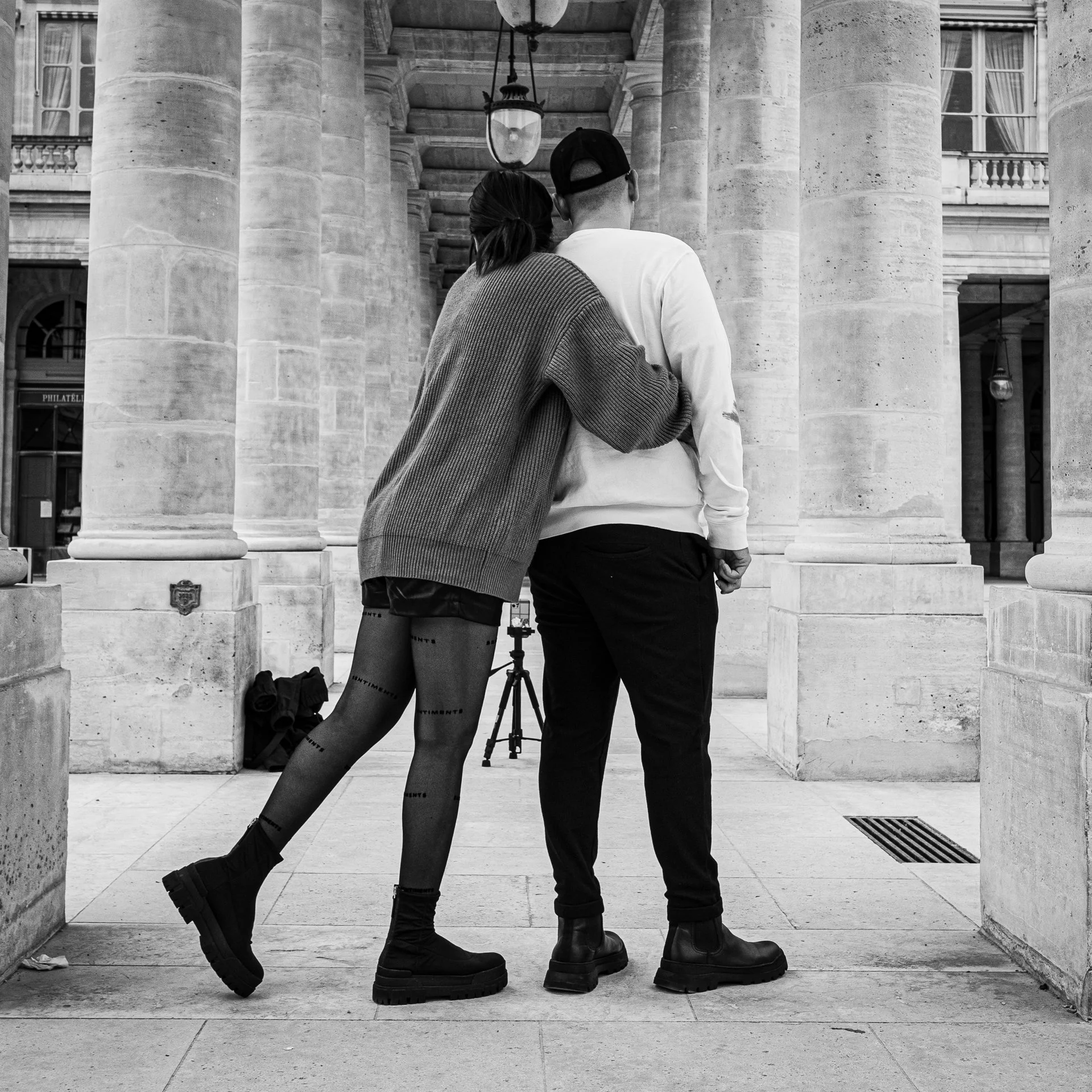
Did I Just Photobomb Them?
© Jean-Francois Cleroux | Paris, France
The couple is absorbed in their own moment — leaning in, creating their selfie, wrapped in the intimacy of the gesture — and I’m standing just outside that bubble, watching the scene unfold. The presence of the small tripod on the ground hints that they’re already thinking about framing, angles, and capturing themselves. So the idea that I might appear in their final shot adds a playful layer: the photographer becoming the accidental subject, the observer slipping into the story.
It’s a classic street‑photography dynamic — the world photographing itself while you photograph the world.
Compare Your Logic to Your Influences
Return to the photographers in your Living Library and to the styles you identified earlier in this series. This is where your influences and your instincts begin to speak to one another — where you can see, with clarity, how the work that shaped you is quietly alive in your own decisions, and where your voice has begun to diverge into something distinctly your own.
Ask yourself:
Which parts of my visual logic echo theirs?
Which parts diverge?
What do I admire in their work that I don’t yet do?
What do I do naturally that they don’t?
This is not imitation. It is lineage — and individuality. You are learning to recognise the threads you’ve inherited and the threads you’ve spun yourself, the ways your influences shaped your instincts and the ways you’ve quietly departed from them. This is how you begin to understand your place in the continuum of photographers: not as a copy of those you admire, but as the next voice in a long, evolving conversation.
Identify the Rules You Didn’t Know You Had
When we began, I referred to your own internal rules that every photographer carries — quiet, unspoken boundaries that shape how they work. Some are aesthetic. Some are practical. And some are ethical, guiding you long before you articulate them:
“I never shoot in harsh light.” “I avoid clutter.” “I only shoot when something ‘interesting’ happens.” “I don’t photograph people directly.” “I wait for someone to enter the frame.” “I don’t make photographs of people in vulnerable situations unless I can honour them.” “I lower the camera when the moment feels private.”
These rules shape your work more than your camera settings ever will. They reveal not only how you see, but what you value — what you’re willing to approach, what you refuse to exploit, and where your sense of responsibility begins.
Once you identify these rules, you can decide:
Which rules serve you
Which rules limit you
Which rules you want to break
Which rules you want to strengthen
Which ethical boundaries you want to clarify or reaffirm
This is where growth becomes intentional — where your craft and your conscience begin to align with the photographer you are becoming. It’s the point at which your choices stop being accidental and start becoming anchored in awareness: the way you use light, the way you approach people, the boundaries you honour, the moments you choose to enter or step away from. When you can see the rules beneath your decisions, you’re no longer just reacting to the world — you’re shaping your practice with clarity, integrity, and purpose.
Use Your Fourth Style to Expand Your Logic
In PART II of the Creative Growth and the Art of Seeing series, you identified your three styles and selected a fourth style — the one that stretches you — which is your expansion point. It’s the place where your familiar instincts meet something just beyond your reach, where your habits loosen and your seeing begins to widen. This style isn’t meant to replace your voice; it’s meant to reveal the parts of it that haven’t yet been exercised.
If your visual logic is built on restraint, your fourth style might invite complexity. If your logic is built on clarity, it might introduce ambiguity. If your logic is built on quiet moments, it might challenge you to embrace chaos.
And there is another layer here: your fourth style is also the safest, most intentional way to borrow from another photographer. By studying a style that differs from your own, you can experiment with adding similar elements — a kind of deliberate mimicry — without losing your centre. You’re not copying their voice; you’re testing what happens when you let their way of seeing brush up against your own.
And just as with introducing the opposite of your natural tendencies, the key is to move slowly. Add one element at a time — a gesture, a type of light, a way of framing, a rhythm of movement — and let it settle before adding another. Whether you’re stretching toward contrast or borrowing a stylistic echo, the process is the same: slow, deliberate, intentional. This is how you expand your logic without overwhelming it.
Studying photographers who embody this fourth style helps you:
see differently
think differently
move differently
compose differently
respond differently
And if your natural presence on the street is quiet or invisible, consider studying photographers who are comfortable being seen — their boldness can reveal new emotional and spatial possibilities in your own work.
This is how your visual logic grows — gently, deliberately, with curiosity. Not by abandoning who you are, but by widening the edges of your seeing, letting a new influence stretch your instincts just enough to reveal what else might be possible. It’s an expansion, not a departure — a way of becoming more fully yourself by briefly stepping into someone else’s way of looking, and returning with something new woven into your own voice.
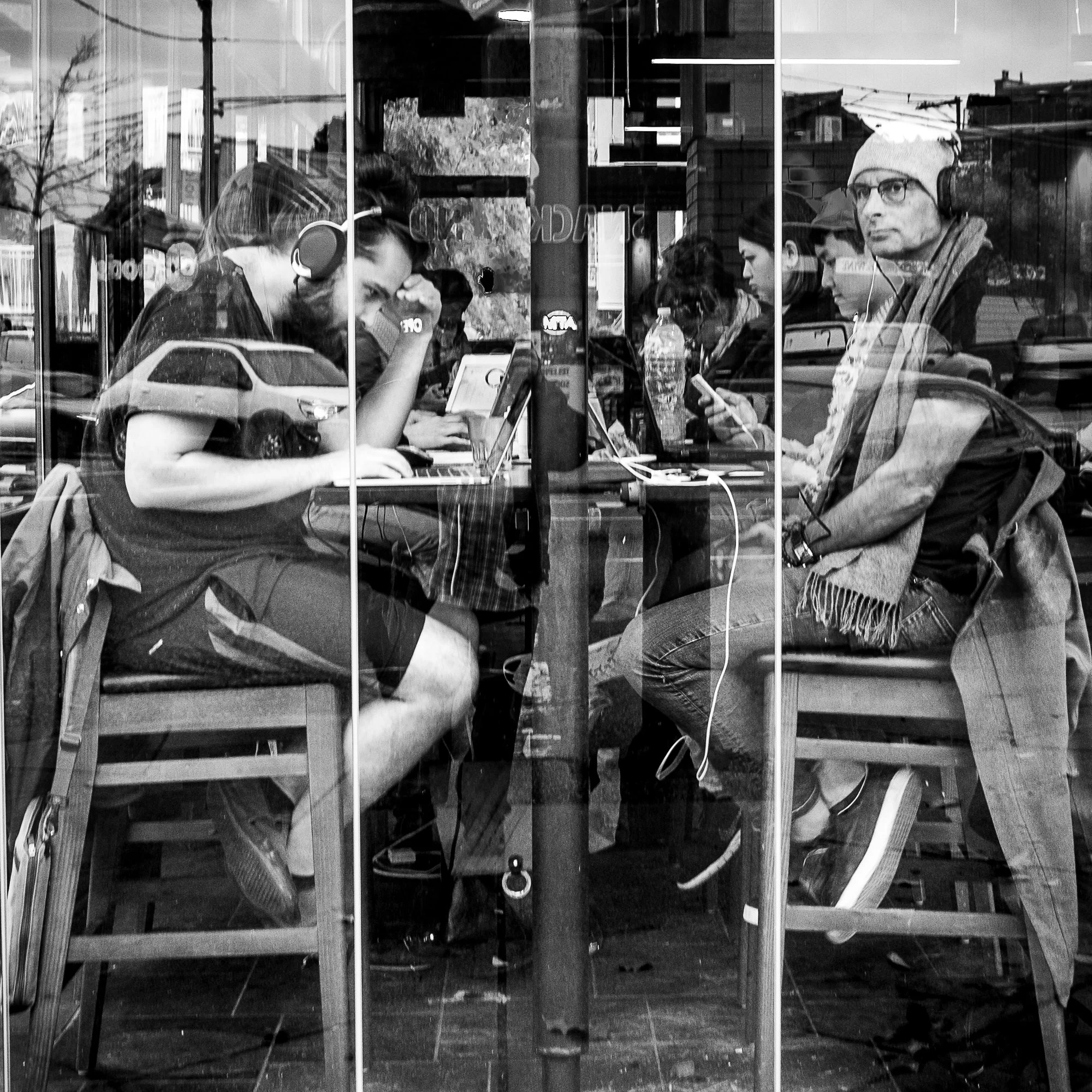
Reflections of Quiet Work
© Jean-Francois Cleroux | Vancouver, Canada
This image thrives on layers — literal and metaphorical. Shooting through glass gives you that beautiful blend of interior and exterior worlds: people absorbed in their screens inside, and the faint reflections of the street drifting across them. It creates a sense of modern urban life where boundaries blur — private focus inside a public space, the city folding over itself.
The people at the table are deeply immersed in their own digital worlds, which gives the photograph a quiet, almost meditative stillness. No one is performing. No one is aware of you. That unselfconsciousness is gold in street photography.
The reflections add narrative ambiguity: who belongs to which layer, what is inside, what is outside, what is real, what is reflected. It’s the kind of image that rewards a second look, then a third.
Practice Breaking Your Own Rules
There comes a moment in this work when understanding your visual logic is no longer enough. To grow, you have to stretch it — gently, deliberately, and with curiosity. One of the simplest ways to do this is to choose a single rule you’ve been following unconsciously and break it on purpose.
Choose one rule and break it for a week — or at least three or four outings.
If you always shoot wide, shoot tight.
If you avoid crowds, seek them out.
If you chase light, embrace shadow.
If you wait for gestures, photograph stillness.
The point is not to abandon your instincts or to become someone else. It’s to loosen the grip of your habits long enough to see what else might be possible. When you break a rule on purpose, you reveal the rule’s shape — its strengths, its limits, and the space just beyond it. You’re expanding the range of who you can be, one small, deliberate experiment at a time.
And as you experiment, remember that stylistic rules are the ones meant to be broken — not your ethical boundaries. Curiosity should never override dignity, and no exercise is worth compromising the humanity of the people you photograph. Growth should widen your seeing, not narrow your compassion.
Note also that learning these new stylistic elements can be set aside until such time you may need them to direct your voice in a future project. But there are other reasons to practise them as well — reasons that deepen your craft even if you never use these elements again.
Breaking your own rules teaches you things your comfort zone never will.
You build creative flexibility. Even if you return to your natural instincts, you now have more ways to respond when the street offers you something unexpected.
You strengthen your awareness. Stepping outside your habits makes you more conscious of the choices you normally make without thinking — and why you make them.
You learn the difference between preference and limitation. Some things you avoid because they don’t resonate with you. Others you avoid because you’ve never learned how to handle them. Breaking a rule reveals which is which.
You develop resilience in unfamiliar conditions. When the light is harsh, the space is crowded, or the moment is still, you won’t feel lost. You’ve practised navigating those situations on purpose.
You expand your emotional range. New stylistic elements often bring new emotional tones — tension, stillness, ambiguity, intimacy — that can enrich your work even if you use them sparingly.
You sharpen your sense of intention. Once you’ve tried the opposite, returning to your natural way of seeing feels more deliberate, more chosen, more grounded.
When you break a rule on purpose, you stretch the edges of your seeing. Even if you return to your old habits, you return changed — a little wider, a little freer, a little more awake to what else might be possible.
Return to Your Work With New Eyes
After experimenting, look again. Not with the eyes you had before, but with the ones shaped by what you’ve just tried — the ones that have been stretched, unsettled, or surprised. This is the moment when your work begins to reveal something new.
Ask:
What changed?
What surprised me?
What felt uncomfortable?
What felt exciting?
What new possibilities emerged?
These questions aren’t about judging the results. They’re about noticing the shifts — the subtle recalibrations in how you see, move, and respond. Even a small experiment can tilt your perspective, opening a door you didn’t know was there.
This is the moment when your visual logic begins to evolve — not in theory, but in practice. You’re seeing the world, and your own instincts, from a slightly different angle. And sometimes that slight angle is all it takes to reveal a new path forward.
The Living Architecture of Your Seeing
You’ve spent this chapter tracing the quiet structure beneath your work — the instincts you rely on, the influences you carry, the rules you didn’t know you had, and the styles that stretch you. You’ve looked at the photographers who shaped you, the patterns that guide your decisions, the boundaries you honour, and the habits that deserve to be questioned. You’ve stepped outside your comfort, broken a rule on purpose, and returned to your work with eyes that have been subtly, meaningfully altered.
This is the slow, deliberate work of understanding your visual logic — not as a fixed identity, but as a living architecture that shifts as you shift. When you can see the forces that shape your photographs, you can refine them, challenge them, expand them, or reinvent them. You can choose your influences with intention. You can stretch your instincts without losing your centre. You can move through the world with a clearer sense of what you’re drawn to — and why.
Your way of seeing will continue to evolve as you do. That is its strength. Your visual logic is alive. Let it keep growing.
Let your seeing evolve in its own rhythm, widening gently as the world leans closer and reveals itself to you.
Coming Up in The Flâneur’s Journal
As we close this chapter of Creative Growth and the Art of Seeing — Part IV, I hope this exploration offered a clearer sense of how your visual logic forms, shifts, and quietly guides your work. Each exercise in this series is meant to open a small door — not to overwhelm you, but to give you one more way of understanding how your seeing evolves over time.
Next week, we’ll look at another image in Within the Frame.
And two weeks from now, we’ll continue this Creative Growth and the Art of Seeing series with Part V — Refining Your Visual Voice, exploring how the editing process reveals your themes, patterns, and direction as a street photographer.
Your practice will keep unfolding in its own rhythm. Some insights arrive quickly; others take their time. Let the work meet you where you are. Keep walking, keep paying attention, and allow your way of seeing to deepen in the quiet, steady ways that only the street can teach.