Working a Block: Repetition and Variation
The quiet discipline of returning to the same block
A single city block is a living organism — restless, layered, and endlessly expressive. It shifts with the hour, the weather, the season, and the mood of the people passing through it. To return to the same block again and again is not an act of redundancy; it is an act of deepening. With each visit, you begin to understand its rhythms: when the light slices across a wall, when the street empties, when a gesture repeats itself like a refrain.
Working a block is a discipline of attention. It teaches you to stop chasing novelty and instead cultivate presence. Over time, the block becomes a collaborator — one that reveals more of itself the longer you stay in conversation with it. You start to anticipate the choreography of the everyday, and the street begins to recognize you in return.
This practice is not glamorous. It is slow, patient, and often uncertain. But repetition is how instinct is built, how intuition sharpens, and how the ordinary begins to reveal its quiet, luminous layers.
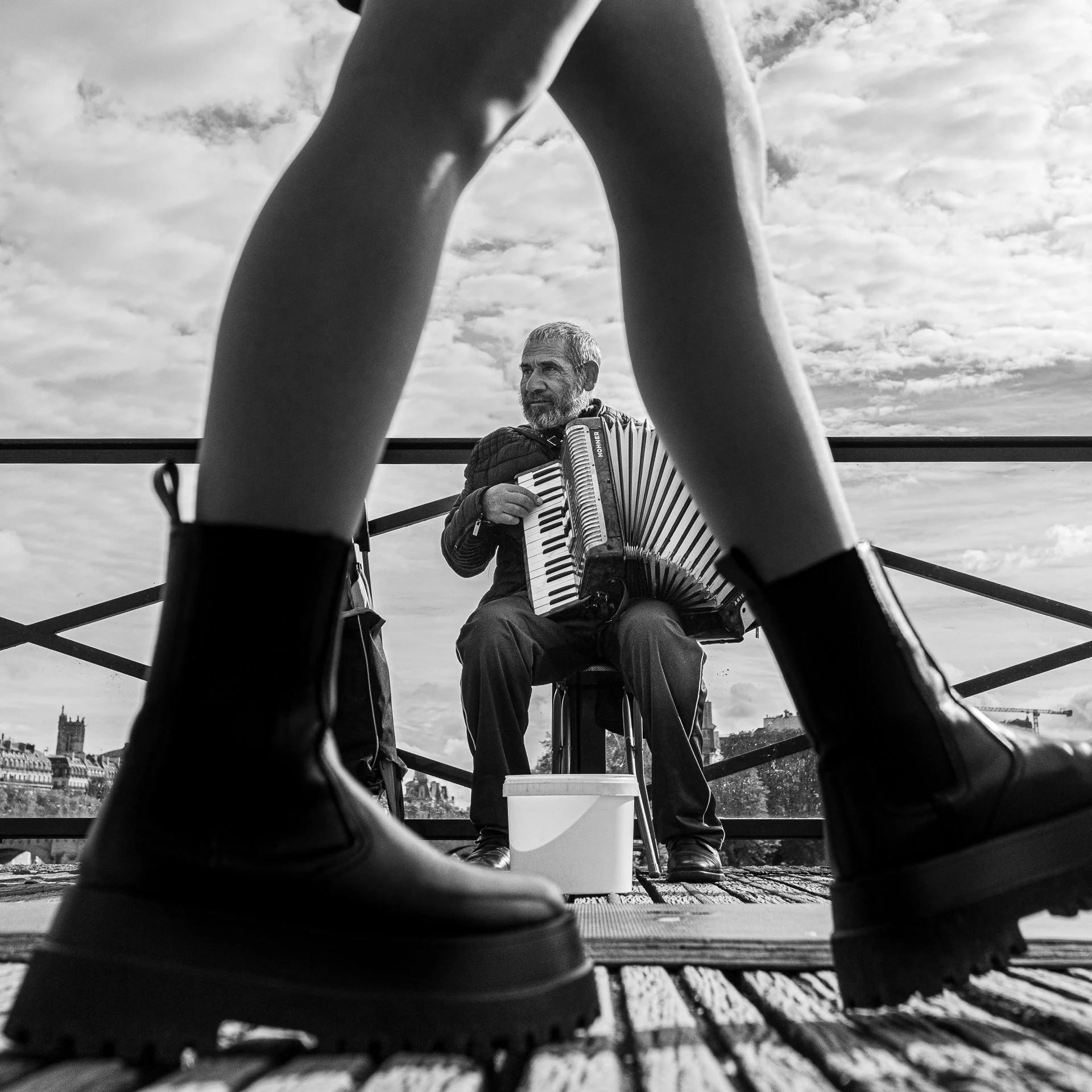
Music Between Footsteps
© Jean-Francois Cleroux | Paris, France
We’ll explore this image of the accordion player on the Pont des Arts in a full Within the Frame post soon, but it’s worth pausing here to acknowledge the setting itself.
The Pont des Arts is one of my favourite places to wander in Paris — a floating crossroads where characters, cultures, and stories gather in a steady, ever‑shifting stream. Buskers tune their instruments, lovers drift past in quiet conversation, locals cut purposeful lines through the crowd, tourists hover in wonder, and yes, the occasional pickpocket moves like a shadow at the edge of things.
Every hour brings a new constellation of people and energies. With the weather turning, the light shifting, and the river breathing beneath it, the bridge becomes a small universe of unfolding mini‑adventures.
I return to it often. Not because I expect something extraordinary, but because I trust that repetition reveals what hurried wandering cannot.
Why repetition matters
Repetition is not about photographing the same thing twice. It is about learning the block’s language.
When you return to the same stretch of pavement, you begin to notice:
patterns you missed the first time
how light behaves at different hours
how people move through space
which corners hum with energy and which ones hold silence
how weather transforms mood, colour, and gesture
Repetition builds intimacy. It sharpens your instincts. It teaches you to see beyond the obvious.
And perhaps most importantly, it normalizes uncertainty. Some days nothing happens. Some days everything happens at once. Both are part of the apprenticeship.
If you feel unsure, or if you worry that you’re “not finding anything,” you’re not doing it wrong — you’re doing it right. Repetition is the slow accumulation of understanding, not a hunt for constant success.
How variation keeps the block alive
Variation is the counterweight to repetition — the subtle shift in tone that keeps your conversation with the block alive. Repetition teaches you its language; variation reveals its inflections, its moods, its unexpected turns. Together they ensure that each return is not a rerun, but a renewed exchange. Here are the most powerful ways to let your approach evolve:
Time of day — Morning softness, midday contrast, late‑day glow, and night’s neon each create entirely different emotional architectures.
Weather — Rain transforms reflections; fog softens edges; snow simplifies; heat creates shimmer; wind animates the street.
Angle and height — Shoot low for drama, high for geometry, straight‑on for clarity, oblique for tension.
Distance — Step back for context, move in for intimacy.
Lens choice — Wide for immersion, telephoto for compression and abstraction.
Subject focus — One day follow gestures; another day follow shadows; another day follow colour, texture, or signage.
Movement vs. stillness — Capture the rush of the street one session, and the quiet corners the next.
Light quality — Hard light for silhouettes and contrast; soft light for mood and subtlety.
Intentional constraints — Give yourself a rule: only vertical frames, only reflections, only hands, only corners, only one colour. Constraints sharpen attention.
Variation ensures that the block never becomes predictable. It keeps your curiosity alive.
A twelve‑session study plan
A gentle structure for turning one block into a living studio.
If you want to turn this philosophy into practice, here is a twelve‑session study that will help you see a single block with depth, nuance, and growing intuition.
Baseline walk — Photograph everything that catches your eye.
Begin without expectation. Wander the block with an open gaze and no agenda. Let instinct lead. Notice what pulls you, what repels you, what you overlook. This first walk is simply a map of your natural curiosities — a sketch of where your attention already wants to go.
Morning light — Notice how the block wakes up.
Return when the day is still soft. Watch how the first light brushes across windows, how long shadows stretch themselves awake, how the street feels before it fills. Morning reveals the block’s gentler rhythms — quieter gestures, slower footsteps, a different kind of openness.
Midday contrast — Work with hard shadows and strong geometry.
At noon the block becomes sharper, more graphic. Edges harden, shadows carve deep shapes, and the pace quickens. This is the time to study structure — the architecture of light, the clarity of lines, the choreography of people moving through brightness and shade.
Late‑day glow — Capture warmth, long shadows, and silhouettes.
As the sun drops, the block softens again. Warm tones settle over surfaces, shadows lengthen into elegant gestures, and silhouettes emerge with a quiet drama. This is a moment of transition — the day exhaling, the night preparing its entrance.
Night study — Explore artificial light, reflections, and mood.
After dark, the block becomes a different world. Streetlights pool in unexpected places, windows glow like small stages, and reflections shimmer across glass and pavement. Night invites mood, mystery, and a slower, more attentive way of seeing.
Weather variation — Rain, fog, snow, or wind; let the atmosphere lead.
Weather transforms everything. Rain turns the street into a mirror. Fog softens edges and swallows distance. Snow simplifies the world into shape and tone. Wind animates the smallest details. Let the atmosphere dictate your approach — follow what it offers.
People and gesture — Focus on human presence and micro‑stories.
Spend a session watching how people inhabit the block. Look for gestures, interactions, glances, rhythms. Notice how strangers navigate shared space. These small human moments — fleeting, unrepeatable — are the heartbeat of street photography.
Stillness and objects — Photograph the block without people; look for traces and artifacts.
Remove the human figure and see what remains. Study the objects, textures, and quiet corners that often go unnoticed. Look for evidence of presence — a discarded cup, a chalk mark, a bicycle leaning against a wall. The block speaks even when the people are elsewhere.
Architectural study — Lines, corners, textures, and the block’s structural personality.
Every block has a skeleton — a geometry that shapes how light falls and how people move. Spend time with the architecture itself. Explore angles, patterns, materials, and the way structures frame the world. This is the block’s underlying grammar.
Movement — Cars, bicycles, footsteps, passing figures; experiment with shutter speed.
Shift your attention to motion. Study the blur of a cyclist, the sweep of a passing bus, the rhythm of footsteps. Experiment with shutter speed to stretch or freeze time. Movement reveals the block’s pulse — its tempo, its urgency, its flow.
Constraints — One lens, one colour, one theme, or one compositional rule.
Give yourself a limitation and let it sharpen your attention. Work only in vertical frames. Follow only the colour red. Use only a 35mm lens. Photograph only reflections or only corners. Constraints create clarity — they narrow the field so you can see more deeply.
Synthesis — Revisit your favourite spots and create a cohesive set that reflects everything you’ve learned.
Return to the places that stayed with you. Bring together the instincts, observations, and variations you’ve gathered. Create a small body of work — a quiet portrait of the block as you now understand it. This final session is not about perfection; it is about integration.
By the end of twelve sessions, the block becomes familiar not because it is small, but because you have learned to see it deeply.
A Closing Reflection on Staying Still
Working one block for thirty days is one of the most quietly transformative practices a street photographer can take on. By returning to the same small stretch of pavement day after day, you begin to understand how a place breathes — how light pools differently after rain, how a familiar corner suddenly feels theatrical at dusk, how certain characters appear like clockwork while others drift through only once.
What first seems ordinary becomes layered, rhythmic, and alive.
As your attention sharpens, you start noticing the subtle gestures and fleeting expressions you would have missed while wandering, and you learn to wait, to anticipate, to let the world come to you. The street no longer needs to be exotic to be extraordinary; it only needs your sustained attention, your willingness to return without expectation, and your openness to being surprised. Over time, the block becomes less a location and more a relationship — one built through patience, revisitation, and the slow accumulation of seeing.
And here’s something worth naming: when you return to the same block for thirty days, you are not the only one who begins to notice. The people who pass through that space — the regulars, the shopkeepers, the quiet observers in their own right — will start to recognise you too. You may not be invisible, and that’s all right. Those small acknowledgements, those brief exchanges of curiosity or familiarity, become part of the practice. They shape the way you move, the way you see, and the way the block slowly opens to you. I’ll speak more about these interaction effects soon — the subtle ways a place begins to look back.
This is where your instincts deepen, where your visual language begins to take shape, and where you shift from taking pictures to making work that carries the weight of presence and time.
Coming Up in The Flâneur’s Journal — Part 3 of Creative Growth and the Art of Seeing
Next week, we’ll step into Part Three: Studying the Work That Shapes You — Nine Ways to Deepen Your Study and Sharpen Your Vision. This chapter explores how to learn from the photographers who influence you without imitating them — how to study with intention, curiosity, and a clearer sense of what your eye is reaching for.
More is unfolding just ahead. Let your practice open at its own pace, and return with a deeper sense of your own way of seeing.