The Emotional Thread Running Through Your Work
The Architecture of a Photographic Project — Chapter 2
Most photographers begin projects long before the projects reveal themselves. A project doesn’t announce itself. It doesn’t arrive with a title or a plan. It begins quietly, in the background of your practice — in the images you make without thinking, in the places you return to without explanation, in the moods that keep surfacing even when you’re not trying to be consistent. Long before you name a project, you are already making one. Your work has been speaking. This chapter is about learning to listen.
The Patterns Beneath Your Awareness
When you look back through your recent photographs, you may notice certain patterns emerging — not because you intended them, but because your attention keeps drifting toward the same kinds of moments. Perhaps you find yourself drawn to a particular kind of light, or a certain gesture, or a recurring tension in the street. Perhaps you keep photographing people at a distance, or you keep finding yourself in the same neighbourhood at the same time of day.
These repetitions are not trivial. They are clear evidence of voice, the beginnings of a project forming beneath your awareness. They reveal what your eye trusts, what your instincts lean toward, and what your curiosity finds meaningful even when you’re not trying to be meaningful. A project often begins with a repetition you didn’t intend.
Instinct as the First Expression of Voice
It’s easy to dismiss instinct as casual or unimportant, as if the images you make without planning are somehow less meaningful. But instinct is not random. Instinct is the earliest expression of voice — the part of you that sees before you explain, chooses before you justify, and returns before you understand.
When you notice what you keep photographing, you are noticing the shape of your curiosity. Curiosity is the beginning of every project. It is the quiet engine that pulls you toward certain scenes, certain moods, certain people, certain corners of the city. You don’t need to understand why yet. You only need to recognise that your instincts are already doing the early work of shaping a project.
The Emotional Thread Running Through Your Work
Projects rarely begin with subjects; meaningful projects begin with feelings.A project might start with a mood you keep returning to — a quietness, a melancholy, a sense of anticipation, a feeling of distance or closeness. These emotional threads often run deeper than subject matter. They hold your attention over time.
When you look at your photographs, ask yourself what atmosphere keeps appearing. What feeling seems to follow you from street to street? What emotional temperature seems to define your way of seeing? These emotional threads are often the most reliable indicators of where a project might eventually grow. A project grows from these emotional threads long before it grows from the subject.
The Visual Tendencies That Shape Your Seeing
Alongside emotion, there is the visual thread — the way you compose, the way you frame, the way you respond to light, the way you move through space. These tendencies are not conscious decisions; they are habits of seeing. You may find that you favour silhouettes, or that you photograph from the hip, or that you are drawn to reflections, shadows, or edges. You may prefer intimacy or distance, symmetry or chaos.
These tendencies are not limitations. They are the architecture of your voice. They reveal how you relate to the world visually, and they often point toward the kind of project your work is already trying to make. A project often emerges from the way you see, not from what you see.
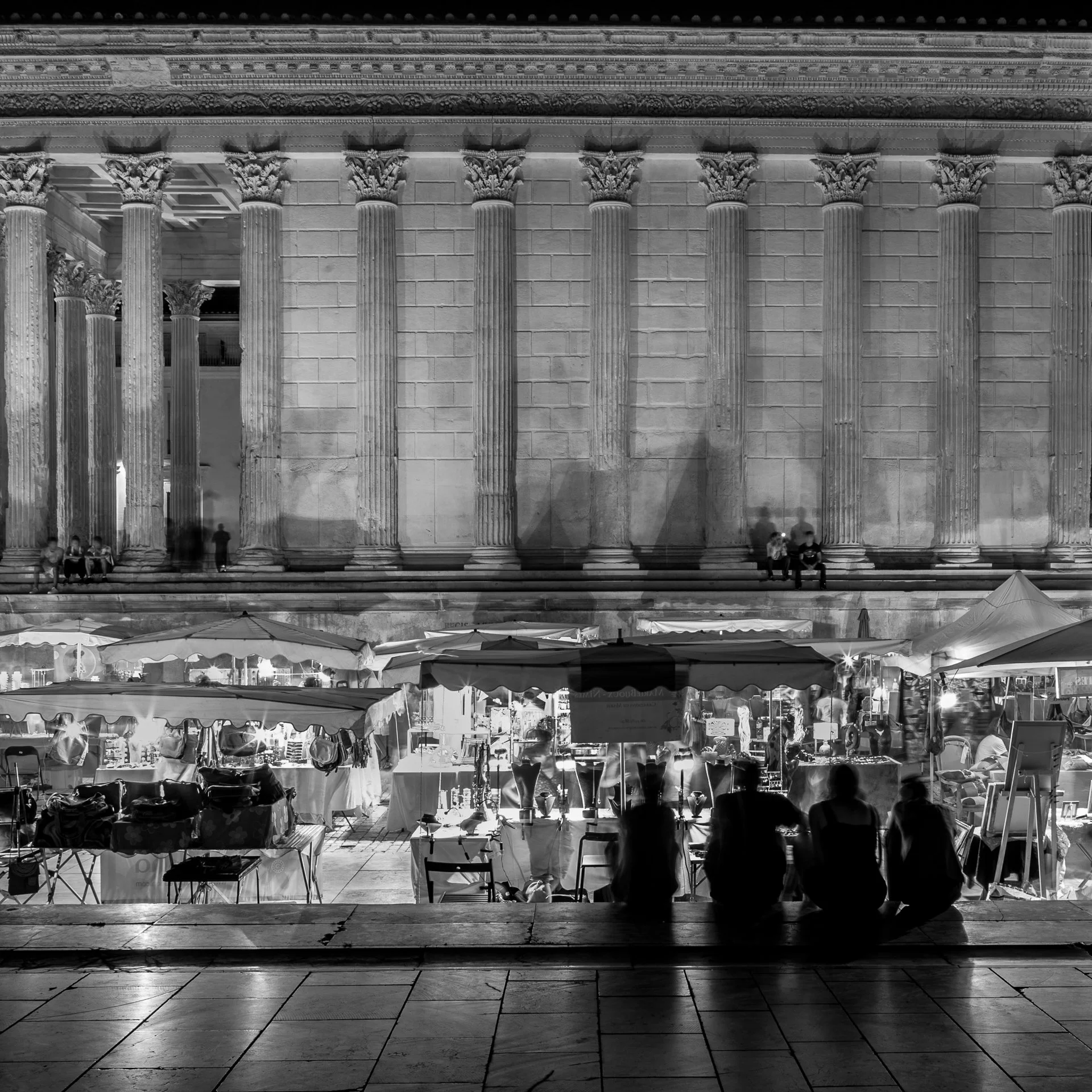
Night Market at the Maison Carrée
© 2026 Jean-François Cléroux | Maison Carrée, Nimes, France
This is an image of a Roman temple stands in the night, its tall Corinthian columns glowing softly above a lively market unfolding at its base. The ancient façade holds steady while blurred figures drift across the square — traces of movement, gestures of public life. Tents and stalls spill warm light into the darkness, creating a quiet dialogue between centuries: the endurance of architecture and the passing rhythm of people. The long exposure turns the scene into a kind of theatre, where time stretches and the city breathes in slow motion.
When you look at this scene — the Roman temple holding steady while blurred figures drift through the night market — you might feel a quiet kinship with Echoes on the Terrace (below). Both images share the same tension between permanence and motion, the same soft choreography of public life, the same way night turns a city into a stage. Does this photograph feel like it could belong to the same project, or at least speak to it across distance and centuries? It’s worth asking whether these two moments, Paris and Nîmes, are already in conversation?
The Places You Return To Without Knowing Why
Every photographer has places that feel like home — not because they are familiar, but because they are fertile. You return to them because they give you something: a mood, a rhythm, a tension, a possibility. A project often begins with a place you return to without knowing why.
It might be a single street, a single corner, a single block, a single café, or a single stretch of waterfront. The place is not the project. The place is the doorway. It is the environment where your instincts, emotions, and visual tendencies converge. When you recognise the places that keep calling you back, you begin to recognise the early geography of a project.
Themes Are Categories; Projects Are Commitments
It’s important to understand the difference between a theme and a project. A theme is a category; a project is a commitment. A theme says, “I photograph people.” A project says, “I am trying to understand how people move through this particular space.” A theme says, “I photograph light.” A project says, “I am trying to understand how dusk changes the emotional temperature of the city.”
A theme says, “I photograph architecture.” A project says, “I am trying to understand how ancient structures hold public life, how they witness movement, how they shape the way people gather.”
A theme is broad. A project is lived. A project asks you to return, to stay, to deepen, to question, to evolve. It asks for time. It asks for attention. It asks for patience. It asks for you.
Depth, Longevity, and the Quiet Test of Resonance
A project doesn’t need to be long to be meaningful. Some projects last a week; others unfold over months or years. What matters is not their size or duration, but the purposive approach behind them — the intention, the attention, and the willingness to return.
Depth can take many forms. A project might be deep because it spans time, or because it asks a difficult question, or because it reveals something subtle that only emerges through repeated looking. Breadth, scale, and duration can enrich a project, but they do not define it.
What matters now is simply noticing which ideas feel alive — which ones tug at you, which ones whisper, which ones keep returning. A project begins with resonance. It grows through repetition. It matures through attention.
What Your Work Has Been Trying to Say
When you look at your photographs with attention, you begin to see the quiet message running through them — the thing your work has been trying to say long before you were ready to hear it. It might be a question, a mood, a tension, a fascination, a longing, or a way of relating to the world.
Your work has been speaking. Chapter Two is about learning to listen.
Exercise: Listening for What Repeats
Set aside twenty minutes and move slowly through your recent photographs. Don’t organise them. Don’t judge them. Don’t try to make sense of them. Simply look. Let the images meet you as they are.
As you move through them, pay attention to what returns — the moments, moods, gestures, or places that seem to appear again and again. Notice the emotional temperature of your photographs, the way you tend to frame a scene, the kinds of people or spaces that draw your eye without effort. These repetitions are not coincidences; they are early signals of what your work has been quietly circling.
When you’re done, write a short paragraph describing what you see emerging. Not a theme, not a project, not a decision — just a recognition. A quiet acknowledgement of the threads already running through your practice.
Let this be a moment of noticing rather than choosing. Your work has been speaking. This exercise helps you hear it more clearly.
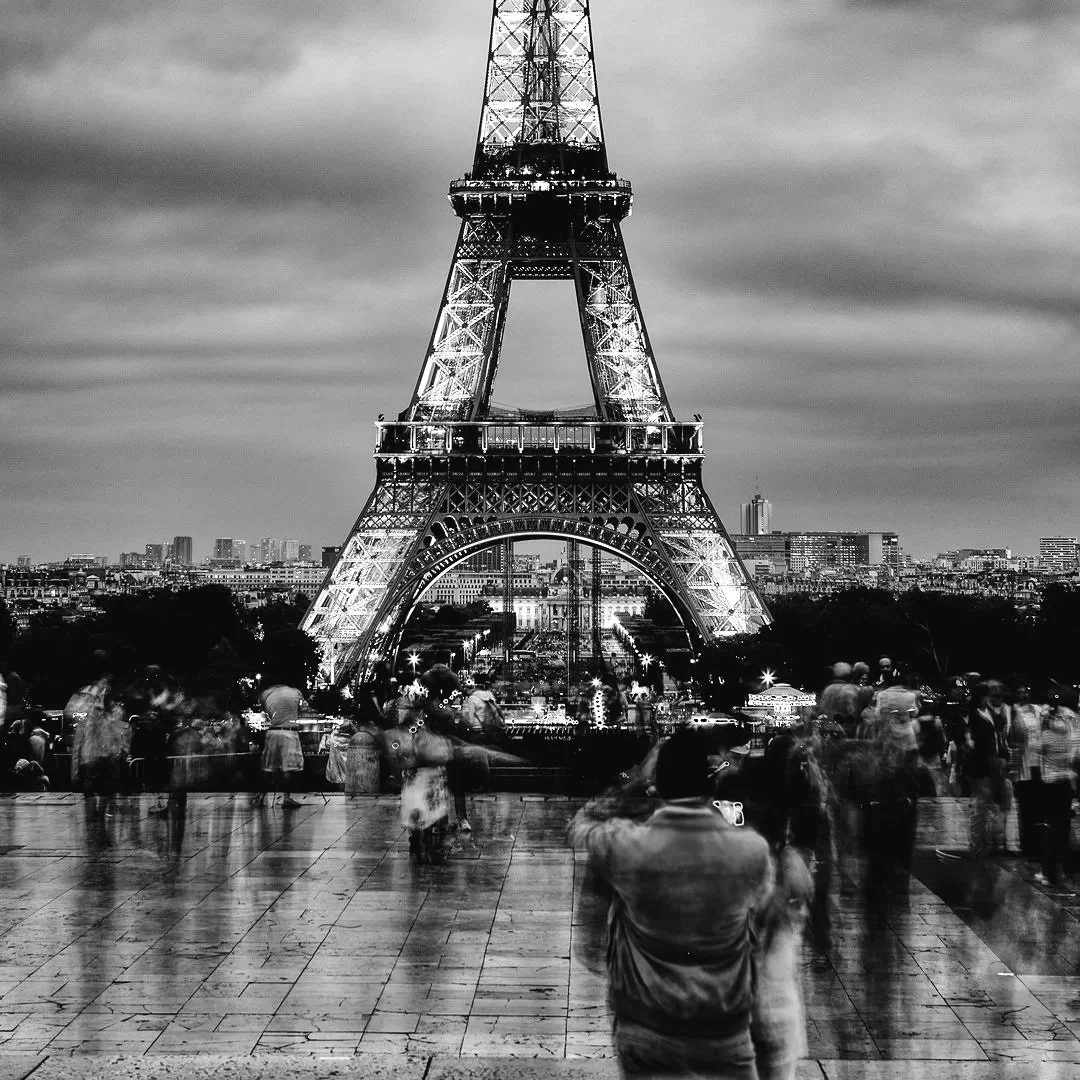
Echoes on the Terrace
© Jean-Francois Cleroux | Paris, France
What works here is the long exposure. The Eiffel Tower is the most photographed subject on earth, and the ghosted crowd is what rescues this from postcard territory — the living blur against the iron permanence gives the image its idea: transience gathered at the foot of the eternal. The wet pavement doubling the lights adds depth, and the figure in the lower right, camera raised, adds a quiet self-awareness — the photographer photographed photographing.
Centred, symmetrical, shot from the Trocadéro terrace — it's the default vantage, and technique alone can't fully overcome that familiarity. The frame is also bottom-heavy; the lower half goes quite dark, and the foreground figure, while conceptually nice, dissolves a little too far into the blur to anchor the image the way it wants to.
In short: atmospheric and technically assured, but compositionally safe. The blur is doing most of the expressive work. I'd ask of it what you ask of any street image — not "was I there," but "what did I see that the thousand other cameras on that terrace didn't?"
What One Photograph Can Teach You About Projects
Every so often, a single photograph contains more than its surface suggests. Echoes on the Terrace is one of those images — a frame where stillness and motion meet, where the Eiffel Tower stands immovable while the city dissolves into blur. It’s a strong photograph on its own, but it also carries the beginnings of several possible projects. When you look closely, you can feel the quiet directions it offers, each one a doorway into a deeper inquiry.
One direction begins with the tower itself: a landmark holding steady while life moves around it. This tension between permanence and motion could become a project about iconic structures as witnesses — places that endure while crowds shift, seasons change, and the city breathes around them. The Eiffel Tower is only one example; every city has its own anchor points, its own immovable presences.
Another possibility lies in the blurred figures in the foreground. They are gestures rather than individuals, atmosphere rather than subjects. This opens the door to a project about the choreography of public life — how people move through shared spaces, how anonymity becomes texture, how human presence can be felt without being defined. It’s a project rooted in movement, rhythm, and the ethics of unobtrusive seeing.
The long exposure itself suggests a third direction: a study of time as a visual element. In this image, time stretches the sky, softens the crowd, and reveals the city’s underlying pulse. A project built around long‑exposure studies could explore how cities breathe, how light drifts, how motion becomes a kind of language. It’s a way of slowing the world down just enough to see its deeper patterns.
There is also Paris — not as postcard, but as stage. In Echoes on the Terrace, the terrace becomes a place where motion gathers, where public life performs itself. This could grow into a project about the city’s living theatre: terraces, squares, bridges, metro entrances, each one a site where the city reveals its character through movement and mood.
And beneath all of these possibilities is a quieter, more conceptual thread: the dialogue between stillness and motion. The tower endures; the people pass. The architecture holds; the sky drifts. This tension is universal, not tied to any single place. It could become a project about what lasts and what changes, about the emotional weight of permanence and the beauty of transience.
A final direction emerges from the night itself — the illuminated tower, the softened architecture, the drifting sky. Nightfall changes the emotional temperature of a city. A project exploring cities after dark could follow this shift: how light becomes mood, how darkness reveals a different kind of presence, how the city’s voice changes when the day lets go.
All of these possibilities live inside one photograph. Echoes on the Terrace doesn’t tell you which project to choose — it simply shows you how many projects can begin quietly, almost invisibly, inside a single frame. The image is not the project. The image is the invitation.
If you listen closely, it’s already pointing the way.
Questions That Naturally Arise From This Stage
As you begin noticing the early threads in your work, certain questions naturally rise to the surface — quiet, honest questions that signal your practice is opening. Many of these will be explored in the chapters ahead:
How do I know which of these early threads might become a real project?
What do I do with the images that feel connected, but I’m not sure why?
How much structure does a project need in its early stages?
What belongs in a project — and what doesn’t?
How do I stay open without feeling lost?
How do I know if more than one project is beginning at the same time?
How do I keep a project alive when inspiration dips or the work becomes difficult?
When does a project become “real”?
These questions are not obstacles — they are signs of growth. The next chapters will guide you through each one, slowly and with clarity, as your projects begin to take shape.
Coming Up in The Flâneur’s Journal
Next week, we’ll step into a conversation about why every street photographer should study poetry — how rhythm, metaphor, compression, and ambiguity sharpen the flâneur’s eye and deepen the emotional intelligence behind your seeing. It’s a gentle bridge between wandering the city and listening to its quieter, more lyrical offerings.
In two weeks, in Chapter 3 of The Architecture of a Photographic Project, we’ll move from seeing to shaping — beginning the conversation with your work itself. We’ll explore how early images start speaking to one another, how patterns emerge, and how a project quietly announces its intentions long before you name it.
The exploration continues — slowly, attentively, one return at a time.