Why Every Street Photographer Can Benefit from Studying Poetry
And why the observant modern flâneur already lives in both worlds
There is a deep, almost ancestral kinship between the poet, the street photographer, and the modern flâneur. All three move through the world with a heightened sensitivity to the ordinary — a willingness to pause, to listen, to let the city speak in its own quiet dialect. Over the years, wandering Vancouver’s soft rainlight, Paris’s drifting afternoons, and New York’s restless corners, I’ve come to understand that poetry is not merely adjacent to street photography. It is one of its most powerful teachers.
Poetry sharpens the very instincts the flâneur depends on: attention, rhythm, metaphor, and the courage to dwell in ambiguity. It gives us a vocabulary for the subtle, a grammar for the fleeting, and a way of seeing that honours the dignity of the people who pass through our frames. When we study poetry, we are not learning how to write better captions — we are learning how to see.
And when we see the world differently, we photograph it differently. A shift in perception becomes a shift in attraction: what draws our eye changes, what feels meaningful changes, and the frames we make begin to carry the emotional weather of the person behind the lens. Much like how we photograph differently when we are joyful or grieving, poetry opens a new emotional aperture — one that changes the very nature of our attention.
The flâneur’s attention: slow, porous, and attuned
Historically, the flâneur was imagined as a man wandering 19th‑century Paris. Today, the modern flâneur can be anyone who moves through the city with curiosity, patience, and a porous kind of awareness. The modern flâneur is not simply a wanderer; they are a listener. They move through the city absorbing gestures, overheard fragments, shifting light, and the emotional weather of a street corner.
Poetry cultivates this same porousness. A poem asks you to notice the small — the way a hand rests on a railing, the way a shadow folds across a doorway, the way a stranger’s posture reveals a private story.
When I read a poem slowly, I practise the same discipline I rely on when I walk with a camera:
to linger without grasping
to observe without intruding
to let meaning emerge rather than forcing it into clarity
Poetry teaches us that attention is not passive. It is an active, ethical stance — a willingness to be changed by what we notice.
And this is where the flâneur’s practice deepens: poetry trains us to see not only what is there, but what it suggests. It teaches us to notice the emotional undertones of a scene, the quiet metaphors unfolding in real time. When we see through the eyes of a poet, the world becomes layered — not simply a street to be photographed, but a living text to be read.
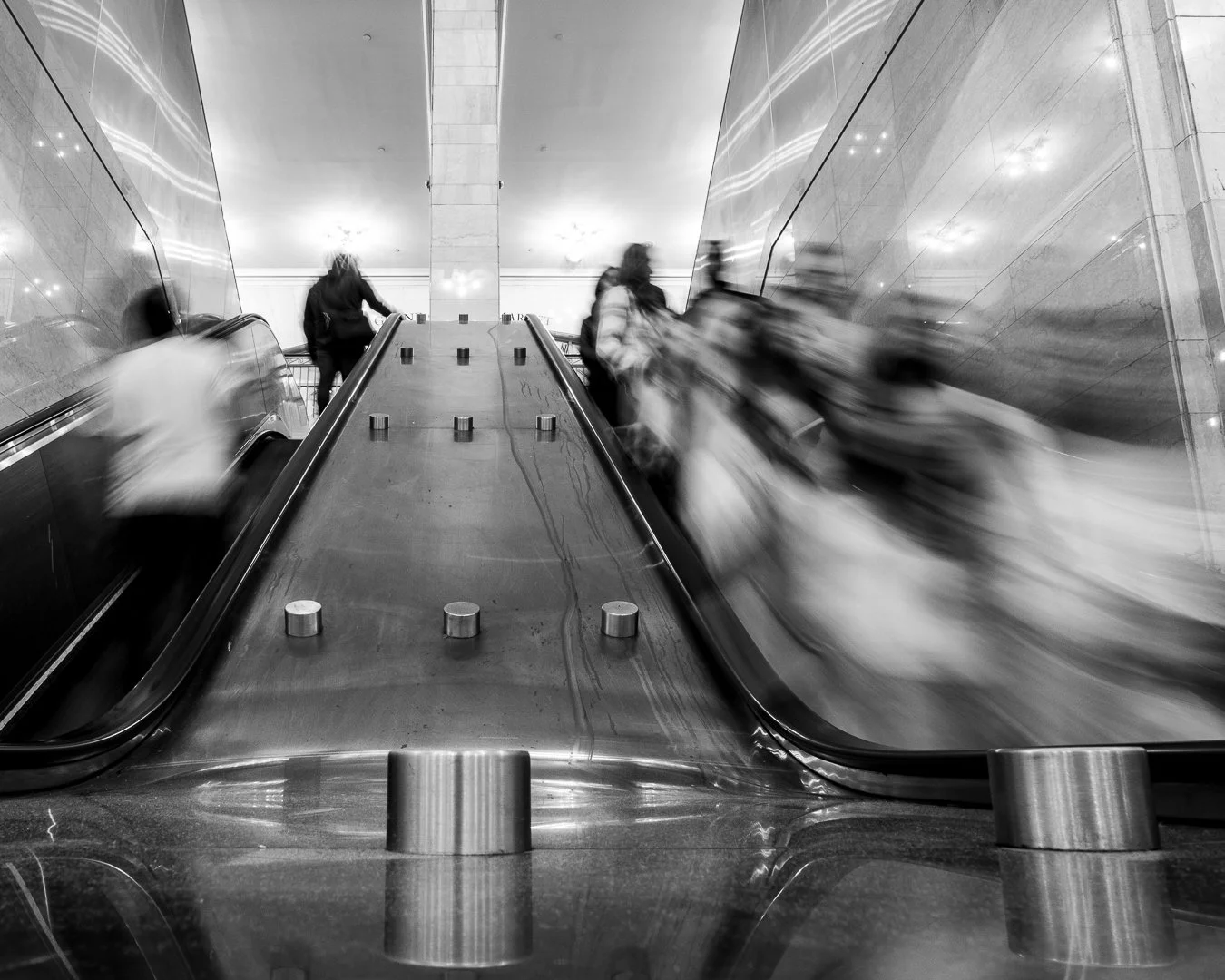
Where Motion Becomes a Line of Verse
© 2026 Jean-François Cléroux | New York, NY, USA
When I look at this photograph, I see the city speaking in its own metre. The escalators rise and fall like parallel stanzas, each carrying its own fleeting cast of characters. The blurred figures — half‑formed, half‑vanishing — feel like words caught mid‑utterance, the kind a poet might overhear and tuck into a notebook before they dissolve back into the noise of the day.
The architecture holds the scene steady, offering a kind of structural grammar: polished stone, reflective surfaces, the clean geometry of rails and steps. Against that stillness, the motion blur becomes the poem — a reminder that meaning often lives in what refuses to stay still.
This is the kind of moment the modern flâneur knows intimately. You’re not photographing people so much as photographing passage — the act of moving through a city, the emotional weather of transition, the way strangers share space without ever truly meeting. Poetry teaches us to notice these thresholds. It teaches us that the world is full of metaphors waiting to be recognised: ascent and descent, clarity and blur, the known and the unknowable.
Seeing through the eyes of a poet changes what we notice. It draws us toward gestures that feel symbolic, toward rhythms that echo something internal. A photographer who has studied poetry will see this scene not as an escalator, but as a meditation on movement, anonymity, and the quiet choreography of urban life. And because you see it differently, you photograph it differently — with more patience, more curiosity, more willingness to let ambiguity breathe.
In this frame, the city becomes a verse, and the people become its fleeting syllables. The photograph doesn’t explain; it invites. It doesn’t declare; it listens. It holds the same generosity you speak of in your blog — the willingness to witness without taking, to honour without interrupting.
This is what happens when a photographer sees through the eyes of a poet: the ordinary becomes luminous, and the moment becomes a line worth reading twice.
How poetry strengthens the photographer’s eye
1. Vocabulary of imagery → Vocabulary of seeing
Poetry gives us a language for the subtle textures of experience: tone, rhythm, contrast, tension, gesture, silence. These are not only literary terms — they are the building blocks of the Language of Photography. When you learn to recognise metaphor in a poem, you begin to recognise metaphor in a scene. When you understand how a poet uses contrast to shape meaning, you start to see how light and shadow can do the same in a frame.
A photographer who studies poetry begins to see the street not as a collection of subjects, but as a field of relationships — a place where meaning is carried not only by what is visible, but by what is implied.
2. Rhythm and cadence → Timing and composition
Poems breathe. They move in beats and pauses. They rely on tension and release. Street photography is built on the same architecture. The flâneur who reads poetry learns to feel the rhythm of a street — the syncopation of footsteps, the rise and fall of traffic, the quiet between gestures. This sensitivity becomes a practical tool:
You anticipate moments rather than chase them.
You compose with the rhythm of the scene rather than imposing your own.
You sense when a frame is ready — the way a poet senses when a line has reached its natural end.
3. Compression and restraint → Stronger, more honest frames
A poem is a masterclass in compression. It teaches you to remove everything that is unnecessary so that what remains can breathe. This is the heart of editing — both in writing and in photography. Poetry trains you to trust the power of a single gesture, a single sliver of light, a single human moment.
The flâneur learns to say more by showing less.
4. Metaphor and ambiguity → Images that resonate beyond the literal
Poetry thrives on suggestion. It leaves space for the reader to enter. Street photography, at its best, does the same. When you study poetry, you learn to embrace ambiguity — not as a flaw, but as a form of generosity. You stop trying to explain your images and instead allow them to hold multiple meanings.
This is where photography becomes art: when it invites interpretation rather than simply delivering answers.
Seeing the world differently → photographing the world differently
When we see through the eyes of a poet, our attention shifts. We become drawn to different things — not only the dramatic or the unusual, but the quietly resonant. A poet’s gaze is emotional, relational, metaphorical — a way of seeing that notices how light touches a shoulder, how two strangers mirror each other’s posture, how a moment feels before it becomes visible.
And this shift in perception changes our photographs.
We photograph differently when we are happy, when we are lonely, when we are restless, when we are at peace. Poetry gives us access to those inner states. It teaches us to name them, to recognise them, and to let them shape our seeing. The camera becomes less a device and more an instrument of emotional literacy.
A poet’s eye does not look for subjects — it looks for meaning.
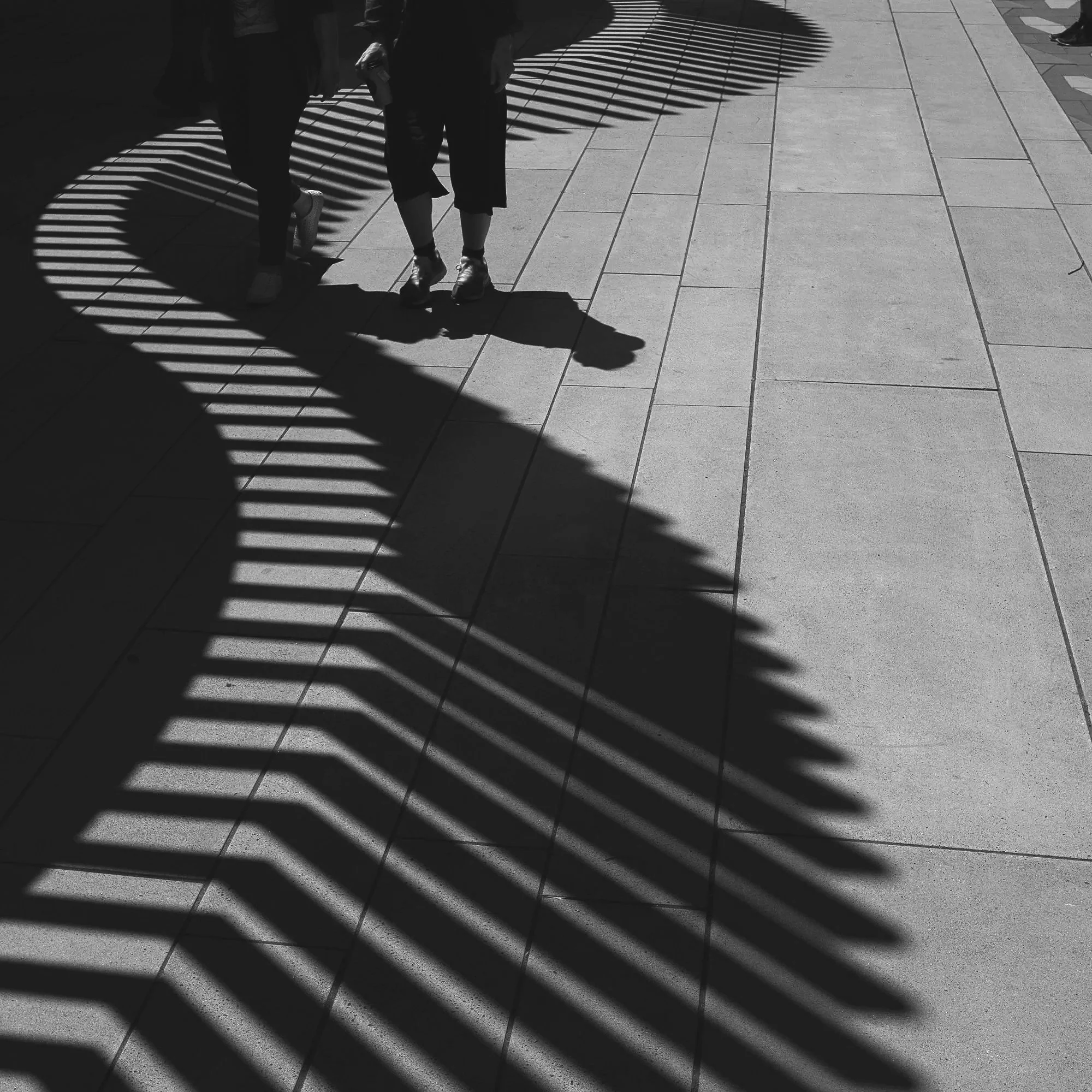
The City Writes in Light
© Jean-Francois Cleroux | Vancouver, BC, Canada
This image feels like a stanza unfolding across the pavement. The shadows — those sinuous, repeating lines — behave almost like handwriting, a visual script cast by the city itself. They ripple with a rhythm that echoes the cadence of a poem: measured, deliberate, yet alive with subtle variation.
The two figures walking through the pattern become part of the poem rather than its subjects. Their legs and shadows weave into the larger composition, suggesting how we, as flâneurs, are always both readers and participants in the city’s ongoing text. Nothing here is staged; everything is quietly offered.
What makes the photograph resonate is its interplay between structure and fluidity. The fence creates order, but the light transforms that order into something musical. This is precisely what poetry teaches us to see — the way the ordinary becomes expressive when we attend to its rhythm. The shadows are not merely shapes; they are metaphors for movement, for passage, for the way people drift through the city carrying their own private stories.
Seeing through the eyes of a poet changes what we notice. A photographer trained in poetry will be drawn to these subtle, repeating gestures — the kind of visual music most people walk past without a second thought. And because you see differently, you photograph differently. You’re not capturing a walkway; you’re capturing the city’s breath, its quiet insistence on pattern and presence.
This frame holds the same generosity you write about in your blog: a willingness to witness without interruption, to let meaning arise from what is already there. It’s a photograph that listens. It’s a photograph that reads the world as a poem.
If you’d like, I can also craft a short caption for your site or social channels, or help you pair this image with a two‑line poem in the spirit of your exercises.
The ethical dimension: seeing without taking
Both poetry and flânerie teach humility. They remind us that the city is not ours to possess; it is ours to witness. A poet does not claim ownership of the world they describe — they honour it. A flâneur does not interrupt the flow of the street — they move within it. A street photographer, too, must learn to see without taking, to observe without diminishing.
Poetry helps us cultivate this ethical stance. It teaches us to approach the world with curiosity rather than entitlement, with sensitivity rather than hunger. It reminds us that every person we photograph carries a private universe we will never fully know.
Practical exercises for the modern poetic flâneur
These are tools I bring to workshops and to my own walks — small practices that bridge poetry and photography.
The One‑Line Walk
Write a single line about something you notice — a gesture, a sound, a shift in light. Then make one photograph that responds to that line.
The Stanza Stroll
Choose a short poem. Walk at its pace. Photograph three moments that feel like the poem’s opening, middle, and closing breath.
The Compression Edit
Shoot ten frames of a scene. Reduce them to one. Ask yourself what the poem of the moment truly needed.
Metaphor Pairing
Pair a photograph with a two‑line poem. Let the poem complicate the image rather than explain it.
These exercises are not assignments; they are invitations — ways of slowing down, of listening more deeply, of letting the city reveal its quieter truths.
A closing reflection: where poetry, photography, and flânerie meet
Studying poetry does not turn you into a poet, just as walking with a camera does not automatically make you a photographer. But both practices deepen your way of being in the world. They sharpen your attention, refine your instincts, and give you a vocabulary for the subtle, luminous moments that pass through a city like breath.
When I walk with a camera and a small notebook, I am not collecting evidence. I am practising a way of seeing — one that is ethical, lyrical, and patient. Poetry keeps my eye honest. Photography keeps my language grounded. Flânerie keeps me open to the world’s quiet offerings.
If you want your images to carry more meaning, read a poem. If you want your seeing to be more deliberate, write one line about what you notice. If you want to understand the city more deeply, walk it slowly — as a poet, a photographer, and a flâneur at once.
The three practices are not separate. They are three ways of listening to the same world.
Coming Up in The Flâneur’s Journal
Next week, we’ll step into Chapter Three of the Projects series — Beginning the Conversation With Your Work. This chapter turns your attention toward the early signals already forming inside your photographs: the moods you return to, the places that keep pulling you back, the gestures and tensions that appear without your permission. It’s about recognising the beginnings of a project long before you can name it — learning to notice the subtle threads your work has been weaving beneath your awareness.
You’ll explore how projects often begin quietly, not as ideas but as repetitions — a certain kind of light, a recurring emotional temperature, a handful of images that seem to lean toward one another. This chapter invites you to sit with those early constellations, to listen without forcing meaning, and to stay uncommitted long enough for a project to reveal its first whisper.
More is unfolding just ahead. Let your practice move with curiosity, stay open to the subtle signals in your own images, and allow the next chapter to meet you with whatever your eye is ready to notice.