The Architecture of a Project - Early Stages
The Architecture of a Photographic Project — Chapter 4
A project begins quietly — long before you name it, long before you understand it, long before you decide what it is “about.” In my own practice, the earliest stages often feel like a soft gathering of repetitions: a mood that keeps returning, a gesture that feels familiar, a visual tendency that seems to follow me from street to street. These signals begin as fragments, but eventually they start leaning toward one another. They form a loose constellation.
This is the moment when a project begins to take shape.
Not a rigid shape. Not a defined shape. Not a shape you can outline or explain. But a shape nonetheless — a gentle, early form with project possibilities.
This chapter is about learning to recognize that early form without forcing it into a project, without rushing it, without closing the work too soon. It is about building just enough structure for the project to breathe.
The First Gentle Structures
In the early stages of a project, structure should feel like a suggestion, not a decision. You are not building walls; you are noticing patterns. You are not defining the project; you are acknowledging its early gravity — the way certain images seem to lean toward one another, the way certain moods begin to cluster, the way certain questions quietly rise to the surface.
This is the moment to gather the work lightly.
Perhaps you create a small folder of images that seem to belong together — not because you can explain the connection, but because they speak in the same emotional register. You might jot down a few notes about what keeps returning: a gesture, a kind of light, a recurring tension or tenderness. You may find yourself writing a short list of questions your work is asking — questions too early to answer but too persistent to ignore.
As you move through your photographs, you begin to recognise the emotional temperature running through them, the atmosphere that seems to follow you from frame to frame. Certain places, moods, or gestures feel central — not thematically, but in the way they quietly anchor your attention.
None of this is planning. None of this is definition. It is simply the earliest form of listening with shape.
Gentle structure is not about deciding what the project is. It is about recognising that something is forming — that your work is beginning to organise itself, that your attention is circling the same questions, that your instincts are gathering material even before you understand why.
The project is not defined. But it is forming.
Your role, at this stage, is to let that formation happen without rushing it, without naming it, without closing it down. You are building just enough structure for the project to breathe — enough shape to notice what is emerging, but not so much that the work loses its ability to surprise you.
What Belongs and What Doesn’t Yet
One of the earliest challenges in project work is learning to recognise what belongs — not in any final or authoritative sense, but in a provisional, intuitive way. At this stage, belonging is not about subject matter. It is about resonance.
You begin to sense which images hum at the same frequency — which ones feel part of the same conversation.
Some photographs carry the same emotional temperature: a shared atmosphere, a familiar mood, a tone that feels consistent even if the scenes differ. Others echo the project’s emerging feeling, leaning toward the same kind of quiet, or tension, or curiosity. Some share a visual tendency — a way of framing, a way of responding to light, a way of moving through space that feels aligned.
And some images simply feel like they are speaking to one another — raising similar questions, circling the same emotional thread, deepening the early inquiry without trying to define it.
In contrast, you will encounter images that do not feel as though they belong — at least not yet. They may distract, pulling your attention sideways. They may feel louder than the others, introducing a tone that disrupts the early coherence. They may open a new thread that is interesting but pulls the project off balance. Or they may simply feel like a different conversation entirely.
Not‑belonging is provisional: an image that feels out of place today may find its home later, or belong to another project entirely.
Early in the process, a project possibility is porous. It lets things in and out. It shifts as you return. It changes shape as your seeing deepens.
Your job is not to decide. Your job is to notice.
Belonging, at this stage, is a feeling — a quiet recognition that certain images lean toward one another while others stand apart. You are not choosing. You are listening.
The Danger of Closing the Work Too Soon
One of the quietest dangers in the early stages of a project is the urge to define it before it is ready to be defined. The moment you sense a pattern, a part of you may want to name it, shape it, or claim it. This impulse is understandable — naming feels like clarity, and clarity feels like progress.
But in the early architecture of a project, clarity can be premature, and premature clarity can be harmful.
Many photographers rush toward definition. They choose a title too early, hoping it will anchor the work. They begin drafting an artist statement before the project has found its voice. They decide what the project is “about” long before the work has revealed its deeper questions. They start editing with a fixed idea in mind, excluding images that don’t fit the shape they have already imagined.
Each of these actions closes the work too soon. Each one collapses possibility. Each one forces the project into a form it has not yet earned.
Early architecture must remain open. It must be allowed to shift, to breathe, to contradict itself, to surprise you. If you define the project too soon, you stop listening. And once you stop listening, the project stops growing.
The early stages of a project require humility — a willingness to let the work lead rather than your ideas about the work. They require patience — the discipline to wait for the project to reveal itself rather than rushing to explain it. They require vulnerability — the courage to be wrong about what you think the project is becoming.
A project reveals itself slowly. Your job is to stay open long enough to hear it.
This openness is not passive. It is an active form of attention — a way of returning to the work without expectation, of letting the images speak without forcing them into coherence, of allowing the project to gather itself in its own time.
The danger of closing the work too soon is real. But so is the beauty of letting it unfold.
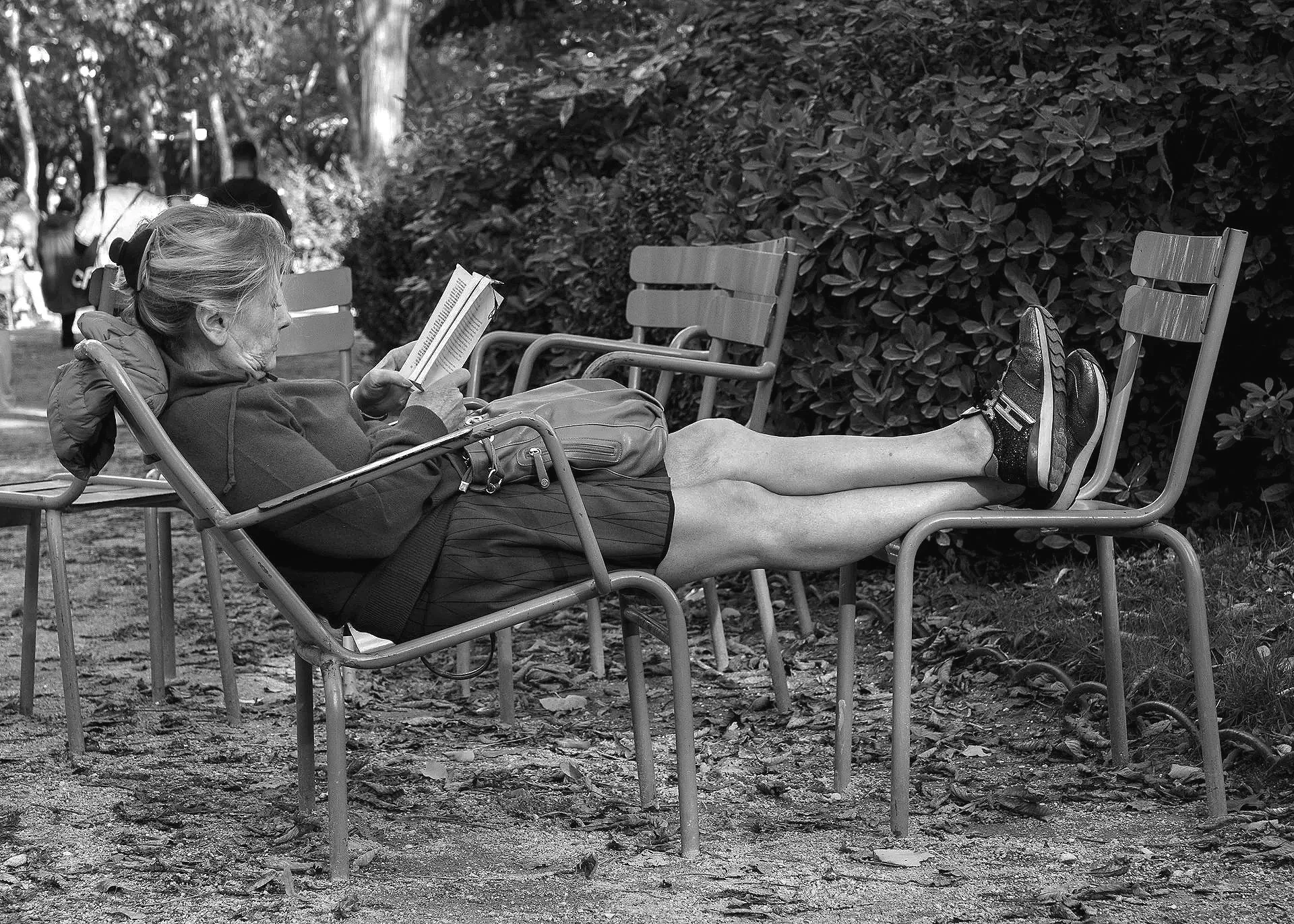
Afternoon Ledger
© 2026 Jean-François Cléroux | Paris, France
I like the quiet economy of this frame: a single figure folded into a small domestic ritual, legs extended across a second chair, a book held like a private island. The black‑and‑white treatment gives the scene a modest gravity — leaves and metal chairs become texture and rhythm, and the figure’s stillness becomes the image’s centre of gravity. Compositionally, the chairs create a subtle X of lines that both anchors and gently unsettles the picture, while the surrounding foliage keeps the moment intimate rather than theatrical.
What makes the photograph linger is its restraint. There is no insistence here — no forced gesture, no dramatic light — only a patient observation of leisure and solitude. A slightly tighter crop on the reader and the chairs would heighten the intimacy; conversely, a little more space on the left might emphasise the sense of the park as a lived environment. Either choice would be a decision about tone: closer for quiet confession, wider for gentle context.
Ethically and poetically, the image feels respectful and attentive. The subject is captured in a moment of unselfconscious repose, and the photograph honours that privacy while still inviting the viewer in. It reads as a small, honest study in how ordinary gestures — reading, resting, being still — can hold a kind of quiet architecture worth returning to.
Working With Multiple Projects at Once
Most photographers don’t make one project at a time. They make several — often without realising it. This is natural. This is healthy. It is part of the architecture of a long‑term practice.
Your instincts rarely move in a single direction; your emotional threads are layered; your visual tendencies are diverse; your curiosity is not singular. Your life is not singular. It makes sense that your projects aren’t either.
Working with multiple projects at once is not a distraction. It is a sign of maturity. It means you are paying attention to the different parts of your seeing — the quick, agile impulses that form short projects, and the slow, patient inquiries that grow into long ones.
A healthy practice contains both: the week‑long study that sharpens your instincts, and the multi‑year project that deepens your voice.
The challenge is not managing multiple projects. The challenge is recognising what each one is.
Some projects are just beginning — small clusters of images that feel alive but fragile. Others are deepening — gathering weight, coherence, and emotional gravity. And some are simply collections of images that will not grow further, even if they were meaningful to make.
You do not need to choose between them. You do not need to commit to one and abandon the others. You do not need to decide which project is “the real one.”
You only need to notice which projects are alive.
Some will grow. Some will fade. Some will merge. Some will split. Some will disappear for years and return when your life shifts.
Your job is to keep the doors open — and to keep track of what is unfolding.
This is where documentation becomes essential. Not rigid planning, not detailed outlines, but simple, honest notes: a folder for each project, a few sentences about what feels central, a record of the questions the work is asking.
Documentation gives your projects a place to live. It allows you to return without losing the thread. It helps you recognise when a short project has run its course, and when a long project is quietly gathering strength.
Multiple projects thrive when they are held lightly but kept visible. They need room to breathe, and they need somewhere to belong.
Your role is to give them both.
The Early Questions That Shape the Architecture
As the early architecture begins to form, certain questions rise — not as demands, but as invitations. They surface quietly, almost tentatively, as if the project is beginning to test its own edges.
These questions are not there to be solved. They are there to help you recognise the shape that is beginning to gather.
You might find yourself wondering about the emotional centre of the project — the feeling that seems to hold the images together. You may notice what keeps returning, the gestures or atmospheres that seem unwilling to let go. You might sense what feels essential and what feels peripheral, even if you cannot yet articulate why.
These questions are not meant to be answered. They are meant to be held.
Holding a question is different from solving it. Holding a question means letting it accompany you as you make new images, as you return to old ones, as you move through the places that feel central to the work. It means allowing the question to shape your attention without shaping your decisions.
This is where documentation becomes quietly powerful.
When you write these questions down — in a project folder, a notebook, a small document where the project is beginning to live — you give them a place to breathe. You allow them to guide your seeing without controlling it. You create a record of your early curiosity, something you can return to weeks or months later and recognise how the project has shifted, clarified, or surprised you.
Documenting the questions is not about creating a plan. It is about creating a mirror.
A project grows through the questions you carry, not the answers you force. Answers close things down. Questions keep things open.
These questions are not instructions. They are companions.
They walk beside you as the project forms, offering a quiet orientation — not telling you where to go, but helping you notice where you already are.
Letting the Project Breathe
The early architecture of a project is fragile. It needs space. It needs patience. It needs time. It needs you to approach it gently, without the pressure of definition or the urgency of clarity.
At this stage, the work is still discovering itself. It is still learning what it wants to become.
Letting a project breathe means returning to it without expectation — coming back to the images with openness rather than agenda. It means looking without deciding, allowing the work to show you what feels alive rather than trying to force coherence. It means making new photographs without trying to “fit” them into anything, trusting that the project will gather what it needs and leave behind what it doesn’t.
Breathing is the opposite of forcing. Breathing is the opposite of rushing. Breathing is the opposite of shaping too soon.
A project breathes through your willingness to let it remain unfinished. When you resist the urge to define, you create room for the work to surprise you. When you resist the urge to organise, you allow the project to shift and expand. When you resist the urge to control, you give the project permission to grow in directions you could not have planned.
The early architecture is not a blueprint. It is a pulse — faint at first, but steady enough to follow.
Exercise: Building Gentle Structure
Set aside thirty minutes and gather twenty to thirty recent photographs — not your favourites, not your “best,” just the ones that feel alive. Choose the images that tug at you, the ones you keep returning to without knowing why. This exercise is not about excellence. It is about energy.
Move through them slowly. Let each image meet you without expectation.
As you look, begin noticing which photographs seem to lean toward one another. Some will share a mood, others a gesture, others a kind of light or a way of framing. Without forcing anything, let the images drift into small clusters — gentle groupings that form naturally, almost without your involvement.
Don’t justify the clusters. Don’t explain them. Don’t analyse them. Simply allow the images to gather where they want to gather.
When the clusters feel settled, write a short paragraph about each one. One or two sentences are enough, keep these notes provisional. Describe what holds it together — the mood, the question, the emotional temperature, the visual tendency that seems to run through it. You are not defining a project. You are noticing the early coherence of your seeing.
These notes — simple, honest, provisional — can become part of your project documentation. They give the clusters a place to live. They create a record of what feels central at this moment in time. They allow you to return weeks or months later and recognise how the work has shifted, clarified, or surprised you.
Documentation at this stage is not about planning. It is about remembering. It is about giving your early curiosity a home.
These clusters are not projects. They are the early architecture of projects.
Treat them gently. Let them breathe. Let them remain open.
This exercise is not about deciding what the project is. It is about recognising what is already forming.
Closing Gesture
As you move through these early structures — the clusters, the questions, the gentle patterns that keep returning — you may begin to sense which project is quietly asking for more of your attention. Nothing is decided yet. Nothing is fixed. But something in the work may start to feel a little more insistent, a little more anchored, a little more willing to grow.
This is not the moment to choose. It is the moment to notice.
The early architecture you’ve been building is not a commitment; it is a way of listening. It helps you recognise which threads carry weight, which moods hold steady, which questions continue to rise no matter how many times you return. It shows you where your curiosity is gathering, where your seeing feels most alive.
Soon — but not yet — you will begin to follow one of these threads more deliberately. You will step into the middle of the work, where the project deepens, where patience becomes essential, where the images begin to ask more of you.
As these early structures gather — the clusters, the questions, the gentle patterns that keep returning — you may begin to sense which thread is quietly asking for more of your attention. Nothing is decided yet. Nothing is fixed. For now, your work is still forming; your role is to notice. In the next chapter we step into the middle of the work, where patience becomes devotion and the project begins to ask more of you. Stay close to what is forming. Let the early architecture remain open. Let the work breathe.
Coming Up in The Flâneur’s Journal
Next week, we’ll shift into a practical discipline: One Lens — One Month, a month‑long exercise in attention, fluency, and the quiet craft of learning a single field of view. It’s not a project — it’s a constraint that sharpens instinct, steadies your seeing, and teaches you how a lens becomes an extension of your eye. A gentle, grounded practice before we return to long‑form work.
In two weeks, we return to The Architecture of a Photographic Project with Part V — Stepping Into the Middle of the Work, where the project begins to gather weight, where curiosity becomes commitment, and where the work starts asking more of you than simple noticing. It is the moment when the project becomes a place — a terrain you can walk into, a space with its own gravity.
More is unfolding — slowly, deliberately, through the quiet discipline of returning to what matters.