Within the Frame #04: Reading in the Jardin du Luxembourg
A series on reading photographs
About Within the Frame — This series is an invitation to slow down. Each instalment offers a single photograph and asks you to sit with it — to look, to think, and to articulate what the frame is doing on its own terms. Composition, emotion, gesture, rhythm, tension, atmosphere, narrative suggestion — all of these become part of the language of reading photographs.
Over time, these small exercises sharpen your instincts. You begin to notice what you once overlooked. You start to recognise the quiet architecture that holds an image together. And gradually, you learn to trust your own way of seeing — not by memorising rules, but by paying attention with patience, curiosity, and care.
In this edition, we turn our attention to a quiet moment in the Jardin du Luxembourg — a man reading alone in one of Paris’ most iconic public gardens. We’ll look closely at how the frame works, where it struggles, and what it reveals about solitude, public space, and the act of reading in the open air.
We’ll also consider how this photograph might belong to one of three emerging long‑form projects — each one asking meaningful questions about solitude, belonging, and the cultural architecture of reading.
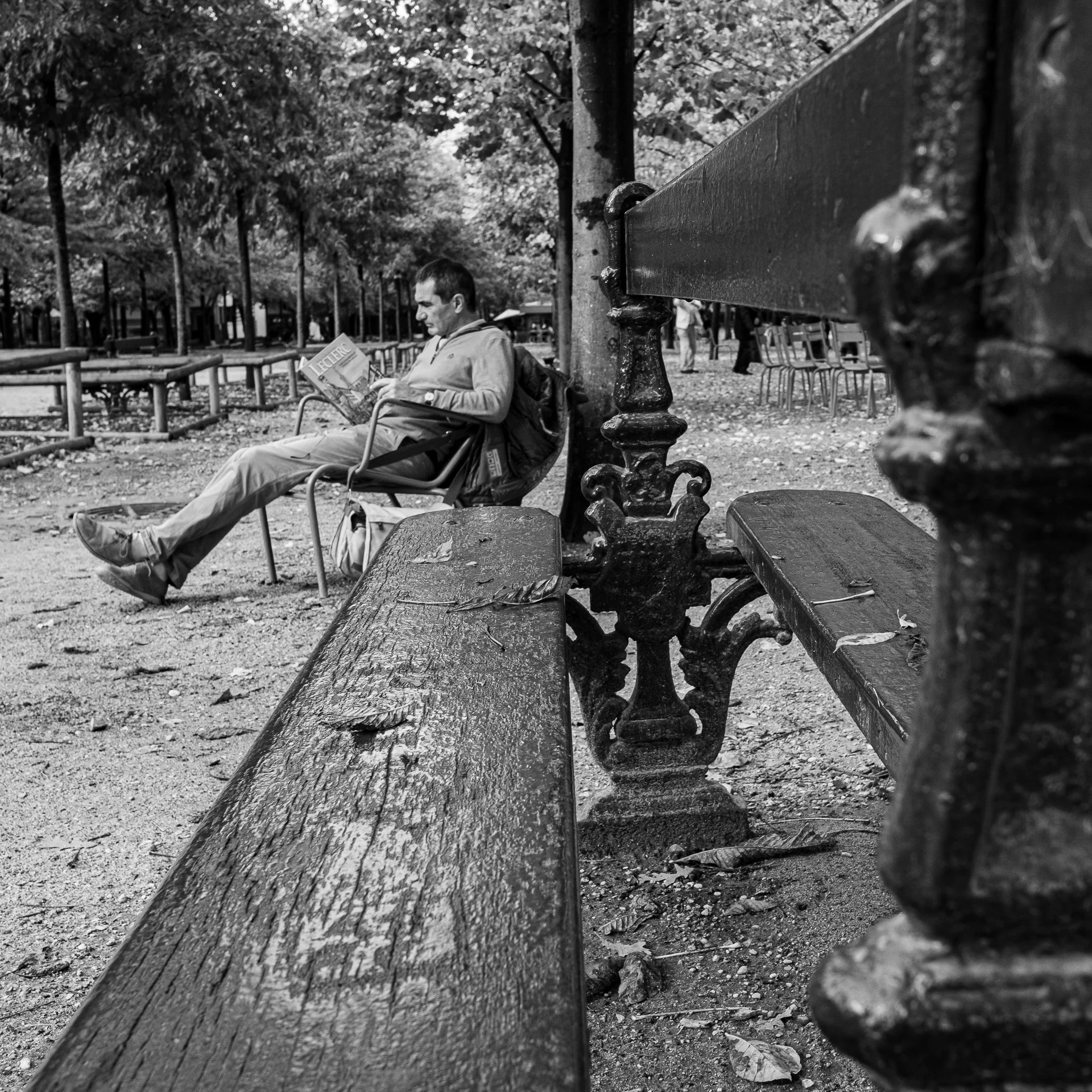
Reading in the Jardin du Luxembourg - © 2026 Jean-François Cléroux | Jardin du Luxembourg, Paris, France
Pen and Paper Exercise
Before you read my critique and observations, spend a few quiet minutes with the photograph on your own terms. This series is built on the belief that looking is a form of practice — a slow, attentive act that deepens your ability to read the world. When you pause long enough to articulate what you see, you begin to uncover the patterns, preferences, and sensitivities that shape your way of seeing.
This exercise is not about getting it “right.” It’s about noticing what draws you in, what unsettles you, what feels intentional, and what lingers after you look away. Over time, these small exercises sharpen your instincts. You begin to notice what you once overlooked. You start to recognise the quiet architecture that holds an image together. And gradually, you get better at the language of reading photographs — not by memorising rules, but by paying attention with patience, curiosity, and care.
Take out a pen and paper. Sit with the image. Let your eye wander without rushing to conclusions.
What to Do
Move through these steps slowly, in your own words:
Describe what you notice first
The element that catches your attention often reveals the photograph’s centre of gravity for you. Is it the long, weathered bench? The man reading? The geometry of the trees? The atmosphere of the park?
Trace how your eye moves through the frame
Follow the path your gaze takes. Does the bench guide you toward the reader? Does the background pull you away? Where does your eye settle, and where does it return?
Observe the relationships between elements
Look at how shapes, lines, tones, or subjects interact. Notice the contrast between the heavy bench and the lightness of the trees, the stillness of the reader and the openness of the garden. Consider how the textures — wood, metal, leaves — speak to one another.
Attend to gesture and mood
What does the reader’s posture suggest? What emotional tone emerges from the scene? Does the image feel solitary, communal, contemplative, or simply quiet?
Consider the structure of the image
Notice how the frame holds together — its balance, its density or spaciousness, its sense of order or tension. Pay attention to how the bench anchors the foreground and how its leading lines guide your eye toward the reader. Observe whether the background feels busy or supportive.
If you recognise specific techniques — leading lines, framing, contrast, depth — name them. Learning their vocabulary is part of learning to see.
But even if you don’t yet recognise or know the names of particular techniques, make observations anyway. Describe what feels stable, what feels heavy or light, what feels connected or separate. Often, what you notice intuitively is a technique that is simply unnamed for you at this stage. The language will come later; the seeing begins now.
Notice what remains unclear
Ambiguity is part of the language of photography. What questions does the image raise for you? What do you wonder about the reader, the setting, or the moment?
Write down what lingers
What lingers is not always a point of clarity or beauty. Sometimes it’s a small disquiet — something that feels slightly off, unresolved, or out of balance. That, too, is worth noticing. A lingering discomfort can reveal how the plane of focus affects your reading of the image, how visual weight is distributed, or how certain choices (intentional or accidental) shape your emotional response. These moments of unease are part of the language of photography, and learning to recognise them will deepen your ability to read images with honesty and nuance.
Why This Step Matters
Writing first helps you define and enhance your own visual instincts before you encounter mine. It turns looking into a conversation between you and the image — one shaped by your curiosity, your language, and your way of paying attention.
This exercise also prepares you for the second half of the post, where we explore how this photograph might belong to one of three emerging long‑form projects. Each project carries social value and aligns with the early architecture described in Chapters 1–4: noticing patterns, sensing emotional temperature, recognising early coherence, and letting the work breathe.
When you reach the end, you’ll be invited to return to your notes and reflect on how your first impressions align with, differ from, or deepen in light of what you’ve read. That return is an essential part of the practice.
The Image - Reading in the Jardin du Luxembourg
Paris has a way of folding quiet moments into its public spaces, and nowhere is this more visible than the Jardin du Luxembourg — the large garden where children sail small wooden boats across the pond, where chairs are scattered freely, and where reading becomes part of the city’s daily rhythm. In France, reading in public is not an exception but a way of life. Books hold a privileged cultural status here, supported by independent bookstores, libraries, literary festivals, and civic campaigns that celebrate reading as a cultural act. You see it everywhere: people reading in parks, cafés, on transit, along the river — a quiet, everyday expression of curiosity and engagement.
This photograph comes from one of those quiet corners: a man seated alone, absorbed in his book, surrounded by the geometry of trees, benches, and pathways.
What the Image Shows
The foreground is dominated by a long wooden bench with ornate metal supports, stretching diagonally across the frame. Its weathered texture — worn boards, softened edges, the patina of time — hints at how many people have sat here over the decades, reading, resting, thinking, or simply watching the garden unfold. The exact age of the bench is unknown, but its surface suggests decades of use — a place touched by thousands of quiet moments before this one.
Behind it, a man sits on a metal chair, reading. The background reveals rows of trees and additional chairs, the familiar architecture of the Luxembourg Gardens. The photograph is rendered in black and white, which heightens the textures of wood, metal, and foliage, and gives the scene a gentle, contemplative tone.
The Critique - How the Image Works (and Where It Struggles)
This is not one of my strongest images — and it’s important to say that honestly. The subject is small within the frame, and the background carries more visual activity than the moment requires. The reader’s gesture is subtle, and the distance between camera and subject makes the emotional centre harder to locate. There is also a quiet dissonance in the plane of focus: the bench is sharp, the reader is softer, and that imbalance affects how the eye settles. When an important part of the image sits slightly outside the focal plane, it can either weaken the photograph or, when done intentionally, create a meaningful emotional effect. In this case, the softness around the reader introduces a mild distraction — a small pull away from where the emotional centre wants to be.
And yet, the image still carries value.
The bench creates a strong leading line, guiding the viewer’s eye toward the man reading. It anchors the frame, adds depth, and creates a visual pathway from foreground to subject. The weathered texture of the bench adds character and history — a reminder that public spaces accumulate stories over time.
Depth of field is one of the quiet structural choices that shapes how a viewer reads an image. Too much sharpness can disperse attention; too little can obscure intention. It’s also worth considering how the photograph might have changed if the focal plane had been placed differently — closer to the camera, farther from it, or held across a deeper field. A deeper focus might have strengthened the relationship between the bench and the reader, giving the entire scene a more unified clarity. A focal plane set closer or farther could have shifted the emotional centre, either grounding the viewer more firmly in the foreground or pulling them deeper into the garden. These choices affect how the eye settles, how the narrative unfolds, and how the emotional weight of the image is distributed. Every viewer responds differently to these decisions, and part of the craft is learning how those responses shape the photograph’s quiet architecture.
But even without that refinement, the image still speaks — quietly, but meaningfully. Sometimes the images that are not our strongest still teach us something essential — about our tendencies, our questions, or the quiet themes that keep returning.
Even with its technical limitations, I chose to include this photograph because it speaks clearly to the questions that keep returning in my work. The image may not be one of my strongest, but it carries a quiet conceptual weight — a small signal of the themes that matter to me: solitude in public, the cultural architecture of reading, and the way people carve out private worlds inside shared spaces. Technical refinement is important, but it is not the only measure of value. Some images stay because they point toward something larger, something forming. This frame does exactly that. It gestures toward the early architecture of several long‑form projects, and for that reason, it belongs.
“The project is the thing that gives your work its spine.” — Ralph Gibson
Where This Image Fits in a Developing Project
With these observations in mind, we can begin to see how this photograph might belong to one of three emerging long‑form projects. Each one asks different questions about solitude, public life, and the cultural architecture of reading. None of these projects are thematic assignments; they are emergent inquiries, shaped by repeated human behaviour and the emotional temperature of the images themselves.
1. The Architecture of Solitude
How people create private worlds inside public spaces.
This image shows how a person carves out emotional space within the noise of the city. The bench becomes a boundary. The chair becomes a refuge. Reading becomes a way of withdrawing gently without disappearing.
This project asks important questions:
How do people protect their inner life in crowded cities?
What does solitude look like when it is chosen rather than imposed?
How do public spaces support or hinder the creation of private worlds?
What gestures reveal the emotional temperature of solitude?
What does it mean to be alone but not lonely?
This photograph is an early signal of that inquiry: a man reading alone, creating a small island of stillness in a large public garden.
2. The Literacy of Belonging
How reading becomes a quiet social connector.
Even though the man is alone, he is part of a larger social ecosystem — a park designed for shared presence, where reading is a communal norm. In France, reading in public is woven into daily life; it is a cultural gesture that signals curiosity, engagement, and belonging.
This project asks important questions:
How does shared silence create community?
What forms of belonging emerge without conversation?
Why do people feel comfortable reading near strangers in some cultures but not others?
How does public reading foster trust, safety, or companionship?
What emotional threads tie people together through parallel solitude?
This photograph hints at that cultural reality: a man reading alone, yet fully inside a social environment that welcomes and normalizes public reading.
3. Reading the City
A cultural study of public reading habits.
Jardin du Luxembourg is one of the clearest expressions of how Paris is designed for reading. The chairs, the shade, the rhythm of the garden — everything invites people to sit, pause, and read. In France, reading is not only a private act; it is a public gesture supported by bookstores, libraries, literary festivals, and civic campaigns that celebrate reading as part of cultural life.
This project asks important questions:
Why do Europeans read openly in parks, cafés, and transit?
Why do Canadians and Americans read less in public?
How does urban design encourage or discourage reading?
What cultural attitudes toward leisure shape public reading habits?
How does reading become part of the social fabric of a city?
This photograph documents that cultural reality: reading as a normal, everyday part of Parisian public life.
A Quiet Beginning
This photograph may not become the centre of a project — it may not even appear in the final sequence — but it is part of the early conversation, one of those quiet frames that helps shape the beginning. Every long‑form project starts this way: with images that return to you without yet explaining why, carrying a faint coherence, a subtle emotional temperature, a small gravitational pull. You don’t know what they mean, but you feel that they matter.
This image carries that kind of early weight. It suggests direction without defining it. It gestures toward solitude, public life, and the geography of attention — themes that may eventually gather into something larger. The man reading alone in the Jardin du Luxembourg is not a dramatic subject, but he is a meaningful one. He embodies a cultural gesture that is deeply French: reading in public as part of daily life, as a way of inhabiting the city with curiosity and calm. The bench, the trees, the open garden — all of it forms a quiet stage where private worlds and public spaces coexist.
In the early architecture of a project, images like this serve as signals. They help you recognise what keeps returning: the gestures you notice, the moods you respond to, the patterns that begin to gather. They reveal the questions that want to be asked — questions about how people create refuge in public, how shared silence forms community, how cities shape the way we read and pay attention.
This photograph is one of the first stones in the foundation — a small, quiet indicator of where your curiosity is leaning, and where your work may eventually want to go. It may never become a final piece, but its role in shaping the project’s early direction is meaningful. These early frames are often the ones that whisper the loudest, pointing gently toward the themes that will matter later.
Before you leave this image behind, return to the notes you made at the beginning. Notice what stayed with you, what shifted, and what softened. These small recognitions are the early architecture of your own way of seeing — the quiet beginnings of a practice that deepens each time you look again.
As always, the invitation is to keep looking — slowly, patiently — and to notice what returns.
Flâneurs’ Lexicon — Emotional Centre
The emotional centre is the point in a photograph where its feeling gathers — the place where the image’s mood, tension, or tenderness quietly anchors itself. It is not always the subject. It is not always the sharpest element. It is the place where the photograph’s emotional gravity lives.
What It Reveals
The emotional centre tells you what the photograph is really about. It may be a gesture, a posture, a small detail, a relationship between elements, or even a space between things. Sometimes it is obvious; sometimes it is subtle. But once you find it, the entire image begins to make sense.
Why It Matters
Learning to recognise the emotional centre deepens your ability to read photographs with nuance. It helps you understand why certain images linger, why others feel unresolved, and why some carry a quiet resonance that is difficult to articulate.
In Practice
The emotional centre is often discovered rather than planned. It emerges through attention — through noticing where your eye returns, where your curiosity gathers, where the photograph feels most alive.
In Street Photography
On the street, the emotional centre is rarely loud. It is often a small gesture, a fleeting alignment, a moment of solitude or connection. Finding it requires patience, humility, and a willingness to look beyond the obvious.
Coming Up in The Flâneur’s Journal
Next week, we return to The Architecture of a Photographic Project series with Chapter 4: The Early Architecture of a Project — a deeper exploration of how a project begins long before you can name it or understand what it is “about.” If this week’s Within the Frame post offered a quiet moment from the Jardin du Luxembourg and touched on reading as a potential project thread, next week’s chapter steps back into the broader practice: how early signals gather, how repetitions begin to lean toward one another, and how the first gentle structures of a project start to appear.
Chapter 4 looks closely at the beginnings of coherence — the emotional temperature that keeps returning, the gestures that quietly anchor your attention, and the subtle patterns that form before anything is defined. It’s about recognising what is forming without rushing it, and about giving a project just enough structure to breathe.
More is unfolding. Return next week as we continue building the series, one quiet chapter at a time.