The Yoga Sutras for Photographers
A Flâneur’s Guide to Presence
I’ve always believed that street photography is less about the camera and more about the way we move through the world. Long before I ever thought about Yoga, my practice was already shaped by breath, by attention, by the ethics of how I enter a space, and how I leave it. Only later did I realise that the principles described in the Yoga Sutras of Patañjali — written more than two thousand years ago — were quietly animating the way I walk, the way I see, and the way I choose to be in the street.
The Sutras are a vast and profound exploration of the human mind and spirit. Their nearly two hundred aphorisms address perception, distraction, self‑awareness, suffering, discipline, and liberation. Entire libraries have been devoted to interpreting them. Rather than attempting a scholarly reading, I’ve chosen to focus on one practical and accessible aspect of Patañjali’s teaching: the Eight Limbs of Yoga (Ashtanga).
This is not an attempt to turn photographers into yogis. It is an invitation to recognise the deep kinship between two disciplines that, on the surface, seem unrelated but share the same centre: presence. The eight limbs are not techniques for making better pictures. They are eight ways of becoming more available to the world.
The eight limbs are not techniques for making better pictures. They are eight ways of becoming more available to the world.
Photography begins long before you release the shutter. It begins in the quality of attention we bring to the moment.
For Photographers Who Don’t Shoot on the Street
Even if your work lives in a studio, a landscape, a wedding, or a lab, these principles matter. Presence is not a genre; it is a way of meeting the world. The same habits that help a flâneur notice a fleeting gesture — steadied breath, ethical attention, patient waiting — will deepen any photographic practice.
Studio photographers gain a quieter, more generous way of directing people; presence softens instruction and invites authentic expression.
Landscape photographers find that breath and patience reveal subtler light and quieter compositions.
Documentary and portrait photographers discover that ethical presence builds trust and enriches encounters.
Commercial photographers can use these practices to slow the pace of production, improving clarity and reducing burnout.
The Sutras offer tools for attention, steadiness, and ethical care that translate across every photographic context. They are not rules for what to photograph; they are ways of being that change how photographs are made.
Why Turn to Yogic Practice and the Sutras
I turn to the Sutras because they name things I already felt but could not easily say. They offer a language for attention. They are not mystical prescriptions; they are practical instructions for how to live and work with steadiness.
They train attention. The Sutras give structure to the habits that make seeing possible: restraint, focus, and the capacity to wait.
They offer ethical clarity. Photography is an act in the world; the Sutras remind us to act with care.
They cultivate endurance. Long practice — of breath, posture, and attention — builds a patience that outlasts trends and algorithms.
They reconnect making with receiving. The Sutras shift the photographer from hunter to witness, from extractor to steward.
A few minutes of breathwork before a walk, a small ethical intention before raising the camera, or a short sitting practice after a session will change the quality of your seeing. Over time, these small habits accumulate into a steadier eye and a more humane practice.
The Eight Sutras
1. Yama — Ethical Presence in the Street
The photograph begins in relationship.
Yama describes ethical restraint: non‑harm, truthfulness, non‑stealing, moderation, and non‑possessiveness. For a street photographer, these are not abstract ideas. They live inside every decision to raise the camera.
Non‑harm asks more than whether an image is legal. It asks what our presence does to the moment, what the photograph may do to the person inside it, and whether the frame preserves dignity or quietly takes it away.
Truthfulness does not mean objectivity. Every frame interprets. Truthfulness is the willingness to be honest about that interpretation — to resist forcing a scene into a story it cannot carry.
Non‑stealing asks whether we are receiving a moment or extracting from it. The street is not a theatre arranged for our ambition.
Moderation teaches us to conserve energy rather than chase every gesture. Non‑possessiveness reminds us to release the photograph we wanted — the missed frame, the blocked view, the light that disappeared.
Photography practice:
A small gesture of consent — a nod, a smile — can reveal whether a moment is freely given.
Edit with honesty; let the frame speak for what it was.
Limit intrusive approaches; choose attentive presence over the compulsion to accumulate frames.
Try a walk where you refuse to photograph anyone who looks away. Notice how restraint sharpens attention.
Ethics are not an obstacle placed around photography. They are part of its vision.
2. Niyama — The Inner Discipline of Seeing
The inner life shapes the frame.
Where Yama concerns our relationship with the world, Niyama turns us gently inward. Purity, contentment, discipline, self‑study, and surrender offer a quiet map for the photographer’s inner life.
Purity can be practical — a camera ready, batteries charged — but it is also perceptual. What can be cleared away so the eye can meet the street without carrying yesterday’s disappointments into today’s walk?
Contentment is not complacency. It is the ability to work with the light, weather, place, and energy we have. A rainy afternoon need not pretend to be golden hour.
Discipline is the willingness to return. We walk when inspiration is absent. We edit when novelty fades. Repetition becomes resonance.
Self‑study begins when we look back through our photographs without rushing to judge them. Patterns emerge. Instinct reveals voice.
Surrender may be the most difficult observance. We prepare, we pay attention, we compose — and then we let the moment remain beyond our control.
Photography practice:
Keep a notebook of images that move you and why.
Limit yourself to one lens or one roll; constraint clarifies intention.
Choose a route and refuse to change it; let the city bring you images rather than you hunting them down.
Review your contact sheets slowly; let instinct reveal its architecture.
Niyama turns photography from a search for successful images into a practice of becoming.
3. Asana — The Posture of the Flâneur
Steadiness gives the eye somewhere to stand.
In the Sutras, posture is described as steady and with ease. For photographers, this means inhabiting the body well enough that the camera no longer becomes a wall between us and the street.
Notice how you stand while waiting. Feel the weight of the camera, the tension in your shoulders, the impulse to move before the scene has finished forming. A steady body makes patience possible. An easeful body remains responsive.
Photography practice:
Before you begin a walk, soften your shoulders, jaw, and breath.
Practise micro‑asanas: a slow pivot, a gentle bend, a subtle shift of weight.
Stand in one place for five minutes and photograph only with your feet and torso, not your arms. Notice how composition changes.
Let posture become the first lens.
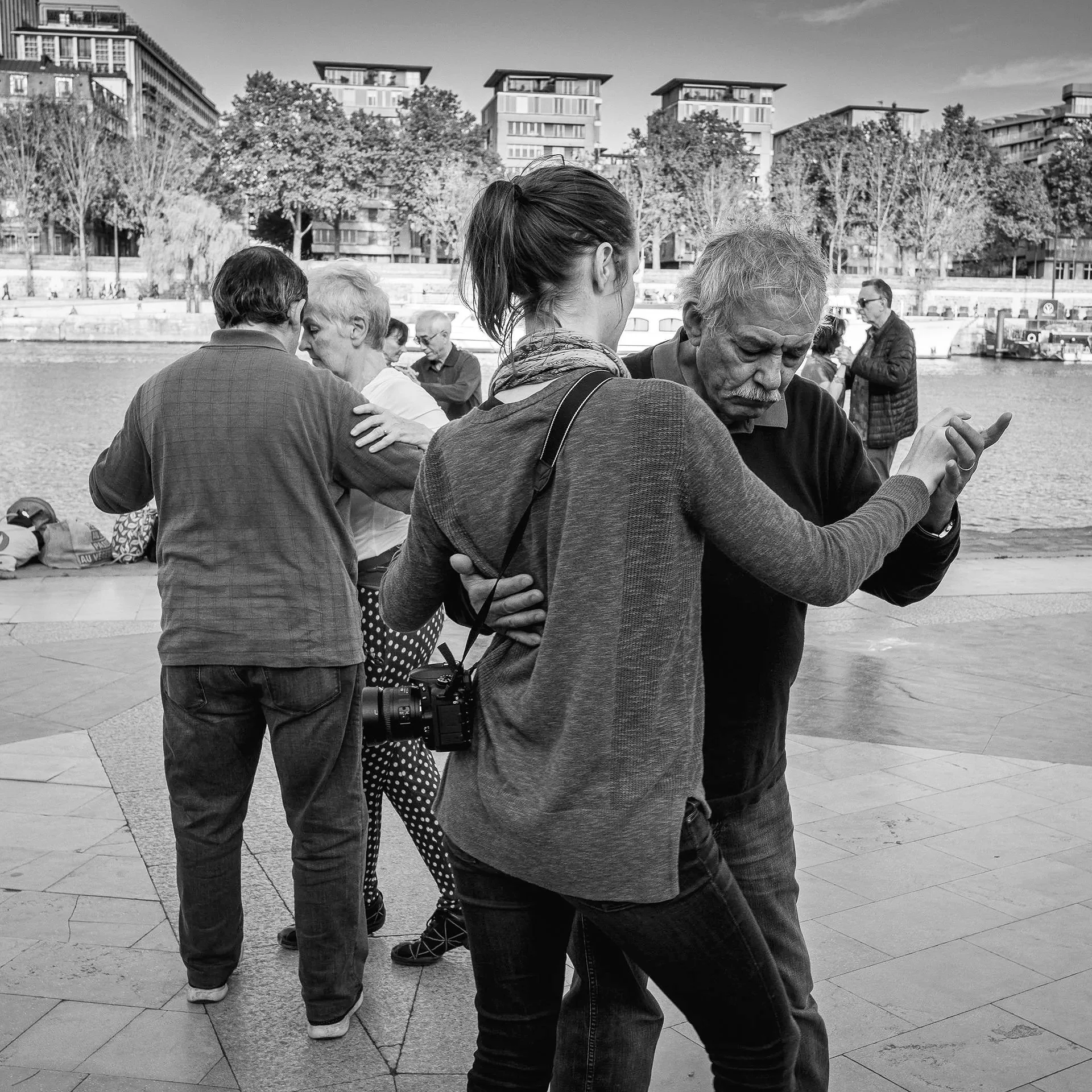
Where the River Teaches Us to Listen
© 2026 Jean-François Cléroux | Paris, France
A gentle reciprocity shapes this frame — pairs of dancers gathered at the river’s edge, each moving within their own small orbit while sharing the Seine's larger rhythm. What I love here is the balance between intimacy and openness: the closeness of the bodies, the looseness of the space, the way the city seems to pause long enough for these gestures to unfold. The photograph doesn’t announce itself; it breathes. It reminds me that presence is often found in the quiet, communal moments where people move together without spectacle, simply because the day allows it.
4. Pranayama — Breath as a Way of Seeing
Breath changes the tempo of attention.
Breath is the metronome of my walk. When I breathe slowly, I notice more. When my breath is shallow, I skim the surface of the world.
Breath creates a small interval between seeing and taking. In that interval, a composition can clarify. A gesture may finish. Someone can leave the frame.
Photography practice:
Take three slow breaths before lifting the camera.
Match your steps to your breath; let rhythm steady your eye.
Try a ten‑minute walk where every photograph is taken on the exhale.
Notice how breath changes timing.
To photograph rhythm, we must first become sensitive to rhythm.
5. Pratyahara — The Art of Selective Attention
Withdraw from noise, not from the world.
Pratyahara is often described as withdrawal of the senses, but in photography it feels more like freeing them from compulsion. The task is not to become numb to the street, but to stop being pulled by every bright surface, every notification, every possibility of a picture.
This is selective listening. We let the loudest things recede so quieter relationships can appear: the pause between two people, the echo of one colour across a block, the small shift in posture that changes the emotional weather of a scene.
A project can be one of the most powerful forms of Pratyahara. When we work inside a project, or theme, our attention is already tuned. We’re not scanning for everything; we’re listening for something. The project becomes a gentle filter — a way of letting the irrelevant fall away so the meaningful can rise. It steadies the eye, quiets the mind, and gives the day a centre.
Photography practice:
Turn off image review for an hour; stay with the world instead of retreating into the last frame.
Spend twenty minutes photographing only shadows or negative space.
Train your eye to follow one element — hands, reflections, colour — and ignore everything else.
Let restraint refine perception.
Work inside a project for a full walk. Notice how the project itself becomes a form of selective attention.
6. Dharana — The Photographer’s Focus
Concentration holds the frame open.
Dharana gathers attention around a single point. It does not narrow photography into tunnel vision; it gives attention enough continuity for a place to reveal more than its first impression.
Choose one corner and stay. Choose one quality of light and follow it. Choose one question — how people protect their solitude in public, how shadows divide a pavement — and let the question organise your seeing.
Photography practice:
Commit to one place for thirty minutes.
Set a timer and refuse to move more than a step.
Photograph one subject for an hour, making small variations.
Let constraint deepen attention.
The first glance recognises a subject. Sustained attention begins to understand a relationship.
7. Dhyana — The Flow of the Walk
Attention begins to flow.
Dhyana is meditation — not a single act of concentration, but a continuous current of awareness. In photography, it resembles those rare periods when technique becomes quiet. Seeing, moving, waiting, and framing begin to belong to one gesture.
This state cannot be commanded. It is prepared for. Ethics makes our presence gentler. Discipline brings us out. Posture steadies us. Breath regulates our pace. Sensory restraint protects our attention. Concentration gives it continuity.
Then, sometimes, effort softens.
Photography practice:
Walk without a destination; let curiosity lead.
Shoot without reviewing; let the walk be the work.
Practise a weekly “no‑review” walk.
Let attention become a single gesture.
Meditation does not guarantee a successful frame. It offers something more important: a way of working in which attention itself becomes part of the meaning.
8. Samadhi — Union with the Moment
The photograph is no longer something you take.
Samadhi is absorption — the rare moment when observer and observed briefly soften into one arrangement of light, gesture, distance, and time. We do not disappear, and our responsibility does not disappear with us. But the anxious self who wants to secure, prove, and possess the photograph becomes quieter.
The resulting image can feel less like something taken and more like something received.
Photography practice:
Cultivate conditions: ethics, breath, posture, patience.
When a moment arrives with clarity, pause. Let it breathe.
Keep a journal of those rare frames; study the conditions that preceded them.
Let Samadhi return you to the beginning: relationship, conduct, presence.
The deepest photographs do not announce mastery. They carry the trace of a meeting.
Closing Invitation
Yoga and photography meet in their devotion to attention. Both ask us to notice the restless movement of the mind. Both return us to the body. Both reveal how easily desire can disguise itself as vision.
The eight limbs do not promise better photographs. They offer a richer practice — one in which conduct matters as much as composition, breath as much as timing, surrender as much as control.
When I walk with a camera, I am not trying to escape the world or conquer it. I am trying to enter it more fully — to become quiet enough to recognise the subtle choreography already underway. A person steps into a seam of light. Two shadows touch before the bodies do. A gesture rises and vanishes. The city writes, erases, and writes again.
We cannot hold these moments. The camera cannot keep them from passing. It can only make a small vessel for the attention we gave them.
If you want to deepen your photography, begin before the shutter. Notice how you arrive. Let the body settle. Let the breath lengthen. Choose one thing worthy of your full attention, then stay long enough for looking to become listening.
The street does not need to be conquered. It is already speaking. Our practice is to become available to its quieter voice.
Coming Up in The Flâneur’s Journal
Next week, we’ll step into a different kind of presence — the presence that emerges not in a single walk, but across the long arc of a photographic project. We’ll explore that subtle moment when the fog begins to thin, when coherence starts to gather, and when the work quietly reveals what it has been becoming all along.
In Chapter 6: When a Project Begins to Clarify, I’ll share how projects deepen through repetition, patience, and the slow accumulation of attention. We’ll look at the emotional centre that begins to form, the patterns that return again and again, and the gentle requests a project makes as it starts to find its own internal logic.
More is unfolding just ahead — a deeper conversation about intention, coherence, and the lived architecture of long‑form work.