When a Project Begins to Clarify
The Architecture of a Photographic Project — Chapter 6
Every project reaches a moment when the fog begins to thin.
Not lift — never quite that. But thin enough to recognise the terrain you have been walking. Thin enough to feel the emotional centre that has been gathering quietly beneath your attention. Thin enough to sense, for the first time, that the work understands something you are only beginning to.
This is the moment when a project begins to clarify.
It does not arrive as an idea. Not as a theme, not as a thesis, not as a sentence you can say aloud with confidence. It arrives the way morning arrives on a street you have walked a hundred times — gradually, then all at once. The same buildings. The same light. And yet you are seeing them differently, because you have finally been looking long enough.
I have come to trust this moment completely. And I have learned not to rush past it.
Clarification in a photographic project is not an intellectual event. It is an experiential one. It arrives through repetition, through patience, through the slow accumulation of presence.
This chapter is about recognising that clarification when it comes — trusting it, and learning to work with it without closing the project too soon.
The Slow Emergence of Coherence
Coherence does not appear suddenly. It emerges slowly, almost shyly, through the patterns you have been noticing, the clusters you have been gathering, the emotional threads that have been quietly strengthening beneath your seeing.
I remember spreading a winter of contact sheets across my table in Vancouver — months of walking, hundreds of frames — and feeling, for the first time, a single mood rising off the paper like breath. I had not planned it. I had not pursued it. It had been there all along, waiting for me to notice.
You may begin to feel it too:
A mood that holds the work together.
A way of seeing that feels unmistakably yours.
A rhythm in the images — a pulse, a cadence, a kind of breath.
A sense of direction, even if you cannot yet articulate it.
This coherence is not something you create. It is something you recognise.
It is the project revealing its internal logic — the way the images relate to one another, the way the emotional centre holds steady, the way the work begins to feel like a single conversation rather than a collection of moments.
Your work, in this phase, is simply to notice. To stay close. To resist the urge to name it too soon.
Understanding What the Project Is Asking For
As coherence strengthens, the project begins to ask for more specific things.
Not instructions. Not demands. Subtle shifts in your attention — invitations, really, arriving in the body before they arrive in the mind.
You may feel the project asking you to:
Return to a particular street, a particular corner, a particular hour of light.
Stay longer with a mood you have only brushed against.
Follow a recurring gesture — a hand, a hesitation, a way of turning away.
Remain with a tension you have been quietly avoiding.
Move closer — or step further back.
These requests are not conceptual. They are embodied. They arise from the work itself, from the emotional centre that has begun to clarify.
Listening to them is part of the discipline of long-form work. They guide your seeing without narrowing it. I often photograph from the hip, the camera present but unobtrusive, and I have noticed that my body learns these requests before my mind does — my feet slow on a certain block, my attention lingers where it once hurried past.
Trust that. The project is teaching you how to see it.
Letting Go of What No Longer Belongs
As a project clarifies, some images that once felt central will begin to drift.
They may feel louder than the others now. They may carry a tone that no longer fits. They may belong to an earlier version of the project — a version that has since deepened, the way a river deepens past its first banks.
Letting go is part of the process.
This does not mean deleting images or abandoning ideas. It means recognising that the project has shifted — that its emotional centre has grown more specific, more grounded, more honest.
Images that no longer belong may:
Move into a different project, where they are suddenly central again.
Rest in your archive, held for a future you cannot yet see.
Return later, when the work evolves and calls them back.
Or simply remain as part of your practice — true photographs that were never meant for this particular conversation.
Letting go is not loss. It is refinement.
It is the project clarifying itself through what it keeps — and what it gently releases.
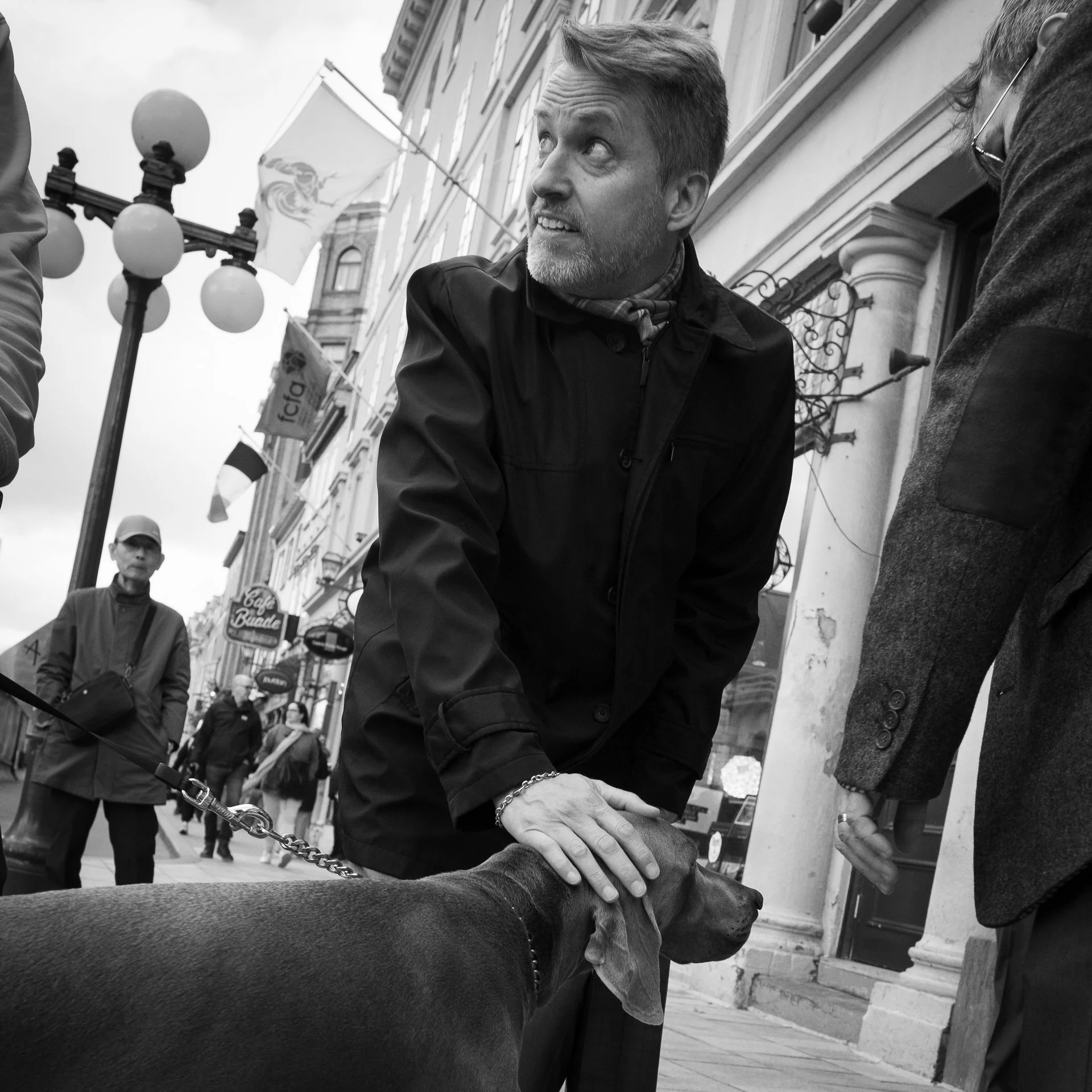
The Interruption
© 2026 Jean-François Cléroux | Quebec City, Quebec, Canada
A man bends to a great Dane on a grand old European boulevard, one hand resting on the dog's head — and mid-pat, something off-frame catches his eye. His eyebrows lift, his mouth opens mid-thought, and the whole picture pivots on that upward glance. The dog, gloriously unbothered, stays exactly where it is. Behind them: globe lampposts, old facades, hanging signs, and a capped onlooker watching the whole small theatre unfold. A half-figure at the right edge leans in, giving the frame its near layer.
The man's expression is the raison d'être of the photograph — that split-second between the dog and the distraction is pure Street Photography, the decisive moment wearing everyday clothes. The dog's calm is the perfect counterweight; without it, the glance would be just a glance. The layering is strong: foreground fragment, midground pair, background witness. My gentle notes: the right-edge figure merges a little with the column behind it, and the bright lamppost globes top-left compete faintly with the face for the eye's first landing. But the tonal range is rich, the gesture is honest, and nobody's dignity is disturbed — man or dog. A keeper.
The Deepening of Intention
Intention does not arrive through planning. It arrives through recognition — through understanding what the work is becoming, and responding to it with care.
In these middle stages, intention begins to deepen. You start making photographs with a quiet awareness of the project's emotional centre. You begin to understand what the work needs — more of this, less of that, a return to this place, a deeper exploration of that mood.
Intention is not control. Intention is alignment.
It is the moment when your seeing and the project's direction begin to move together — not perfectly, not predictably, but with a shared sense of purpose.
I think of it as devotion rather than direction. You are no longer searching for the project. You are serving it.
Working With the Project’s Internal Logic
Every project has an internal logic — a way of organising itself that is not imposed by you, but revealed through the work.
This logic may appear through:
A recurring spatial relationship — how bodies sit in the frame, how the street holds them.
A consistent emotional temperature — the particular weather of the work.
A characteristic distance or proximity — how close you allow yourself to come.
A rhythm in the way people move through the frame.
The way light behaves in the places you keep returning to.
This internal logic is not a rule. It is a pattern — a quiet coherence that helps you understand what the project is becoming.
Working with it means trusting the patterns you see. Returning to the places that feel central. Making images that deepen the project's pulse. And allowing the work to contradict itself when necessary — a single discordant frame can sometimes reveal the rule by breaking it.
Internal logic is not about consistency. It is about honesty — the honesty of following what feels true in the work.
This, I believe, is the quiet discipline at the heart of Street Photography as I practise it: not imposing order upon the street, but recognising the order the street — and the work — has been offering all along.
The Clarifying Questions
As the project clarifies, the questions it asks become more specific. No longer the early, tentative questions. Deeper ones. More grounded. More insistent.
I find myself asking:
What is the emotional centre of this project?
What keeps returning, no matter how many times I look?
What feels essential — and what feels peripheral?
What is the project teaching me about my own seeing?
What does the work need next?
These questions are not meant to be answered. They are meant to orient you — to keep you close to where the project is gathering strength, close to what the work is becoming.
Questions clarify the work. Answers close it down.
Carry the questions. Let them walk with you.
Exercise: The Quiet Edit
45–60 minutes · your work laid out before you — prints, contact sheets, or a quiet hour with your files
This exercise is an act of listening, not of making. Clarification comes through recognition, so we begin with what is already there.
1. Lay the work out — 20 minutes of looking.
Spread your recent work before you. Do not rearrange anything yet. Simply look. Notice what repeats: a mood, a distance, an hour of day, a gesture. Let the work speak first.
2. Gather the pulse.
Set together seven to twelve images that seem to share one breath — the frames that hold the emotional centre of the project. You will feel this more than think it. Trust the feeling.
3. Honour what drifts.
Now notice what no longer belongs — the images that feel louder now, or earlier, or written in a different hand. Set them gently aside. For each one, note where it might live instead: another project, the archive, a later return. Nothing is discarded. Everything is honoured.
4. Write the provisional line — in pencil.
One sentence. This project feels like… Keep it simple. Keep it provisional. You are not defining the work; you are listening to it think aloud.
5. Carry one question.
Choose one clarifying question from the list above. Carry it into your next week of photographing. Do not answer it. Let it walk with you, the way a good companion walks beside you — quietly changing how you see.
Closing Gesture
Clarification is not the end of a project. It is the deepening — the moment when the work begins to reveal its internal logic, its emotional centre, its quiet coherence. The moment when your seeing aligns with the project's direction. When intention becomes devotion. When the work begins to ask more of you — and you find you are ready to give it.
Nothing is final. Nothing is fixed.
But something in the project is becoming clear. Stay close to it. Stay close to what is gathering strength. Stay close to the project's pulse.
A project clarifies through attention. And you are already attentive.
Coming Up in The Flâneur’s Journal
Next week, we step briefly outside the series for a standalone reflection — Learning from Others: The Workshop as a Creative Compass — a flâneur's reflections on curiosity, courage, and the craft of learning. It begins on an ordinary evening in Vancouver in 2012, when a three-hour street photography workshop quietly redirected my entire path — and traces the teachers who have shaped my practice since, from Ian MacDonald to Valérie Jardin, from Bruce Gilden to the week ahead with Peter Turnley.
In two weeks, we return to The Architecture of a Photographic Project with Chapter 7: The First Meaningful Shape — the moment when a project begins to gather into its first provisional form. We will explore how images begin to hold each other, how the first edit is an act of recognition rather than reduction, how to recognise the project's spine, and how to give the work gentle structure — scaffolding, not walls — without closing it down too soon.
Until then, keep your camera close and your attention closer. Go out and walk. Make a few quiet frames. The street is always offering — our work is simply to be there when it does. I will see you next week.