Studying the Work That Shapes You
The Evolving Photographer - Part III on Creative Growth and the Art of Seeing
In Part II, we stepped back to explore the wider landscape of street photography — the many visual languages, traditions, and stylistic lineages that surround our practice. By seeing the field more clearly, you began to understand where your own instincts sit within that spectrum, and where they might be ready to stretch. Now, in Part III, we turn our attention to the photographers who truly shape us. This chapter is about studying influence with depth and intention — not to imitate, but to understand. By looking closely at the work that moves you, you begin to recognise the choices, rhythms, and sensibilities that resonate with your own emerging voice. This is where influence becomes evolution.
Some Ways to Deepen Your Study and Sharpen Your Vision
Most photographers study the work of others in a passive way: they scroll, they admire, they save images to a folder, they feel a spark of inspiration — and then they move on. There’s nothing wrong with that, but it rarely leads to real growth. Inspiration is fleeting. Transformation requires intention.
In my earlier posts — A Living Library of Inspiration and A Working Catalogue of Street Photography Styles — I asked you to name the photographers who shape your seeing and to map the styles that surround your work. Knowing who to study and what to study is only half the equation. The other half is learning how to study.
Studying photographers is not imitation. It is a disciplined form of attention: a way to see more clearly, more deeply, and more honestly. It reveals the visual instincts that shape your work and the blind spots that hold you back. When done well, study becomes creative self‑inquiry.
Below are nine practical ways to deepen your study and sharpen your vision.
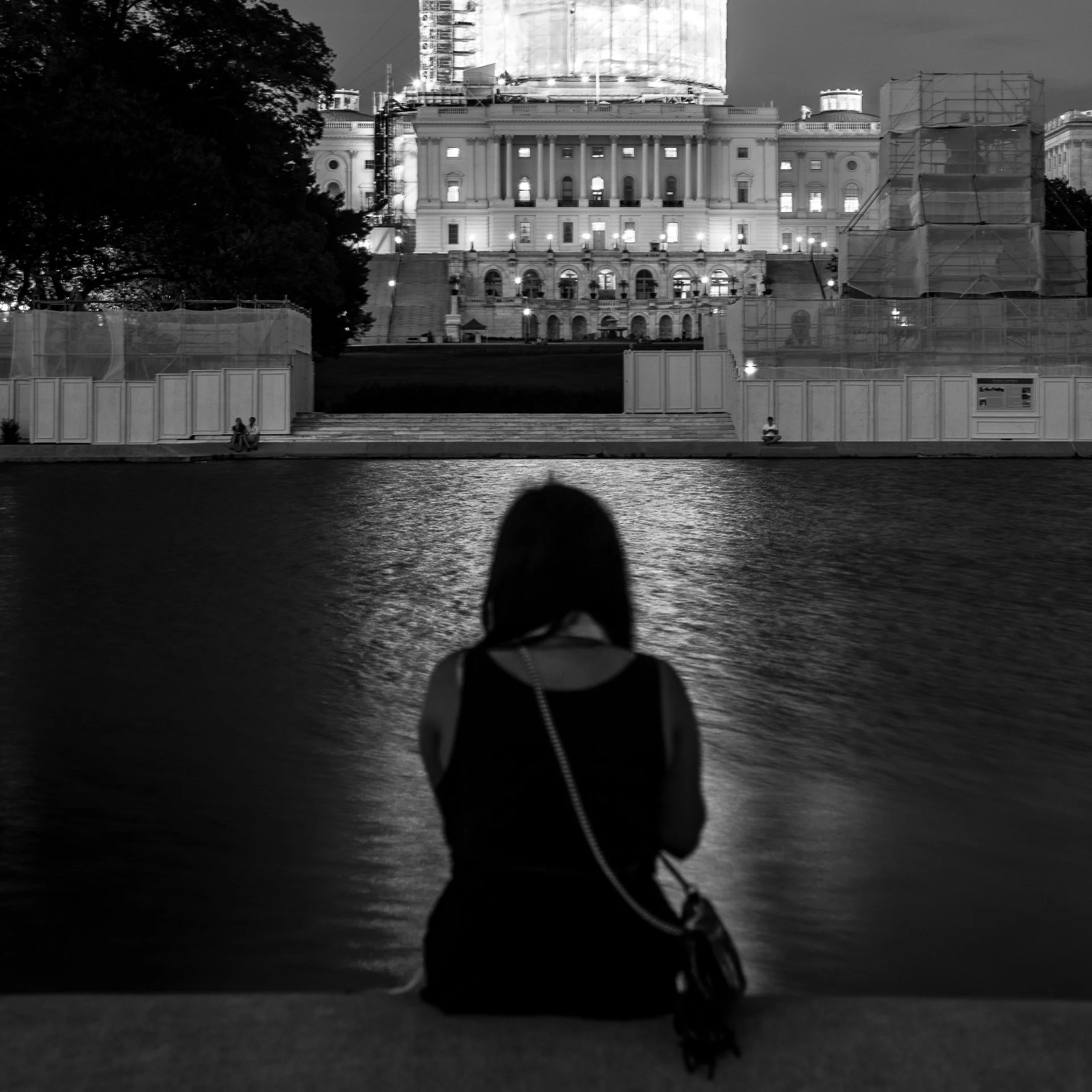
Stillness Before the Monument
© Jean-Francois Cleroux | Washington, DC, USA
A lone figure sits at the edge of the reflecting pool, held in the hush between night and illumination. Across the water, the great domed building rises — half shrouded in scaffolding, half glowing with its own quiet certainty. Its reflection trembles on the surface, a soft echo of light and architecture drifting toward the viewer.
The scene feels suspended, as if the city has paused to breathe. The scaffolding suggests a structure in transition, yet the person watching it brings a sense of calm, a human scale to the monumental. Light pools, shadows gather, and the water becomes a page where the night writes its own slow poem.
It is a moment of contemplation — a private stillness set against the vast machinery of a nation — where the viewer is invited to linger, to listen, and to feel the quiet weight of presence.
Nine ways to deepen your study and sharpen your vision.
1. Start With Your Three (and Your Fourth)
In A Living Library of Inspiration, I invited you to identify the three photographers whose work most reflects your own instincts. In A Working Catalogue of Street Photography Styles, I expanded that idea into a creative exercise: choose the three styles that feel closest to your work — and a fourth style that represents your growth edge.
These choices matter. They give you a map.
Your three photographers and three styles show you who you are now. Your fourth shows you who you’re becoming.
When you study photographers through this lens, you’re no longer wandering aimlessly through an endless sea of images. You’re studying with purpose — with a sense of direction, curiosity, and self‑awareness.
2. Slow Down and Study With Intention
Don’t scroll. Don’t skim. Don’t rush.
Choose one photographer from your list and spend real time with their work. Sit with a book, a website, or a gallery of images and look slowly.
A powerful exercise: Print 10–15 of your favourite images of theirs and lay them out on a table. Group the ones that speak to you most, and set the outliers aside. Then ask:
What do these favourites share?
What draws me in — and why?
What’s missing from the images that don’t move me as much?
Let those differences help guide you.
Notice:
how they use light
how do they organise the frame
where they stand
what is their relationship to distance
what is the emotional temperature of their images
what they wait for
what they ignore
what they return to again and again
Ask yourself: What does this photographer see that I don’t? What do they value? What do they allow into the frame — and what do they leave out?
This is where transformation begins.
3. Study the Work, Not the Myth
Every great photographer carries a mythology — the stories, the quotes, the persona that grows around their work. Reading about their life, their process, and their techniques can be valuable; it gives context, reveals intention, and helps you understand the conditions in which their images were made.
But when it comes to learning style, the images themselves are the real teacher.
Look at the contact sheets if they exist. Look at the outtakes. Look at the quieter frames. Look at the work that never made it into books or exhibitions. That’s where you begin to see how they think, how they move, how they choose.
The myth is interesting. The techniques are useful. But the work — the images — is where their visual logic lives.
4. Identify the Photographer’s Visual Logic
Every photographer has a visual logic — a set of unconscious preferences that tend to guide their decisions. You can learn to see it.
Ask yourself questions such as:
Do they favour symmetry or asymmetry?
Do they shoot into the light or with it?
Do they prefer chaos or clarity?
Do they wait for gestures or for stillness?
Do they build layers or isolate subjects?
Do they embrace imperfection or refine every frame?
Once you understand their logic, you can compare it to your own. This is where you begin to see your strengths — and your blind spots.
5. Reverse‑Engineer Their Decisions
Choose a single image and ask:
Why this moment?
Why this distance?
Why this composition?
Why this colour palette or this contrast?
Why this shutter speed?
Why this subject and not the one beside it?
You’re not trying to replicate the image. You’re trying to understand the thinking behind it — the chain of decisions that shaped the frame.
This is how you learn to make stronger decisions in your own work.
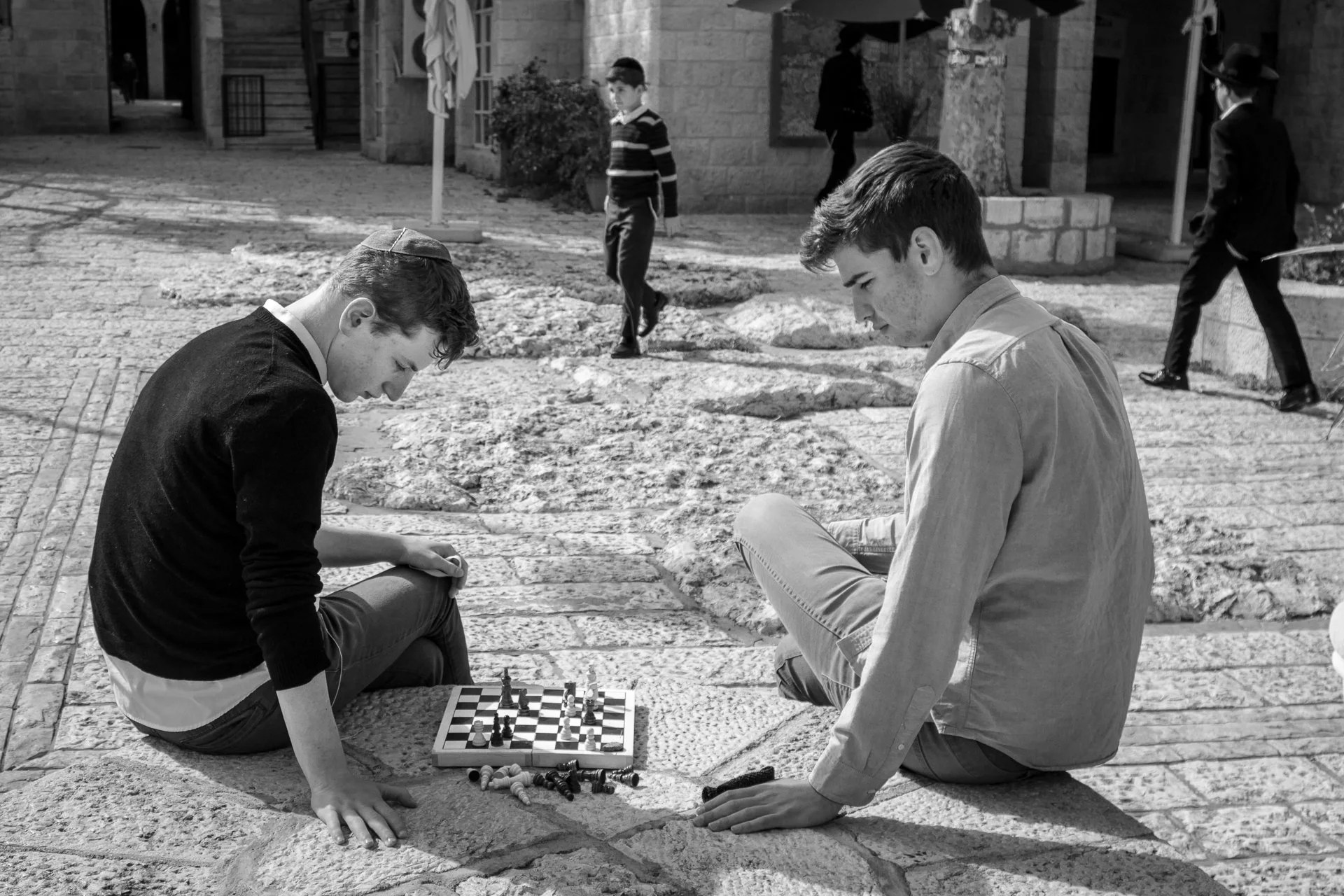
End Game in the Afternoon Light
© Jean-Francois Cleroux | Jerusalem, Israel
Two players sit low on the warm stone pavement, absorbed in the final movements of a long, thoughtful game. The chessboard rests between them like a small stage, its scattered pieces marking the quiet tension of an ending soon to arrive. Around them, the courtyard breathes with soft movement — a child passing through, a figure drifting by — life continuing at its own unhurried pace.
In the frame, three subjects form a subtle but powerful triangle: the player on the left, the player on the right, and the child walking behind them. This triangle anchors the composition, creating a dialogue between focus and distraction, stillness and motion, concentration and innocence. The geometry gives the scene its quiet strength — a balance of presence, gesture, and human connection.
The black‑and‑white tones deepen the textures of the stones, the worn board, the fallen pieces. Afternoon light softens the edges, turning the courtyard into a small theatre of thought and companionship. It is a moment of strategy and reflection, but also of shared humanity — a simple game unfolding in the open air, held gently by the rhythm of the street.
6. Study Your Fourth Style With Curiosity, Not Pressure
Your fourth style — the one you want to grow into — is where the real transformation happens.
If you’re a minimalist, study the complexity of Alex Webb. If you’re a colourist, study the graphic tension of Fan Ho. If you’re a documentary purist, study the abstraction of Moriyama. If you’re a formalist, study the humour of Erwitt. If you’re a photographer learning to slow down, study the presence in my work.
Creative Principle: Choose the Photographer Who Stretches You
The goal isn’t to study the opposite of your style — it’s to study the photographer who expands your instincts. Choose the one whose work challenges your habits, unsettles your assumptions, and opens a door you haven’t yet walked through. Let the unfamiliar challenge you. Let it unsettle you. Let it stretch your instincts.
Growth happens at the edges of your comfort zone.
7. Apply What You Learn — Gently
Don’t force yourself to “shoot like” someone else. Instead, let their influence seep into your work naturally.
Try things that might bring your work a little more inline with images you like:
standing a little closer
waiting a little longer
embracing a different kind of light
experimenting with colour or shadow
allowing more chaos — or more restraint
exploring a new rhythm or mood
Small shifts accumulate. Over time, they reshape your way of seeing.
8. Return to Your Own Work With New Eyes
After studying others, come back to your own images. You’ll see things you didn’t see before:
patterns
habits
strengths
weaknesses
missed opportunities
emerging themes
This is the moment when inspiration becomes transformation.
You begin to understand not only what you’re doing — but why.
9. Let Your Influences Evolve
Your list of photographers will change. Your three styles will shift. Your fourth style will move as you grow.
This is a sign of progress.
An evolving library of inspiration is just that — evolving. A working catalogue of styles is just that — working.
Your influences are not fixed. They are companions on a journey.
Study as a Path to Seeing
Studying photographers is not about imitation or aspiration. It’s about learning to see more deeply — to understand the visual language of the medium and your place within it. When you study with intention, you begin to recognize the threads that connect your work to the larger history of photography, and the threads that pull you toward your future.
Let your influences guide you, challenge you, and expand you. Let your curiosity lead you into unfamiliar territory. Let your study become a practice — a way of sharpening your eye and clarifying your voice.
And above all, remember this:
The goal is not to become someone else.
The goal is to become more fully yourself.
Coming Up in The Flâneur’s Journal
As we close this chapter of The Evolving Street Photographer, I hope something here nudged your practice a little — a new question, a clearer instinct, a shift in how you look at the work of others. Study is not a passive act; it’s a quiet discipline, a way of tuning your eye to the deeper currents beneath your own images. The more intentionally you engage with these exercises, the more your visual voice begins to take shape.
Next week, we’ll step into The Courage to Look: On Fear in Street Photography — an exploration of vulnerability, presence, and the subtle human tensions that rise the moment we turn the camera toward the world.
And two weeks from now, we’ll continue this series with Part IV: Recognising Your Own Tendencies — a deep dive into the unconscious rules that guide your seeing and the patterns that quietly shape every frame you make.
There’s more ahead — more questions, more clarity, more ways of understanding the photographer you’re becoming. Let your practice unfold at its own rhythm. Keep walking, keep noticing, and let your way of seeing deepen with each return to the street.