The Courage to Look: On Fear in Street Photography
A meditation on vulnerability, presence, and the quiet human tensions that rise when we aim a camera toward the world.
Fear in street photography rarely arrives as a single emotion. It comes as a cluster of social, psychological, ethical, and personal tensions that surface the moment we raise the camera. Many photographers assume their fear is a private flaw, a lack of boldness, a sign they’re not built for this genre. But the truth is far more human. These fears are shared, patterned, and deeply rooted in how we navigate public life.
Street photography asks us to do something unusual: to pause in a world that prefers momentum, to look closely in a culture that rewards distraction, to pay attention in places where most people rush past — and then make the world keep that attention by recording it. That act alone — the courage to look and to hold what we see — stirs something ancient in us.
And I’ll be honest: I’ve lived through most of these fears myself. I’ve carried them, wrestled with them, and learned to move through them in the ways I describe below. Some return if I’ve been away from the streets for too long. Others reappear when I’m in a new city, or walking through a neighbourhood where the energy feels tense. And certainly, when I find myself in a rougher part of town, the old anxieties rise again.
In those moments, I remind myself why I do this work — why I walk, why I look, why I lift the camera at all. I remind myself that I love this practice, that it steadies me, that it teaches me how to be present in the world. A little quiet self‑talk, a gentle recalibration of intention, is often enough to settle the nerves and bring me back into the rhythm of seeing.
I laughed as I reread this post and thought — or perhaps hoped — that listing these fears won’t introduce new ones for you. If it does, know this: you will overcome those too. Fear is not a wall; it’s a doorway. And in all my years photographing in cities around the world, I’ve only had three people truly upset with me. Three. That’s it.
Far more often, the opposite happens. After the candid moment, when I approach someone to say hello or show them the image, I’ve met wonderful people and made unexpected friends. I’ve been offered coffee, shared lunches, and even received small gifts from vendor stalls. These moments of connection — these tiny, human exchanges — are the quiet rewards of the craft. They are far greater than any fear.
The Fear of Confrontation
For many, the first fear is confrontation: the imagined stranger who turns, frowns, demands an explanation. Even though genuine hostility is rare, the anticipation can be overwhelming. The body reacts as if to a social threat — heart rate rising, breath tightening, the old fight‑or‑flight circuitry flickering awake.
A quiet countermeasure is to remember this: most people are not thinking about you — they are thinking about themselves. The mind rehearses worst‑case scenarios, but the street rarely delivers them. A soft posture, an easy breath, a gentle nod, or simply moving on with calm intention often dissolves tension before it has a chance to form. Presence, when unforced, is disarming. And when a moment does carry friction, it is almost always brief, human, and far less dramatic than the imagination predicts.
There is much more to say about navigating confrontation — the psychology of it, the body language that softens it, the quiet strategies that turn potential conflict into simple human exchange. We’ll explore those subtleties in a future post, because there are many ways to meet tension on the street without losing your centre.
The Fear of Being Judged
Then comes the fear of being judged — the quiet self‑consciousness of standing alone with a camera while the world rushes past. Street photography places us in a visibly unusual role: the one who stops, who looks, who pays attention. In a culture built on speed and distraction, the simple act of pausing can feel like a small act of rebellion. And rebellion, even in its softest form, can make us feel exposed.
Many photographers feel watched even when no one is watching. We imagine eyes on us, assessing, questioning, wondering what we’re doing. But this sensation often has little to do with the street itself. It comes from the internal spotlight we turn on ourselves — a kind of self‑monitoring that grows louder the moment we step outside the flow of ordinary behaviour.
This fear is deeply human. We are social creatures, wired to belong, to blend, to avoid drawing unnecessary attention. Street photography asks us to do the opposite: to stand still, to observe, to linger in moments others pass through without noticing. That shift — from participant to witness — can feel like stepping onto a small stage we never asked for.
A helpful reframe: You are not performing. You are observing. The moment you stop trying to “look like a photographer,” you begin to move like one — quietly, naturally, without apology.
The Fear of Intruding on Personal Space
A quieter fear sits beneath these: the fear of intruding. Street photography often requires proximity — physical, emotional, ethical. Getting close can feel like crossing an invisible boundary, even when the law says you are allowed to be there.
This fear is not a weakness; it is empathy. A simple countermeasure is to let your presence be gentle. Move slowly. Breathe. Let people feel your humanity before they feel your camera. When your intention is respectful, your proximity becomes less of an intrusion and more of a shared moment.
The Fear of Crossing a Legal Boundary
Public space is not always straightforward. What looks open and accessible may, in fact, be privately owned. Plazas, transit hubs, shopping districts, and even certain sidewalks can fall under private jurisdiction, each with its own rules, its own signage, its own interpretation of what is “allowed.” Add to this the presence of security guards, inconsistent enforcement, and the general public’s misunderstanding of photography laws, and it’s no wonder many photographers worry about being stopped or questioned.
This fear is not unfounded. Laws around photographing people in public vary widely from place to place. In most of North America, including British Columbia, photographing people in public is generally permitted. But Québec and France, for example, have specific privacy and personality‑rights laws that restrict the publication — and in some cases even the capture — of identifiable individuals without consent. These regional differences create a layer of uncertainty that can make even experienced photographers hesitate.
A quiet countermeasure is simple but powerful: know the basics of the law where you are, and let that knowledge steady you. You don’t need to memorize every statute, but a clear understanding of your rights — and your responsibilities — can dissolve much of the ambient anxiety. Legal clarity doesn’t eliminate fear, but it gives you a grounded place to stand.
And of course, legality is only one part of the equation. Ethics, personal boundaries, and cultural sensitivity all shape how we move through public space with a camera. The legalities of street photography deserve their own careful exploration, and we’ll return to them in a future post — because understanding the law is not about finding loopholes, but about creating a foundation for a practice that is both confident and respectful.
The Fear of Ethical Wrongdoing
Beyond legality there are ethical concerns - the fear of breaching the set of moral principles or standards that differentiate right from wrong, and as a result risk causing actual harm. Photographers worry about exploiting vulnerable individuals, misrepresenting someone’s story, or causing unintended consequences through publication. This fear is not abstract; it lives in the body. It appears as hesitation, a tightening in the chest, a quiet voice asking, “Do I have the right to make this image?”
Street photography is built on the tension between what is allowed and what feels right. You can be legally permitted to photograph someone and still feel morally uncertain. You can be standing in a public space and still sense that the moment unfolding in front of you carries a kind of emotional privacy. Ethical discomfort often arises not from the act of photographing, but from the awareness that a photograph has power — to reveal, to distort, to freeze a person in a single frame that may not reflect the fullness of their humanity.
This fear is especially present when photographing children, unhoused individuals, or people in moments of distress. It is a sign of empathy, not weakness. It means you are paying attention not only to the scene but to the person within it. It means you understand that a camera is not neutral — it shapes the story it tells.
This fear is a sign of integrity. The countermeasure is not to avoid photographing difficult subjects, but to cultivate an ethical framework that feels true to you. Ask yourself: Does this image honour the person? Does it tell the truth? Does it respect their dignity? When your ethics are clear, your fear softens.
The Fear of Looking Foolish
Another familiar fear is the fear of looking foolish — standing still while life keeps moving, fumbling with settings, appearing awkward or suspicious.
A gentle reminder: Everyone looks foolish sometimes. Only some of us are making art while doing it. The street rewards sincerity, not performance. The more you embrace your awkwardness, the more it dissolves.
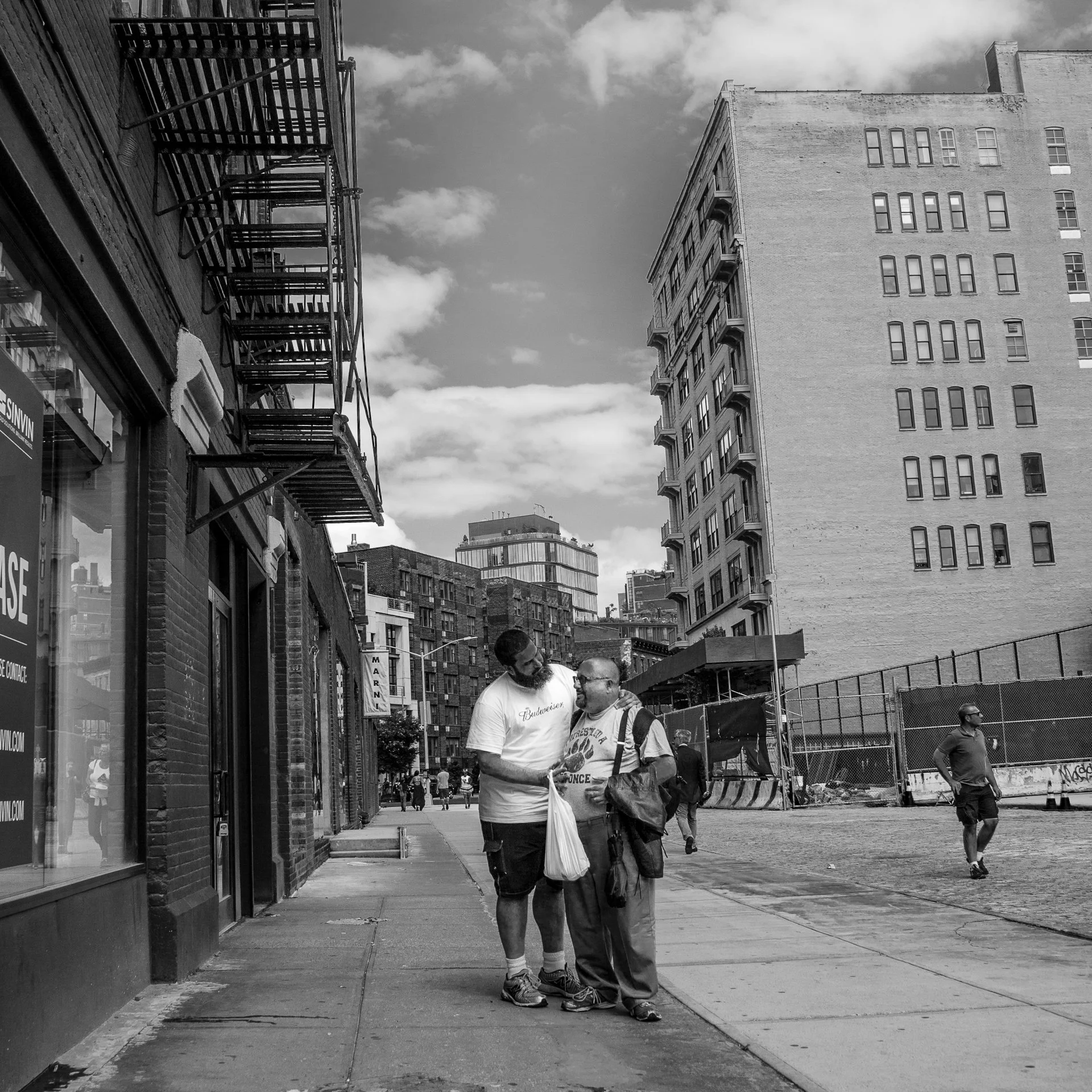
A Moment Held Gently
© Jean-Francois Cleroux | NYC, New York, USA
There’s a quiet tenderness in this frame — two figures leaning toward one another in a way that softens the hard geometry of the city around them. The buildings rise in strict verticals, but the human moment curves gently against that structure, creating a small pocket of stillness in the flow of urban life.
This composition gives them room to breathe. The sidewalk draws the eye toward the pair, and the open space around them amplifies the intimacy of their exchange. Even the stillness of the background — no hurried bodies, no competing gestures — seems to honour the moment, as if the city itself has stepped back to let something gentle unfold.
It’s a simple scene, but it lingers. A reminder that even in the busiest places, connection can carve out its own quiet clearing.
The Fear of Missing the Moment
Then there is the fear of missing the moment — hesitating, fumbling, freezing. Street photography rewards decisiveness, and many photographers fear technical failure: the missed focus, the wrong exposure, the shutter pressed a heartbeat too late. This fear carries its own particular sting because it feels like a failure of instinct, as if the moment slipped through your fingers not because it wasn’t there, but because you weren’t ready.
What makes this fear so potent is its immediacy. The street does not wait. A gesture lasts a fraction of a second; a glance dissolves as quickly as it appears. The pressure to respond quickly can create a kind of internal static — a tightening that makes the hands clumsy and the mind slow. Ironically, the desire to get everything right often guarantees getting nothing at all. Perfectionism becomes its own form of hesitation.
A paradox emerges: The desire to get everything right guarantees getting nothing at all. The countermeasure is to shift the focus from perfection to presence. Familiarity with your camera frees your attention. The more you shoot, the more your hands learn to move before your mind has time to doubt.
The Fear of Being Seen
Perhaps the most intimate fear is the fear of being seen — not just as a photographer, but as a person who is paying attention. Presence makes us visible. For some, this touches deeper questions of identity, confidence, and belonging.
A philosophical countermeasure: To see the world clearly, you must allow the world to see you a little too. This is the quiet courage at the heart of street photography.
The Fear Shaped by Past Experience
Some photographers carry fears shaped by real encounters — a hostile moment, a security intervention, a public shaming. These experiences imprint strongly, often far more deeply than we admit. The body remembers what the mind tries to rationalize. A single sharp exchange can echo for years, resurfacing every time the camera rises. And these encounters are not experienced equally. Race, gender, age, and cultural context all shape how safe a photographer feels in public space. What feels like a minor inconvenience to one person may feel like a genuine threat to another.
These memories settle into the nervous system. They create anticipatory tension — a subtle tightening in the shoulders, a quicker heartbeat, a readiness to retreat before anything has even happened. The street becomes a place of potential repetition rather than possibility. Fear, in this sense, is not imagined; it is remembered.
A gentle countermeasure is to return slowly. Choose familiar streets. Photograph from a distance until your body remembers ease. Bring a friend. Shoot at times of day when the city feels softer. Confidence is not rebuilt through force; it is rebuilt through care. Over time, the new experiences — the quiet walks, the uneventful afternoons, the small moments of connection — begin to outweigh the old ones. The nervous system recalibrates. The street becomes spacious again.
The Fear of Intention
And finally, there is the fear of intention — the quiet, existential uncertainty beneath the craft. Why this person? Why this moment? Why me? These questions don’t arrive loudly. They surface in the small pause before the shutter, in the subtle hesitation that feels less like fear and more like doubt. Without clarity of intention, fear expands. With intention, fear often softens.
Street photography is not only about seeing; it is about choosing. And choosing can feel vulnerable. Every photograph is, in some way, a declaration of what matters to you — what draws your eye, what stirs your curiosity, what you believe is worth holding still. That kind of self‑revelation can feel riskier than any confrontation on the street.
Many photographers worry that their intentions are unclear, or worse, unjustified. They fear being intrusive, exploitative, or simply presumptuous. They fear that their presence might alter the moment, or that their interest might be misinterpreted. Beneath all of this lies a deeper question: What right do I have to witness this?
A gentle countermeasure is to shift the inquiry from justification to curiosity. Instead of asking, “Do I have the right?” ask, “What draws me to this scene?” Not the technical answer — the human one. Is it the light? The gesture? The tenderness? The tension? The fleeting alignment of strangers who will never stand together again?
When you understand what pulls you toward a moment, the act of photographing becomes less about taking and more about honouring. Intention becomes a compass, not a burden. It guides your choices, clarifies your boundaries, and steadies your presence.
And yes — having a purpose, a theme, or a project can help enormously. Not because it gives you permission, but because it gives you direction. A project creates a frame around your attention. It turns the street from an overwhelming field of possibilities into a landscape of meaningful encounters. When you know what you’re looking for — even loosely — the question “Why me?” becomes “Because this is part of the story I’m learning to tell.”
Projects don’t have to be grand or formal. They can be as simple as:
the way light falls on faces at dusk
the choreography of hands in public space
the quiet moments of waiting
the architecture of loneliness
the small rituals of daily life
A project is not a cage; it is a lens. It narrows the noise and amplifies the signal. It gives you a reason to raise the camera — and reasons, even soft ones, are powerful antidotes to hesitation.
Over time, intention becomes less of a question and more of a presence — something felt rather than forced. And when intention becomes clear, the street begins to welcome you back. You move with purpose, not performance. You photograph with sensitivity, not hesitation. Fear doesn’t disappear, but it loses its authority. It becomes a companion rather than a barrier — a reminder that you are doing something that matters to you.
The Fear of Failure
There is also the fear of failure — a quieter, more private fear that rarely gets named, yet shapes so much of how we move through the streets. It’s the fear that we won’t make a good photograph today. That we’ll walk for hours and come home with nothing. That whatever spark we once had has thinned, or vanished, or was never really ours to begin with. Every photographer I know carries some version of this, even the ones who pretend they don’t. Failure in street photography is intimate; it’s not just the missed shot, it’s the doubt that follows you home.
And yet, failure is not the enemy we imagine it to be. In any creative life, failure isn’t a detour — it’s part of the path, and embracing it is how the work deepens. The uncertainty is built into the practice. You can do everything “right” — show up, stay open, pay attention — and still return with empty hands. The world doesn’t owe us a photograph. Some days it reveals itself; other days it stays closed. The work is to keep walking anyway.
Over time, I’ve learned that failure in street photography is rarely a failure of skill. It’s a failure of expectation — the belief that every outing must produce something worthy. When I let go of that, when I allow myself to wander without the pressure to succeed, the images return. Not always immediately, not always dramatically, but steadily, quietly, in their own time. Failure becomes less of a threat and more of a teacher, reminding me that the practice is bigger than any single photograph.
A Closing Reflection
Most fears in street photography are not technical. They are human fears — magnified by exposure, ethics, and visibility. They rise not because we lack skill, but because the act of looking closely asks something of us. It asks us to be present. It asks us to be vulnerable. It asks us to step into the world without the usual armour of anonymity.
Naming these fears clearly is often the first act of becoming a street photographer. Once named, they lose their shapelessness. They become specific, workable, familiar. You begin to see that fear is not a verdict on your ability, but a natural response to the intimacy of the craft. It is simply the body’s way of acknowledging that you are doing something that matters.
Fear does not disappear. But it becomes navigable. It becomes part of the rhythm of looking — a quiet companion rather than an adversary. You learn to move with it, to breathe through it, to let it sharpen your attention rather than shrink your presence. You begin to understand that fear is not a barrier to the work; it is woven into the work itself.
And in time, you discover something quietly liberating: courage in street photography is not the absence of fear. It is the willingness to look anyway — to lift the camera with a steady hand, to trust your intention, and to meet the world with an open, unguarded gaze.
This is the courage that builds over years, over thousands of small moments, over the slow accumulation of trust — trust in yourself, trust in your eye, trust in the simple, human act of paying attention.
And that, in the end, is what street photography asks of us: not fearlessness, but presence. Not certainty, but curiosity. Not perfection, but the quiet, persistent courage to look.
Coming Up in The Flâneur’s Journal — Part 4 of th
Next week, we’ll st. This chap
More is unfolding just ahead. Let your practice open at its own pace, and return with a deeper sense of your own way of seeing.