A Working Catalogue of Street Photography Styles
Part II of Creative Growth and the Art of Seeing
In Part I, we began by building a living library of inspiration — a way of tracing the photographers who shape our instincts and quietly influence how we see. Now, in Part II, we widen the frame. Before we can refine our own voice, we need to understand the landscape we’re moving through. This chapter invites you to explore the full spectrum of street photography styles, not to choose one or imitate any, but to recognise the visual languages that exist around you. By learning how different approaches shape meaning, you begin to see where your own instincts naturally settle — and where they might be ready to stretch.
A guide for photographers learning the language of the street.
Street photography is not a single genre but a vast, shifting landscape of approaches, philosophies, and ways of seeing. Each style offers its own doorway into the world — a different rhythm, a different relationship to light, a different way of noticing. Understanding these styles isn’t about choosing one lane and staying in it; it’s about expanding your visual vocabulary so you can speak more fluently with your camera.
Just as painters study both the old masters and contemporary innovators, photographers grow by exploring the full spectrum of voices that shape the medium. Some styles may feel close to your instincts; others may feel foreign or even uncomfortable. But often it’s the unfamiliar work — the images that challenge your habits or contradict your preferences — that opens the most meaningful creative doors. Studying a wide range of approaches sharpens your intuition, broadens your imagination, and can spark new projects you might never have considered.
What follows is a curated map of the major stylistic currents in street photography today. It’s not meant to be definitive — the street is too alive, too unpredictable for that — but it offers a foundation for understanding the breadth of the craft and the artists who continue to shape it.
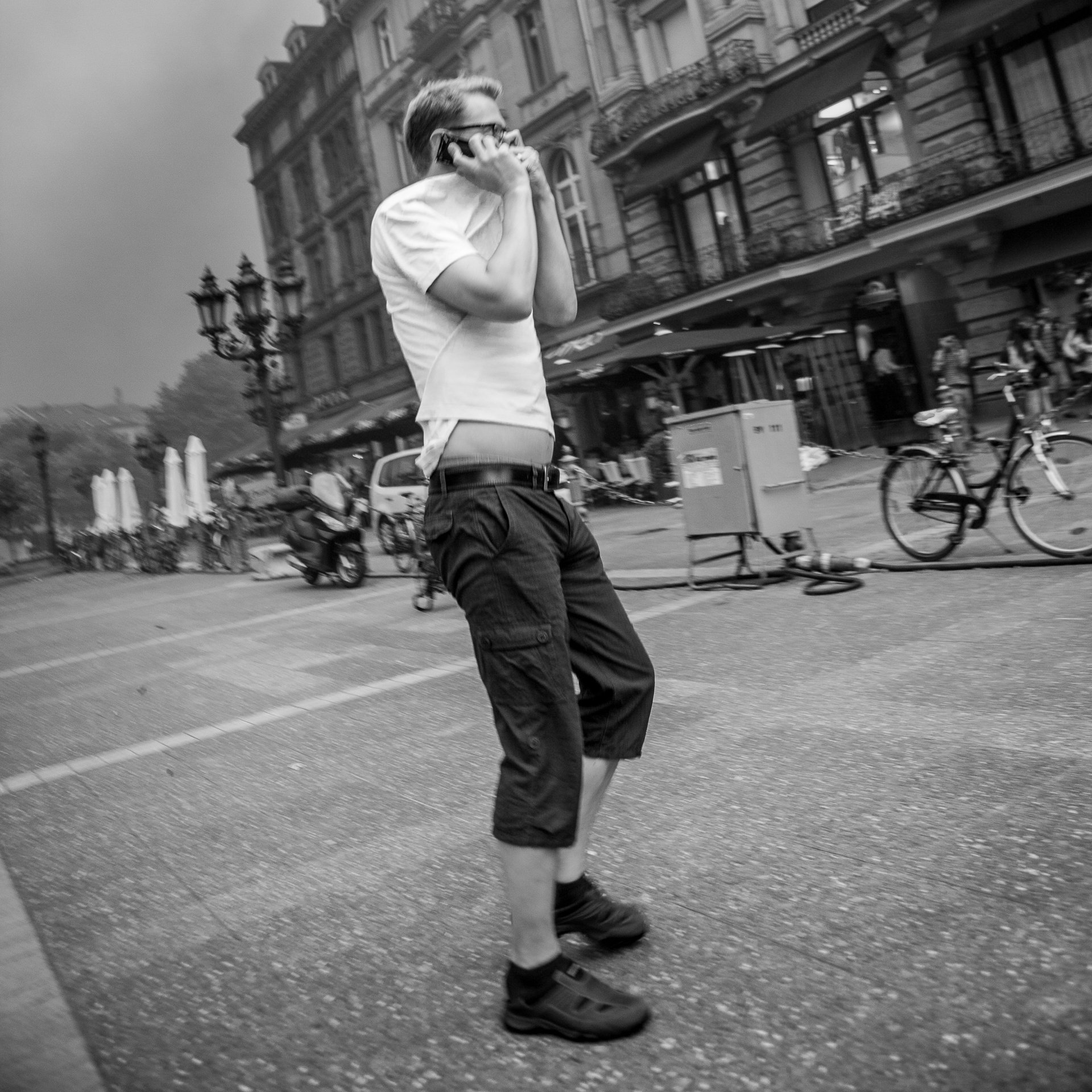
Walking Through the Haze
© Jean-Francois Cleroux | Frankfurt, Germany
The image captures a man walking through a street or walkway, speaking on his phone while covering his nose and mouth with his free hand. The architecture around him — mid‑rise buildings with balconies, umbrellas shading café tables, bicycles leaning casually against railings — places us firmly in a European urban centre. The light is harsh, almost metallic, flattening tones and sharpening edges. The air carries a visible haze, softening the distance and giving the scene a faintly surreal, heat‑struck quality.
The photograph is rendered in black and white, which heightens the sense of atmosphere: the brightness of the street, the dark weight of the figure, the slight diffusion of the background. The monochrome treatment also strips away distraction, allowing gesture, posture, and environment to speak more clearly.
This photograph was made in Frankfurt during a stretch of heavy summer heat, just as a nearby building fire sent smoke drifting through the streets. The haze you see in the distance isn’t weather — it’s the residue of that moment, a thin veil of ash and heat that settled over the city. People moved through it cautiously, covering their noses as they walked, trying to continue with their day while the air carried the sharp scent of burning material. That gesture — a hand raised to the face, a slight tightening of posture — became part of the story, a small human response to an unexpected disruption. The fire itself is outside the frame, but its presence lingers in the light, the atmosphere, and the way the city briefly held its breath.
A Catalogue of Distinct Voices and Visual Philosophies
1. Classic Documentary Street Photography
Rooted in observation, timing, and human presence — a way of moving through the world with patience, curiosity, and an eye for the unguarded moment.
Photographers: Henri Cartier‑Bresson, Garry Winogrand, Joel Meyerowitz, Vivian Maier
This is the backbone of the genre — candid, unposed, attentive to the decisive moment and the poetry of everyday life. Classic documentary street photography teaches us to anticipate gestures, read a scene, and recognize meaning in the split second when composition, emotion, and intention align.
2. Humanistic / Poetic Street Photography
Soft, empathetic, and attuned to the emotional undercurrents of public life — a style that privileges mood, gesture, and the quiet drama of ordinary moments.
Photographers: Helen Levitt, Saul Leiter, Nguan, Dimitri Mellos
These photographers reveal the tenderness of the street: small gestures, fleeting moods, and the soft edges of human connection. Their images feel like visual poems — intimate, lyrical, and deeply human.
3. High‑Contrast Black & White / Graphic Street Photography
Defined by bold silhouettes, deep shadows, and strong architectural forms — a style that turns the street into a stage of geometry and tension.
Photographers: Fan Ho, Alan Schaller, Ray Metzker, Trent Parke
This approach emphasizes structure and drama. Light becomes a sculptural tool, and the world is reduced to its essential shapes. The result is imagery that feels both timeless and intensely graphic.
4. Colour‑Driven / Painterly Street Photography
A celebration of colour as emotion — using hue, temperature, and harmony to create atmosphere and narrative.
Photographers: Saul Leiter, Alex Webb, Harry Gruyaert, Joshua K. Jackson
Colour becomes the subject itself — a mood, a temperature, a way of feeling the world. These photographers use colour not as decoration but as a storytelling device, shaping the emotional tone of the frame.
5. Humorous / Whimsical Street Photography
Built on visual wit, timing, and the delightful absurdities of public life — a reminder that the street is full of comedy if you know how to look.
Photographers: Elliott Erwitt, Matt Stuart, Gus Powell, Richard Kalvar
This style thrives on coincidence, irony, and playful juxtapositions. It requires a sharp eye, quick reflexes, and a sense of humour about the world.
6. Candid Close‑Range Street Portraiture
Intimate, bold, and often confrontational — a style that collapses the distance between photographer and subject.
Photographers: Bruce Gilden, Michelle Groskopf, Tatsuo Suzuki, Boogie
These images feel immediate and electric. The photographer steps into the subject’s space, capturing raw expression, texture, and presence. It’s a style that demands courage and sensitivity in equal measure.
7. Abstract / Experimental Street Photography
A departure from literal representation — using blur, reflections, distortion, and unconventional framing to create dreamlike or surreal imagery.
Photographers: Ernst Haas, Daido Moriyama, Alexey Titarenko, Siegfried Hansen
Here, the street becomes a canvas for abstraction. The focus shifts from documenting reality to transforming it, revealing emotional or psychological layers beneath the surface.
8. Geometric / Formalist Street Photography
Focused on lines, shapes, patterns, and spatial relationships — a style that treats the street as a living composition.
Photographers: Henri Cartier‑Bresson, Fan Ho, Siegfried Hansen, Vivian Maier
This approach requires patience and precision. The photographer waits for the right alignment — a figure entering a frame, a shadow falling just so — creating images that feel balanced, intentional, and visually satisfying.
9. Night Street Photography / Noir Atmosphere
Defined by low light, neon glow, and cinematic mood — a world where darkness becomes a character in the frame.
Photographers: Brassaï, Trent Parke, Joshua K. Jackson, Tatsuo Suzuki
Night transforms the street into something mysterious and theatrical. Colours shift, shadows deepen, and the ordinary becomes uncanny. This style thrives on atmosphere and emotional tension.
10. Social Documentary / Street‑Adjacent
Street photography with a deeper sociopolitical or cultural lens — attentive to context, community, and lived experience.
Photographers: Mary Ellen Mark, Gordon Parks, Bruce Davidson, Zanele Muholi
These photographers use the street as a window into society. Their work is rooted in empathy, curiosity, and a desire to understand the human condition in all its complexity.
11. Minimalist Street Photography
Built on restraint, negative space, and simplicity — a style that reveals how little is needed to say something meaningful.
Photographers: Fan Ho, Michael Kenna, Nguan, Rui Palha
Minimalism invites calm and clarity. It strips away distraction, allowing the viewer to focus on a single gesture, shape, or moment suspended in space.
12. Layered / Complex Street Photography
Rich with depth, multiple planes of action, and visual density — scenes that reward slow looking and repeated discovery.
Photographers: Alex Webb, Constantine Manos, Harry Gruyaert, Matt Stuart
This style thrives on complexity. The frame becomes a tapestry of interactions, colours, and gestures, each layer adding meaning and energy.
13. Conceptual / Staged‑Feeling Street Photography
Not staged, but feels intentional — as if the world arranged itself into a scene with narrative or symbolic weight.
Photographers: Philip‑Lorca diCorcia, Jeff Mermelstein, Rinko Kawauchi, Todd Hido
These images often feel cinematic or metaphorical. They blur the line between documentary and fine art, inviting interpretation and emotional resonance.
14. Mobile / Contemporary Digital Street Photography
Shaped by modern tools, fast workflows, and the aesthetics of digital culture — proof that the camera matters less than the eye.
Photographers: Eric Kim, Dan Rubin, Ed Templeton, various emerging Instagram‑native artists
Mobile photography democratizes the street. It’s immediate, agile, and deeply connected to contemporary visual culture.
15. Painterly or Fine‑Art‑Inflected Street Photography
Soft, atmospheric, and emotionally rich — blending the spontaneity of the street with the sensibility of fine art.
Photographers: Saul Leiter, Rinko Kawauchi, Nguan, Cig Harvey
These photographers create images that feel like visual poems. Colour, light, and mood take precedence over literal representation.
16. Romantic Street Photography
Soft, atmospheric, and emotionally attuned — a way of seeing the street through tenderness, beauty, and the quiet poetry of human presence. Romantic street photography isn’t sentimental; it’s attentive. It notices the gentle moments: a hand brushing a railing, a couple leaning into each other, a figure walking through beautiful light. It’s rooted in feeling, connection, and the belief that the street can be a place of grace.
Photographers: Valérie Jardin, Willy Ronis, Edouard Boubat, Rebecca Norris Webb
This style leans into warmth, simplicity, and emotional resonance. The images often feel hopeful, intimate, and human‑centred. Light plays a major role — soft window light, golden hour glow, gentle backlight, or the luminous atmosphere after rain. Romantic street photographers look for gestures that speak quietly but deeply: affection, solitude, contemplation, companionship. Their work often feels like a love letter to everyday life.
17. Political / Activist Street Photography
Rooted in social conscience and documentary urgency — this style uses the street as a stage for protest, power, and public life. It foregrounds context, signage, bodies in motion, and the visual language of dissent.
Photographers: Gordon Parks, Susan Meiselas, James Nachtwey, Zanele Muholi
This approach teaches the photographer to read context and to place individual gestures within larger social narratives. It requires ethical awareness, sensitivity to subjects, and an ability to combine immediacy with background research. Images often balance human detail with documentary evidence — faces, placards, crowds, and the architecture of power.
18. Surreal / Constructed Street Photography
Where the everyday is nudged toward the uncanny — using staging, timing, reflections, and unexpected juxtapositions to create images that feel dreamlike or slightly off‑kilter.
Photographers: Philip‑Lorca diCorcia, Jeff Mermelstein, Daido Moriyama, Alexey Titarenko
This voice blurs documentary and artifice. It teaches photographers to look for visual coincidences and to consider how small interventions (a change of angle, a timed shutter, a reflected fragment) can transform a literal scene into something metaphorical. The result often invites interpretation rather than straightforward reading.
19. Travel / Global Street Photography
A cosmopolitan, observational practice that emphasises place, culture, and the particularities of public life across different cities and countries.
Photographers: Alex Webb, Steve McCurry, Raghu Rai, Constantine Manos
Travel street work teaches adaptability: how to read unfamiliar light, negotiate language and cultural norms, and find universal gestures within local detail. It’s about balancing curiosity with respect and learning to compose quickly in new environments.
20. Youth & Subculture Street Photography
Focused on fashion, attitude, and the visual codes of specific groups — this style documents how young people and subcultures use clothing, posture, and place to express identity.
Photographers: Nan Goldin, Mark Cohen, Bruce Gilden, Gus Powell
This voice trains the photographer to notice style as social language. It’s about timing, proximity, and an eye for the small signals that mark belonging: a haircut, a jacket, a stance. Ethical sensitivity and consent are important when working close to people.
21. Cinematic / Filmic Street Photography
Composed like a still from a movie — this style emphasises mood, colour grading, framing, and narrative suggestion, often borrowing techniques from cinematography.
Photographers: Todd Hido, Philip‑Lorca diCorcia, Rinko Kawauchi, Gregory Crewdson (cross‑over)
Cinematic street photography teaches control of atmosphere: how light, colour, and composition can imply a backstory. Photographers learn to think in sequences, to wait for the moment that reads like a scene, and to use light as a director uses a spotlight.
22. Intimate Domestic / Interior Street Photography
Finding street‑like moments inside homes, cafés, and small shops — this voice brings the observational eye into private or semi‑private spaces, capturing quiet rituals and domestic gestures.
Photographers: Nan Goldin, Mary Ellen Mark, Sally Mann, Rebecca Norris Webb
This approach teaches sensitivity and trust. It’s less about anonymous crowds and more about relationships, texture, and the small, repeated actions that reveal character. It requires patience and often a longer relationship with subjects.
23. Mobile / Lo‑Fi & Social Media Aesthetics
Immediate, agile, and shaped by the constraints and affordances of phones and social platforms — this style values spontaneity, intimacy, and the vernacular look of contemporary visual culture.
Photographers: Eric Kim, Dan Rubin, Ed Templeton, many Instagram‑native practitioners
Mobile street photography teaches economy: how to make strong images with limited tools, how to edit quickly, and how to use cropping and perspective to create impact. It’s also a reminder that distribution and context (where an image appears) shape how it’s read.
24. Photojournalistic / Breaking‑News Street Photography
Fast, factual, and mission‑driven — this voice prioritises clarity, context, and the decisive moment in situations of public consequence.
Photographers: James Nachtwey, Don McCullin, Susan Meiselas, Mary Ellen Mark
This style trains the photographer to be both a witness and a storyteller under pressure. It emphasises ethics, accuracy, and the ability to capture clear, informative frames that communicate events to a broad audience.
25. Environmental / Contextual Street Photography
Focused on the relationship between people and place — this approach uses the built environment, signage, and landscape to explain social conditions and human behaviour.
Photographers: Dorothea Lange (historical influence), Lewis Hine (historical influence), Gordon Parks, Alex Webb
This voice teaches the photographer to read layers of context: how architecture, infrastructure, and public space shape action. Images often pair a human subject with environmental detail that deepens meaning.
26. Experimental / Cross‑Media Street Photography
A hybrid, boundary‑pushing practice that mixes photography with collage, text, motion, or alternative processes to expand what a street image can be.
Photographers: Daido Moriyama (experimental tendencies), Alexey Titarenko, Ernst Haas, contemporary mixed‑media artists
This style encourages risk and play. It teaches photographers to question the medium, to experiment with process, and to use non‑traditional techniques (double exposure, long exposure, printing manipulations) to express psychological or conceptual layers.
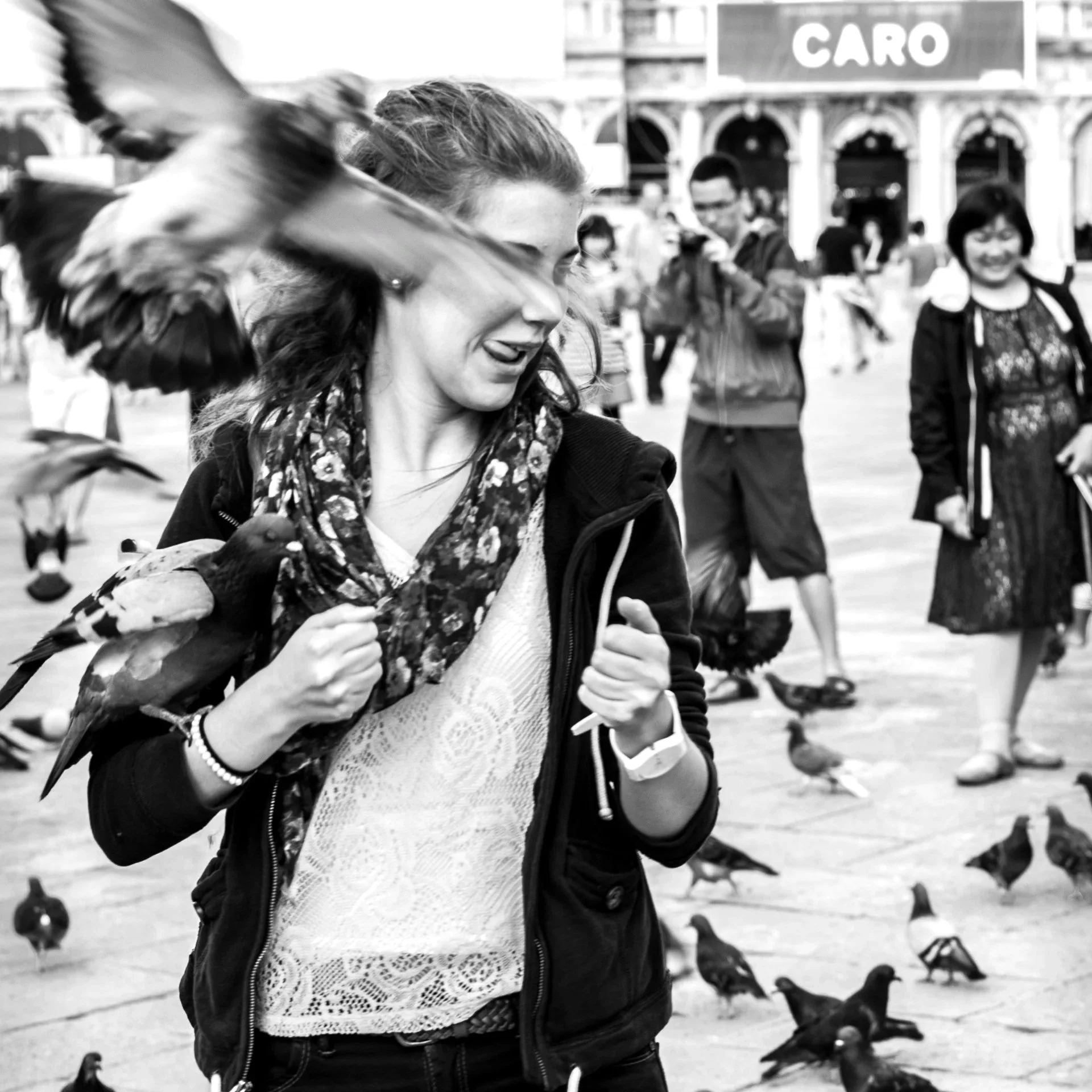
A Feathered Surprise
© Jean-Francois Cleroux | Piazza San Marco, Venice, Italy
In the heart of St. Mark’s Square, where centuries of footsteps have polished the stones to a soft sheen, this photograph captures one of those small, unruly moments that make Venice feel unmistakably alive.
A woman stands in the foreground, wrapped in lace and patterned fabric, her arm extended like an accidental perch. A pigeon settles there with the confidence of a Venetian regular, while another erupts upward in a blur of wings, sweeping past her face. Her tongue sticks out in a spontaneous, unguarded reaction — half‑surprise, half‑delight — the kind of expression no one can rehearse. Around her, people pause: some amused, some curious, one lifting a camera, all briefly rearranged by this tiny burst of chaos.
The image feels like a breath caught mid‑laugh — a reminder that even in a place saturated with history, the present moment insists on being wild, spontaneous, and beautifully unrepeatable.
A Creative Exercise: Find Your Three Styles (and Your Fourth)
Before you leave this catalogue behind, I’d like to offer a creative exercise — one that can reveal a great deal about your photographic voice and the direction your work is quietly trying to take.
Begin by identifying the three street photography styles that feel most reflective of your own images. Not the styles you admire in others, but the ones that feel instinctive when you look at your contact sheets or scroll through your archives. These are the styles that echo your natural way of noticing: the kinds of scenes you’re drawn to, the rhythms you respond to, the visual language you speak without thinking.
This first list of three is important because it helps you understand your current creative identity. Once you’ve named them, return to the photographers associated with those styles. Study how they use light, timing, colour, gesture, or structure. Notice the decisions they make — and the ones they avoid. Their work becomes a mirror, helping you see your own instincts with greater clarity.
But don’t stop there.
After you’ve identified your three, choose a fourth style — one that does not come naturally to you, but that you feel drawn to explore or incorporate into your work. This fourth style is your growth edge. It represents the direction your curiosity is pointing, even if your skills or habits haven’t caught up yet.
Maybe you’re a minimalist who wants to experiment with layered complexity. Maybe you’re a colour‑driven photographer curious about high‑contrast black and white. Maybe you’re a documentary purist who wants to flirt with abstraction or surrealism.
Whatever it is, this fourth style can become a powerful catalyst for evolution.
Studying the photographers associated with your chosen “growth style” gives you a roadmap for expansion. Their work can challenge your assumptions, stretch your visual vocabulary, and introduce you to techniques or ways of seeing that feel unfamiliar — and therefore transformative. Over time, this fourth style may begin to weave itself into your practice, subtly reshaping your images and opening new creative pathways.
Your three styles show you who you are. Your fourth style shows you who you’re becoming.
Revisit this exercise often. As your work evolves, your lists will shift — and that shifting is the clearest sign that your vision is alive, growing, and moving forward.
Closing: A Map for Your Own Journey
This catalogue isn’t meant to confine you to categories, but to give you a language for understanding the many ways photographers move through the world. Styles are not boxes — they are pathways, overlapping and evolving, often blending into one another in ways that defy neat definitions. The exercise of choosing your three (and your fourth) is not about limiting yourself, but about recognizing the patterns already present in your work and the directions your curiosity is quietly pointing.
Your three styles reveal the sensibilities that feel most natural to you — the rhythms, moods, and visual instincts that shape your way of seeing. Your fourth style represents the horizon of your growth, the place where your work wants to stretch, experiment, or take risks. Together, they form a kind of creative map: part reflection, part aspiration.
As you study the photographers associated with these styles, you’ll begin to see your own work with greater clarity. You’ll notice what resonates, what challenges you, and what possibilities open when you step outside your familiar patterns. And as your vision evolves, your map will evolve too — shifting, expanding, and deepening as you continue to explore the street with curiosity and intention.
Let this catalogue be a companion, not a prescription. Wander through it. Return to it. Let it guide you when you need direction, and let it surprise you when you’re ready for something new. Your photographic voice is a living thing — and every style you study, every influence you absorb, becomes part of the journey.
Coming Up in The Flâneur’s Journal
I hope this second part of The Evolving Street Photographer: A Series on Creative Growth and the Art of Seeing offered something useful — a spark, a question, a shift in how you think about your own influences. But the real growth begins when you do the work. These exercises are not busywork; they are the scaffolding that helps your style take shape. The more seriously you engage with them, the more clearly your voice will emerge.
Next week, we’ll step into Working a Block: Repetition and Variation — the quiet discipline of returning to the same block.
And in two weeks we continue with Part III of this series — Studying the Work That Shapes You — Ways to Deepen Your Study and Sharpen Your Vision — a chapter that opens the door a little wider. The series will continue every second week, giving you time to practise, reflect, and return with a deeper sense of your own way of seeing.
More is waiting just beyond this step. Let your practice unfold at its own pace. Keep moving, keep noticing, and let your way of seeing grow a little deeper each time you return.