Yoga on the Street: How Flânerie Became My Practice of Presence
I’ve never thought of myself as a yogi. My practice has always been the street — the long wandering, the quiet listening, the slow apprenticeship to whatever the city is willing to reveal. Everything I know about Yoga — and everything I’m still learning — comes from Christine Naidu, my partner and a deeply experienced Yoga practitioner and certified instructor whose insight and teachings have opened a door I didn’t know I needed. She was the first to point out the connection between Yoga and flânerie; Christine saw something in my street practice long before I did, and her guidance continues to shape the way I understand the parallels between these two ways of moving through the world.
What she named was not about postures, though there is a physicality to street work that often goes unspoken. She meant something deeper — the philosophical and meditative roots of Yoga, the discipline of presence, the ethics of attention.
The more I sat with her observation, the more I realised she was right. Flânerie, as I practise it, is not simply walking. It is a way of inhabiting the world. And in that sense, it shares a quiet kinship with Yoga — a kinship rooted in breath, awareness, and the gentle refusal to rush.
This is an attempt to trace that connection, not as an argument but as an offering — a way of illuminating how two seemingly different paths can lead toward the same centre.
Beginning with the Body
Yoga begins with the body, not as an object to be perfected but as an instrument of awareness. Breath, posture, balance — these are not goals but gateways.
Street photography begins in the body as well. The pace of my walk, the softness of my gaze, the way my camera rests against my hip — these are my asanas. They shape the quality of my attention. They determine whether I move through the street as a participant or as a disruption.
When I walk slowly, I see more. When I breathe evenly, I settle into the rhythm of the city. When I let my shoulders drop, the world opens.
The body becomes the first lens.
The Discipline of Non‑Striving
One of the most misunderstood aspects of Yoga is the idea of effort. It is not about achieving a pose; it is about inhabiting it. The work is real, but it is not forceful.
Street photography, at least the way I practise it, is the same. I do not hunt for images. I do not chase moments. I walk, I listen, I receive.
There is a discipline to this — a refusal to grasp, a willingness to let the city reveal itself in its own time. The best photographs arrive when I stop trying to make them happen. They appear in the space created by non‑striving.
This is pure Yoga: intention without tension.
Breath as a Way of Seeing
In Yoga, breath is the anchor. It steadies the mind, softens the body, and brings the practitioner back to the present moment.
In flânerie, breath becomes a kind of metronome. My pace follows it. My awareness expands with it. Even the way I shoot — often blind, from the hip — depends on a steady, unhurried rhythm.
When I am breathing well, I see well. When my breath is shallow or rushed, my images reflect it.
Breath is the quiet hinge between the inner world and the outer one.
Ethical Presence
Yoga’s philosophical roots emphasise non‑harm, dignity, and awareness of one’s impact. It is a practice of moving through the world gently, with respect for the beings who share it.
My street practice mirrors this. I strive to photograph without intrusion. I honour the dignity of strangers. I hold myself accountable to the ethics of presence.
This is not a rule imposed from outside; it is a commitment I make to myself. A kind of ahimsa expressed through a lens.
To photograph someone without disrupting their dignity is not only possible — it is essential. It is the foundation upon which all my work rests.
The Dialogue Between Inner and Outer Worlds
Yoga is often described as a union — a weaving together of the internal and external, the physical and the subtle, the self and the world.
Flânerie is a similar dialogue. I walk the city to understand myself. I photograph others to understand my own way of seeing. The street becomes a mirror, not a stage.
Every frame is a question: What is the world showing me about myself today?
This is not introspection for its own sake. It is a way of staying awake.
A Lifelong Discipline
Yoga is not a workout; it is a path — a lifelong practice of returning, again and again, to presence.
Street photography is the same. It is not a hobby or a weekend diversion. It is a way of living — a daily apprenticeship to attention, curiosity, and humility.
The work matures not through gear or novelty but through the slow refinement of presence. Through the willingness to keep showing up.
Stillness in Motion
Yoga teaches stillness inside movement. Flânerie teaches movement inside stillness.
I walk, but my mind is quiet. The city moves, but I remain centred.
This is why the images that emerge from this practice often feel calm, even when the street is chaotic. They are made from a place of inner steadiness — a still point inside the turning world.
A Practice of Love
Not sentimental love — attentive love. The kind that notices. The kind that honours. The kind that says: I am here with you, fully.
Yoga teaches this through breath and posture. Flânerie teaches it through walking and seeing.
Both are ways of saying yes to the world.
Closing the Loop
When Christine first suggested that my street practice resembled Yoga, I smiled and shrugged it off. But the more I walked, the more I realised she had named something I had been living for years without ever articulating.
Flânerie is my Yoga. The street is my mat. The camera is my breath. And presence — quiet, ethical, attentive presence — is the posture I return to again and again.
If this resonates with you, perhaps your own practice — whatever form it takes — is already a kind of Yoga too. A way of meeting the world with openness, curiosity, and care. A way of saying: I am here. I am listening. I am awake.
And because our creative lives are inseparable from the bodies that carry us, I want to offer something practical as well — a small companion practice you can return to before a long wander, after a demanding day, or whenever your body asks for a little tending. Think of it as a gentle bridge between the philosophy of presence and the physical reality of being a photographer in the world.
Below is a simple Yoga‑inspired sequence shaped by Christine and I specifically for street photographers — a way of caring for the wrists that hold the camera, the neck that scans the street, the shoulders that carry our gear, and the hips and spine that support our long, wandering days.
It’s not a routine. It’s an invitation. A way of honouring the body that makes the seeing possible.
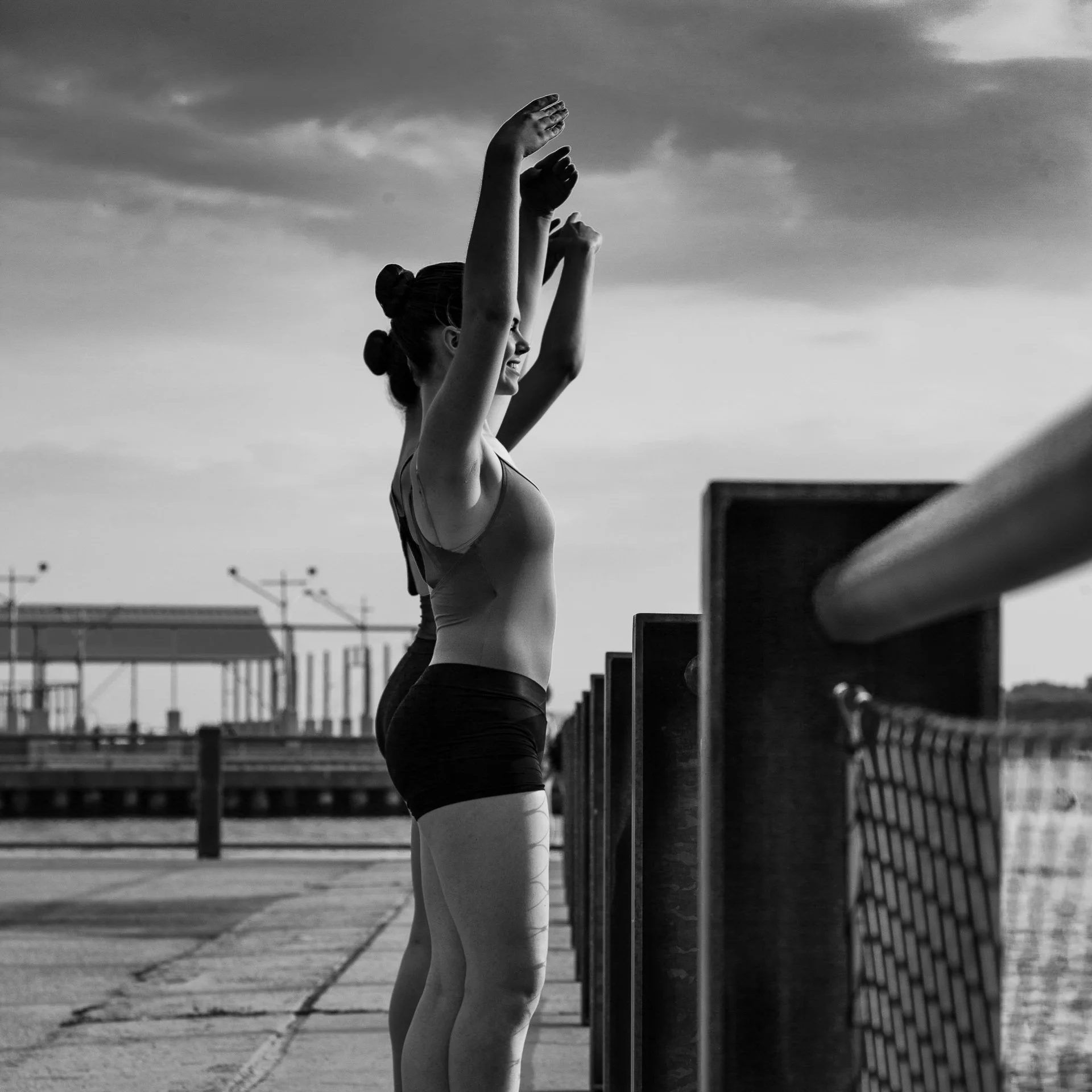
Twin Stretch at the Pier
© 2026 Jean-François Cléroux | NYC, New York, USA
There’s a lovely tension in this frame — two bodies rising into the same gesture, almost mirrored, yet separated by a subtle difference in posture and intention. The industrial backdrop sharpens the contrast: soft human movement against the hard geometry of cranes, railings, and steel. What holds the image is the upward reach — a moment of pause, breath, and alignment in a place not usually associated with stillness. The black‑and‑white treatment works well here, letting form and rhythm take precedence over distraction. It’s a quiet study in synchronicity, presence, and the small rituals people carry with them into public space.
A Gentle Yoga Sequence for Street Photographers
A practice for wrists, shoulders, neck, hips, and the quiet architecture that holds us upright in the street.
As street photographers, we spend hours moving through the world with a kind of soft vigilance — walking, pausing, bending, lifting, twisting, often without noticing how much the body is doing on our behalf. Over time, the small strains accumulate: a stiff neck from scanning the street, tight shoulders from carrying a bag, sore wrists from holding a camera, hips that ache after long hours on concrete.
I’ve learned that tending to the body is not separate from tending to the craft. It is part of the same discipline of presence.
An Important Note & Warning Before You Begin
Before you explore these Yoga‑inspired movements, please listen to your body with care. These stretches are simply practices that help me on long days walking the streets with a camera — they’re not a substitute for medical advice. If you have any existing injuries, health concerns, or limitations, please consult a doctor or qualified health professional before trying anything new. And if you feel pain or discomfort at any point, stop immediately and seek guidance. Your well‑being matters more than any posture or photograph.
Below is a gentle sequence inspired by Yoga — not athletic, not performative, simply a way of returning to the body that carries us through the city. It’s short, simple, and designed to be done anywhere, at any time. You can move through it in ten minutes or linger for thirty. Let it be slow, unhurried, and shaped by breath.
These movements are simply invitations — small ways of caring for the instrument that carries you through your work. If any of them feel unfamiliar, you can search for their names online; there are countless clear demonstrations and thoughtful guides that offer deeper direction and nuance.
1. Wrist Warm‑Up and Release
For the hands that hold the camera, often longer than we realise.
Wrist Circles (Manibandha Sanchalana) — slow, deliberate rotations in both directions. Do 5 circles clockwise and 5 counter‑clockwise, first with a soft fist, then with an open palm. Twenty circles in total. Move slowly, without forcing.
Prayer Stretch (Namaskarasana (variation)) — palms together, elbows wide, lowering the hands towards your breastbone until you feel a soft pull along the forearms. Do five slow repetitions, breathing in expanding your chest and ribcage. On each exhale, soften your shoulders.
Gentle Fingertip Pull (Hasta Sanchalana (variation)) — one finger at a time, easing tension without forcing. Hold each finger for a breath or two, keeping the forearm relaxed.
These small movements help prevent the dull ache that comes from gripping a camera for hours.
For a more advanced version, you can combine Prayer Stretch with Tree Pose found in section 5 below.
2. Neck and Upper Spine Unwinding
For the constant scanning, the subtle forward lean, the weight of attention.
Slow Neck Rolls (Greeva Sanchalana) — half‑circles only, ear to shoulder, chin to chest. Repeat 5 rolls clockwise and 5 rolls counter‑clockwise, moving slowly and without forcing. Finish by gently lifting your gaze upward and holding for five slow breaths, softening the jaw and throat.
Cat–Cow(Marjaryasana—Bitilasana) — seated or on hands and knees, awakening the spine and restoring fluidity. Move with your breath: inhale to lift the chest, exhale to round the back. Let the movement stay small and easy.
Thoracic Twist (Parivrtta Tadasana (Variation)) — seated or standing, turning gently from the ribcage. Turn slowly to the left and hold for one full, slow breath. Turn slowly to the right and hold for one full, slow breath. As you breathe, allow a little more rotation — but from the ribcage, not the hips. Repeat three times on each side.
These movements soften the places where tension hides when we’re alert and watching — the quiet architecture that supports every hour we spend scanning the street.
3. Shoulder and Chest Opening (Pawanmuktasana Series)
For the posture that collapses when we carry gear or walk for hours.
Shoulder Rolls — slow, exaggerated circles. Roll the shoulders forward 5 times, then backward 5 times, letting the movement stay broad and easy. Keep the jaw soft and the breath steady.
Bear Hug Stretch — a simple but powerful way to open the upper back. Wrap your arms around your chest and shoulders as if giving yourself a hug. From this position, gently rotate your torso left and hold for three slow breaths. Rotate right and hold for three slow breaths. Repeat three times on each side. This stretch targets the rhomboids and the muscles along the upper spine — the ones that tighten when we carry a camera bag or walk with a slight forward lean.
Chest Expansion — interlace your fingers behind you, straighten the arms gently, and lift the sternum. Breathe into the front body, letting the collarbones widen and the shoulders soften down the back. Hold for five slow breaths, expanding on each inhale.
Opening the chest restores the sense of spaciousness that street work requires — a posture that lets you walk longer, see more clearly, and move with the kind of ease that makes flânerie feel natural.
4. Hip and Lower Back Release
For the long hours on concrete, the subtle torque of walking with a bag, the weight of stillness.
Seated Figure‑Four Stretch (Sucirandhrasana) — seated or lying down, easing the outer hips. Cross your right ankle over your left knee, keeping the spine long. If seated, hinge forward slightly until you feel a gentle stretch in the outer hip; if lying down, draw the legs toward your chest. Hold for five slow breaths, then switch sides. This stretch targets the glutes and piriformis — key muscles for stability during long walks.
Forward Fold (Uttanasana) — as if tying your shoelaces with soft knees, long spine, letting gravity do the work. Stand with feet hip‑width apart, bend your knees slightly, and fold forward from the hips. Let the head and arms hang heavy. Hold for five to ten slow breaths, softening a little more on each exhale. This releases the lower back and hamstrings without strain.
Healthy hips make for a more fluid, intuitive walk — the foundation of flânerie.
5. Balance and Grounding
or the photographer’s stance — steady, responsive, quietly rooted.
Mountain Pose (Tadasana) — feet grounded, spine long, breath steady. Stand with your feet hip‑width apart. Lift all ten toes, spread them, and then place them back down to ground the centre of each foot. Feel the weight distribute evenly — front to back, left to right. Activate the natural plumb line through the body: ankles steady, knees soft, hips level, shoulders relaxed, ears aligned over the shoulders. This subtle activation makes your stance more stable and less wobbly — the kind of quiet steadiness that supports long days of walking and shooting.
Hold for five slow breaths, letting the spine lengthen on each inhale.
Tree Pose (Vrksasana) — cultivating balance and calm focus. Shift your weight onto your left foot. Place your right foot either on the ankle, calf, or inner thigh — avoiding the knee joint. Press foot and leg gently together to create stability. Bring your hands to your chest or lift them overhead if comfortable. Hold for five slow breaths, keeping the gaze soft and steady. Switch sides.
Tree Pose strengthens the standing leg, steadies the hips, and teaches the kind of balance that carries beautifully into flânerie — especially when the street is unpredictable.
Balancing on one leg while moving through the wrist warm‑ups in section 1 adds stability training and improves your overall posture — something every street photographer benefits from on long days of walking. Tree Pose strengthens the standing leg, steadies the hips, and teaches the kind of quiet balance that carries beautifully into the rhythm of flânerie.
These practices help you stay centred even when the world around you is in motion.
6. Breathwork for Presence
Because seeing begins with breathing.
Box Breath (Sama Vritti Pranayama) — inhale for four, hold for four, exhale for four, hold for four. Sit or stand comfortably, letting the shoulders soften. Inhale slowly for a count of four, feeling the ribs widen. Hold the breath for four, without strain. Exhale for four, steady and controlled. Hold again for four, letting the body settle. Repeat for four to six rounds, keeping the breath smooth and even.
This simple pattern calms the nervous system, steadies attention, and restores the quiet focus that street work depends on.
Breath is the quiet metronome of both Yoga and street photography — the place where attention settles.
A Final Note & Special Thanks
You don’t need to be flexible. You don’t need to be athletic. You don’t need to “do Yoga.”
You only need to return to your body with the same curiosity you bring to the street — the same quiet attention that makes flânerie possible.
A gentle thanks to Christine Naidu, whose insight and guidance shaped the Yoga components of this post. Her experience deepened my understanding of both the physical and mental practices, and together we shaped these movements into a short, simple sequence that supports the long, wandering days of street work. The sequence offered here rests on her steady, thoughtful ground.
Coming Up in The Flâneur’s Journal
In the next instalments, I’m beginning a new series on Projects — why they matter, how they shape a photographer’s voice, and what they offer that wandering alone cannot. We’ll explore what a street photography project actually is, how to recognise the beginnings of one, how to build it with intention, and how to evaluate its growth over time.
Projects are where flânerie becomes direction. They give structure to curiosity, deepen attention, and turn scattered images into a body of work with meaning and momentum. In this series, I’ll share ways of choosing a theme, sustaining it, refining it, and knowing when a project is finished — or when it’s asking you to keep going.
Think of it as a guide to the long game of street photography: how to create work that matures, coheres, and ultimately reveals something essential about the way you see.