Diaries Without Words: Manifesto for the Street Photographer and the Modern Flâneur
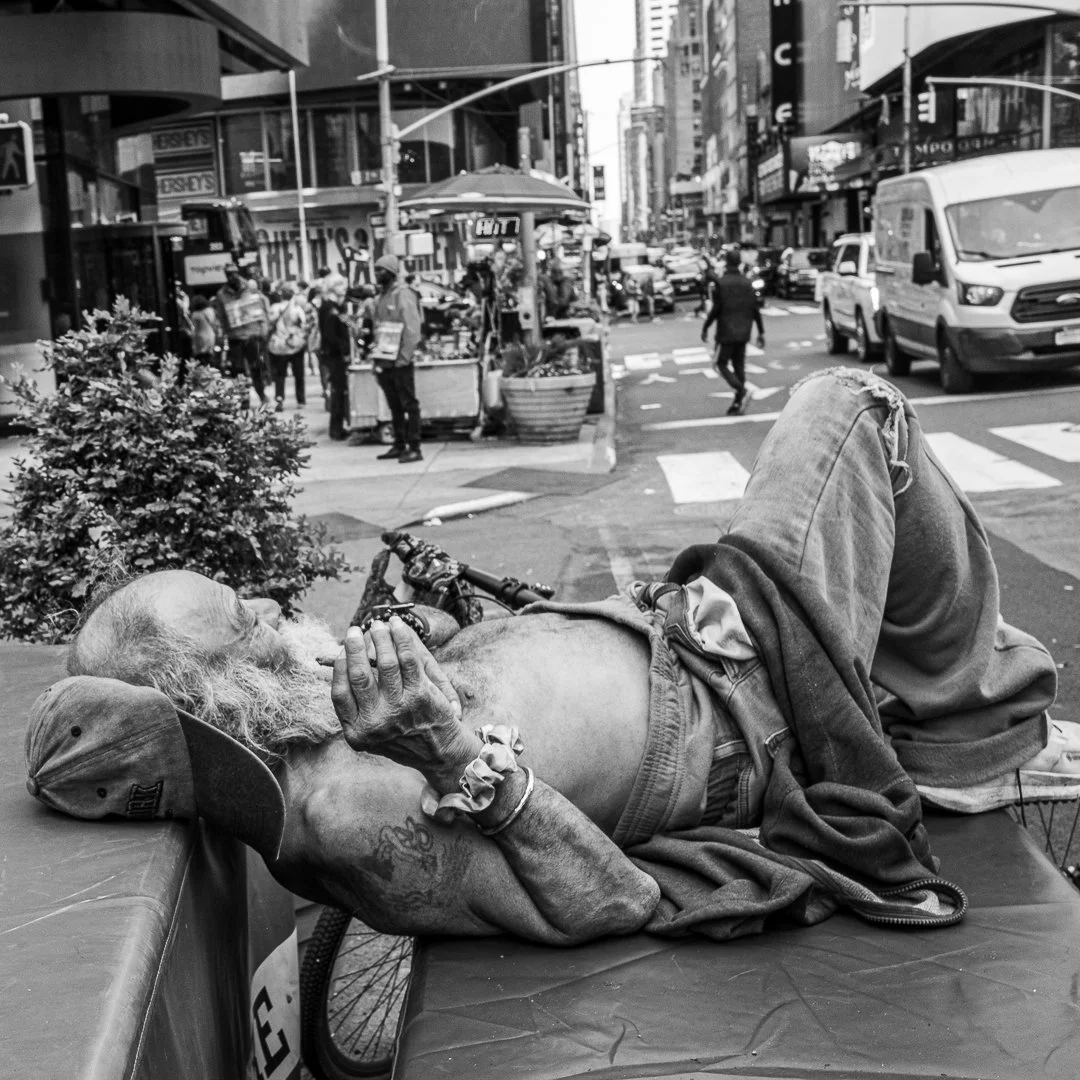
Resting in the River of the City
© 2026 Jean-François Cléroux | New York, NY, USA
A photograph captures a moment, but it rarely captures a life.
What first drew me to this scene was the contrast between stillness and movement: a figure reclining in the foreground while the city flowed relentlessly around him. The image invites interpretation, as many street photographs do, yet interpretation is not the same as knowledge. It also demands a certain restraint from the photographer—a willingness to acknowledge what is unknown rather than assume a story. After making the photograph, I spoke with the subject and learned that he was retired, that these outings formed part of his daily routine, and that he was entirely comfortable with both the encounter and the resulting image. His permission to use the photograph was freely given.
Because of that conversation, I see this image not as a document of hardship but as a small meditation on presence, individuality, and the many ways people choose to inhabit public space. Whether viewers find the photograph comfortable or challenging is for them to decide, but I hope it encourages a pause before certainty.
Context of the Encounter
Street photography often places us in proximity to lives we know very little about. I believe that reality requires humility. As a personal rule, if I photograph someone whose circumstances could be interpreted as vulnerable, I make every effort to speak with them afterward. If permission is not given, the image is never used.
When I speak of restraint, I am referring not to the composition itself but to the process behind it. The restraint lies in setting aside assumptions, seeking context, and recognizing that the person in the frame is always more important than the frame itself. In this case, the conversation revealed a reality quite different from what some viewers might initially imagine. Respect and courtesy come before the photograph, and human connection comes before publication.
Why I like Street Photography
I fell in love with street photography many years ago. It sharpened my attention, steadied my life, and carried me through both hard and hollow seasons. It changed not only what I do, but how I move through the world and how I understand it.
From a young age I was a flâneur—drawn instinctively to the streets, to people, to the city’s endless small dramas—long before I knew the word flânerie, or even the term street photography. Then, in August 2012, after a single one-night introductory class, I was hooked.
I remember driving home thinking, I like this—but what exactly do I like? What is pulling me toward this practice? There was a strange electricity in the act of entering other people’s spaces with a camera, a tension between curiosity and intrusion. The feeling was not entirely unfamiliar. Years of photographing people—in environmental work, fashion, concerts, editorial assignments, and as a newspaper stringer—had already taught me how to move among strangers and navigate the delicate space between observer and participant. Yet street photography asked something different of me. In those earlier chapters, I was often invited in. On the street, I had to learn how to belong without an invitation, how to observe without taking, and how to move through public life with both curiosity and care.
As a flâneur, I had always been drawn to people, to observing them, to noticing the little things—but I sensed there was something deeper at work.
Some of the answers arrived slowly: through more workshops—first as a student, then as a teacher—through poems scribbled in the margins, through tens of thousands of photographs, through reading, study, and the long labour of creating several books. From the very beginning, people asked me, “Why do you like street photography?” and I struggled to say more than, “I just like it.” It was honest, but incomplete.
As you’ll see in an upcoming issue of Frame & Verse, I spent years wrestling with emotions—feeling them, understanding them, and learning how to give them words. The same difficulty haunted my answer to the question, “Why do I like street photography?” It took time, and a fair amount of looking inward, but eventually I learned not only why I am drawn to it, but also how to articulate that pull. I still like it—deeply—but now many of the fuller answers live inside this manifesto.
This manifesto is meant to be read with care. Each sentence is a small lesson in how we might see, behave, and create with integrity. Take your time with it—let every line settle, unsettle, or quietly guide you. You may find, tucked inside these statements, some of the answers you've been searching for. Learn from them, question them, accept them, or set them aside—but let them nudge you toward shaping a manifesto of your own.
In a future blog post—or perhaps in another edition of Frame & Verse—I'll return to the question, “Why do I like street photography?” and offer a fuller, more considered answer
A Street Photographer’s Manifesto
We walk the city not to pass through it, but to see it. We walk without destination so the city may choose our direction. We let light guide us, not as a map, but as a quiet pull.
We are not tourists, not voyeurs, not intruders. We are listeners with our eyes, readers of light, collectors of the unsaid. We move gently. The street is not our stage; it is our shared breathing space. We enter it with humility, knowing we are guests in every moment we borrow.
Street photography is not about perfection. It is about presence. It is the art of being awake. We accept that the street is unpredictable. We welcome the blur, the misfire, the almost‑moment, because life refuses to be perfect.
We do not pose. We do not stage. We do not ask the world to smile. We wait for it to reveal itself. Every photograph is a negotiation—between what we see and what we allow ourselves to see. We choose honesty over convenience, patience over conquest.
We believe a shutter click is a heartbeat. It marks the moment life and light collide. The city is a living novel—every block a chapter, every passerby a poem. We return to the same streets again and again, not for repetition but for revelation. The city never shows the same face twice.
We are mirrors with memory. Our cameras reflect what the world shows us and remember what it forgets. We honour the unnoticed: the quiet worker, the solitary walker, the tired parent, the drifting shadow. These are our teachers. We dance with the unnoticed—a scarf caught in wind, a glance exchanged, a shadow stretching across a wall.
We write diaries without words. Our images are confessions, quiet truths, and fleeting prayers. We are thieves of time. We steal seconds and turn them into stories. We trust that meaning lives in the smallest gestures: a hand adjusting a collar, a pause at a crosswalk, a shadow leaning across stone.
We love strangers—not with possession, but with reverence. Each frame is a love letter to the unknown. We protect the dignity of those we photograph. A frame is never worth wounding someone’s humanity. We know our presence changes the scene, so we tread lightly, breathe softly, and let the world continue without bending to our will.
We paint with what is real. No filters, no fiction. Just the raw, the random, the radiant. We see the city and it sees us—in every reflection, every windowpane, every echo of our footsteps. The camera is not a shield but a bridge. It connects us to strangers we may never meet again, yet whose presence shapes us.
We accept that our photographs are incomplete. They hold only a sliver of truth, a single syllable of a larger story. Our work is not about capturing the extraordinary, but revealing the extraordinary within the ordinary.
We embrace the discipline of wandering. To drift with intention is not aimlessness—it is devotion. We vow to remain students of the street: curious, humble, awake.
This is our practice: to walk with open eyes, to witness without judgment, to frame without possession, to love the world enough to see it clearly.
This is our manifesto. This is our vow: to honour the city, its people, its light, and the fleeting miracles that pass between them—and to never stop looking.
The Street Photographer’s Manifesto: Why Street Photography Needs a Compass
A manifesto is not decoration. It is not a slogan, nor a tidy list of rules taped to a studio wall. It is a declaration of how a photographer chooses to move through the world—how to look, how to listen, and what responsibilities accompany that act of seeing. For the street photographer and the flâneur, whose practice unfolds in public space and in the presence of strangers, a manifesto becomes both anchor and compass. It keeps the work from drifting into habit and returns the photographer to intention, humility, and presence.
What a Manifesto Clarifies
A manifesto sharpens the photographer’s sense of purpose, values, and aesthetic identity, grounding the work in something deeper than instinct or chance. Street photography spans a wide terrain—documentary, poetic, political, humorous, contemplative—and without naming one’s stance, the work risks becoming a scatter of impulses rather than a coherent voice.
Purpose — It articulates why you walk, what you seek, and what you hope your images will offer the world.
Values — It acknowledges the ethical weight of photographing strangers: dignity, consent, representation, and the power dynamics of the lens.
Aesthetic commitments — It names the visual language you trust: gesture, light, rhythm, shadow, the unposed moment.
Boundaries — It defines what you refuse to photograph or publish, and why those refusals matter.
A manifesto is not a cage; it is the terrain you choose to inhabit, the ground on which your seeing stands.
How a Manifesto Shapes the Work
Street photography unfolds in a world that is fast, unpredictable, and emotionally charged. A manifesto becomes a stabilizing force—something to return to when the city overwhelms, seduces, or distracts.
It creates consistency — When every frame is measured against your principles, the body of work becomes intentional rather than accidental.
It deepens attention — Knowing what you stand for changes what you notice; the manifesto becomes a lens through which the city is read.
It strengthens editing — It helps you distinguish between images that belong to your vision and those that are merely clever or lucky.
It protects voice — In a genre crowded with imitation, a manifesto keeps your work from echoing others and cultivates a distinct visual language.
A manifesto does not limit possibility; it reveals the patterns that make your work unmistakably yours.
Why Street Photographers and Flâneurs Need One
Street photographers work where ethics, aesthetics, and public life intersect. They move among strangers, interpret gestures, and translate fleeting moments into images that may outlive the moment itself.
Uncontrolled environments demand clarity about what you pursue and what you let pass.
Photographing strangers requires an ethical stance that is explicit, not assumed.
Interpreting public life means acknowledging that every frame is a point of view, not a neutral record.
The flâneur’s wandering benefits from a philosophy that guides the drift, turning aimlessness into devotion.
A manifesto is a way of saying: This is how I choose to be present in the world, and this is how I choose to see it.
How the Manifesto Deepens the Compass
The expanded manifesto brings a more poetic, principled, and reverent philosophy to the practice—one rooted in humility, reciprocity, and the discipline of wandering.
It affirms that:
We walk to see, not to pass through.
We follow light the way others follow maps.
We are listeners with our eyes, readers of light, collectors of the unsaid.
We welcome the blur and the almost‑moment because life refuses perfection.
We wait for the world to reveal itself rather than shaping it to our will.
We return to the same streets for revelation, not repetition.
We honour the unnoticed and protect the dignity of those we photograph.
We write diaries without words—confessions, quiet truths, fleeting prayers.
We love strangers with reverence, not possession.
We paint with what is real: the raw, the random, the radiant.
We accept that our photographs are incomplete, slivers of a larger story.
We drift with intention, remaining students of the street—curious, humble, awake.
This manifesto transforms street photography from a practice of taking into a practice of receiving, witnessing, and returning—a way of honouring the city and the people who animate it.
What a Manifesto Ultimately Does
A manifesto turns street photography from a sequence of lucky encounters into a deliberate, ethical, and poetic practice. It reminds the photographer that every frame is a choice, every choice reveals a value, and every value shapes how the city is shown. It is not a rulebook but a declaration of how you intend to look, and therefore who you intend to be as an artist.