The Early Signals in Your Work
The Architecture of a Photographic Project — Chapter 1
Series Introduction
This series, The Architecture of a Photographic Project, a new chapter in The Evolving Photographer. is designed to guide you through the evolution that happens when your photography shifts from wandering to intention. We’ll explore how to choose a project that fits your voice, how to build it with clarity, how to sustain it when inspiration fades, and how to shape it into a body of work that speaks. We’ll study published projects that have influenced the field, and we’ll lay out dozens of project ideas you can begin today — from small exercises to long‑form commitments that unfold over years.
Whether you’re just beginning your first project or searching for the next one, this series will help you work with more purpose, more depth, and more direction. Because projects are where wandering becomes meaning, where practice becomes authorship, and where your way of seeing begins to mature into something distinctly your own.
This is the next step in the evolving journey. Let’s begin.
Why Photographic Projects Matter
Projects are where a photographer’s vision begins to take shape. They give direction to curiosity, structure to instinct, and purpose to the quiet hours spent walking with a camera. After learning to see with clarity in Creative Growth and the Art of Seeing, the next step is giving that seeing a home — a place where it can gather, deepen, and evolve. That place is the photographic project.
A project is more than a theme or a collection of images. It is a commitment — to a question, a feeling, a corner of the city, a way of noticing. It is a practice of returning, of looking again, of letting meaning accumulate slowly over time. Projects teach patience. They sharpen decisions. They reveal what you’re drawn to and what you avoid. They show you who you are becoming as a photographer.
Photography begins with wandering — with curiosity, with the pleasure of noticing, with the simple act of carrying a camera through the world. But at a certain point in a photographer’s evolution, wandering is no longer enough. The images accumulate, but they do not yet cohere. The work feels alive, but it does not yet speak. You begin to sense that something is missing: a thread, a direction, a way of gathering your seeing into something larger than isolated moments. That is where photographic projects enter the frame.
A project gives shape to your attention. It turns the instinct to roam into a practice of returning. It asks you to commit to a question, a theme, a place, or a way of noticing — not for a day or a weekend, but long enough for meaning to accumulate. Projects slow you down. They deepen your decisions. They reveal what you’re drawn to and what you avoid. They show you, quietly and without ceremony, who you are becoming as a photographer.
Working on a project changes the way you move through the world. Instead of chasing novelty, you begin to look for resonance. Instead of collecting images, you begin to build relationships — with light, with gesture, with a neighbourhood, with a recurring mood. You start to recognise patterns in your own seeing: the kinds of people you notice, the corners you return to, the emotional undercurrents that keep appearing in your frames. These patterns are not accidents; they are the beginnings of voice.
Projects also teach patience. They teach you to stay with an idea long enough for it to unfold, to endure the quiet days when nothing seems to happen, and to trust that the work is growing even when you cannot yet see its shape. They teach you to edit with intention, to refine your choices, to recognise when an image belongs and when it does not. They teach you that clarity comes slowly — through revisitation, through attention, through the steady accumulation of small insights.
Most importantly, projects transform your relationship with your photographs. A single image can be beautiful, surprising, or emotionally charged, but a project allows images to speak to one another. It creates rhythm, contrast, tension, and narrative. It reveals what you’ve been trying to say all along. It turns practice into authorship.
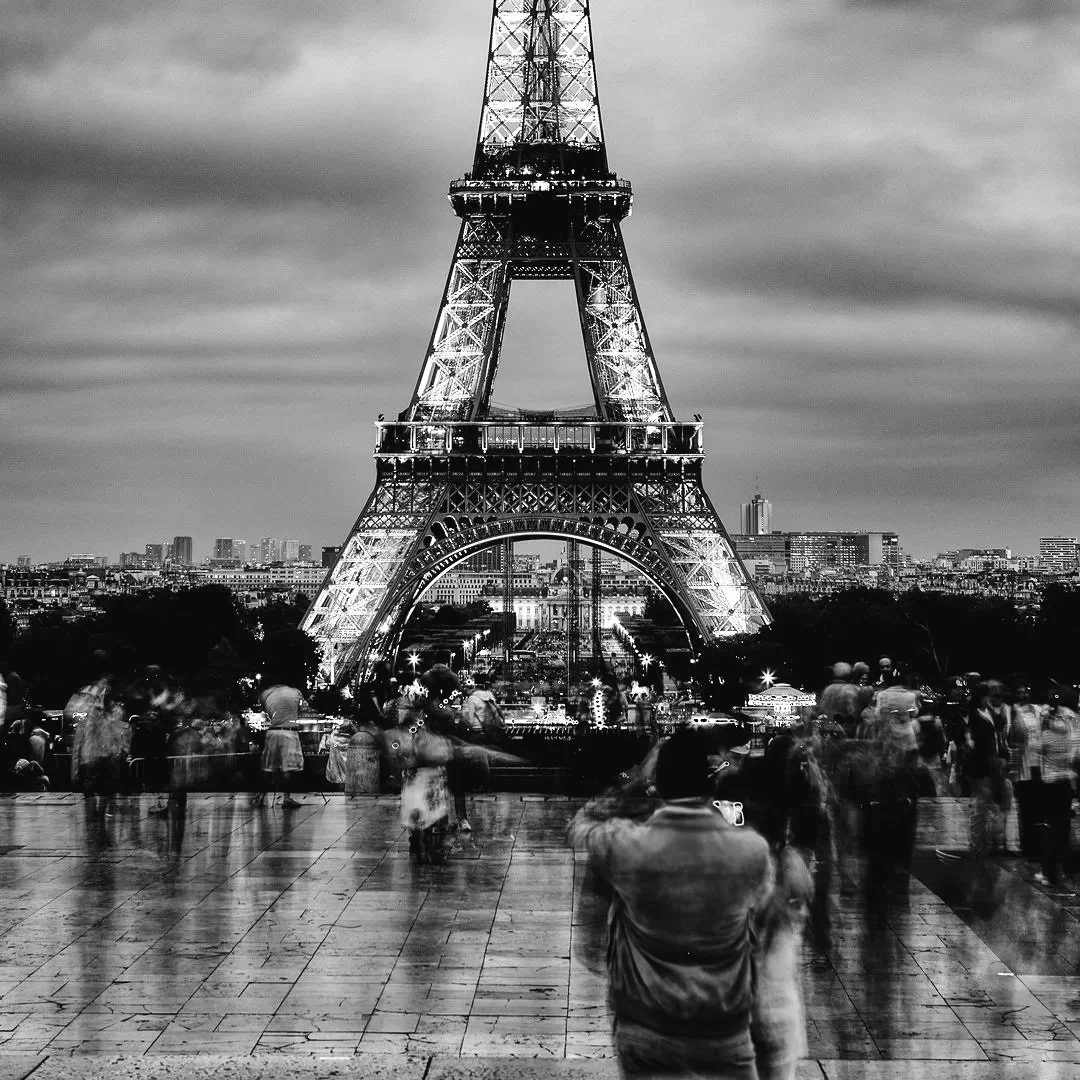
Echoes on the Terrace
© 2026 Jean-François Cléroux | Paris, France
This black‑and‑white long‑exposure HDR photograph of the Eiffel Tower captures the tension between permanence and motion. The tower stands illuminated and immovable at the centre of the frame — a fixed point of steel and light — while the world around it dissolves into blur. The sky drifts in soft streaks, the clouds stretched by time, and the people in the foreground appear as ghosted figures, gestures rather than individuals. Their movement becomes atmosphere.
The HDR blending lifts detail in the surrounding architecture, revealing the textures of the city without overwhelming the tower’s presence. The buildings sit quietly behind it, softened but articulate, anchoring the scene in Paris without competing for attention. The street itself becomes a kind of stage: a place where motion gathers, where human presence is felt but not defined.
The people — blurred, transient, almost spectral — emphasize the tower’s stillness. They remind us that the landmark is not simply a tourist icon but a witness to continuous flow. The photograph becomes a meditation on time: the city moving, the tower enduring.
Beyond its immediate visual impact, this photograph also opens the door to several different project directions. In the chapters ahead, we’ll look at how an image like this — with its interplay of stillness and motion, its blend of architecture and atmosphere, its human presence rendered as blur — can become the foundation for a number of distinct bodies of work. Whether through landmarks, city rhythms, long‑exposure studies, or the quiet choreography of public life, this single frame contains the seeds of many possible projects, each offering its own way of seeing and its own path of inquiry.
Introducing the Photographic Project
Before we move deeper into the mechanics of choosing and shaping a project, it’s worth pausing to understand what a photographic project actually is. In street photography, a project is not simply a folder of images or a theme you happen to enjoy. It is a sustained inquiry — a way of asking the world a question and returning often enough for the answer to reveal itself. A project gives your seeing a centre of gravity. It gathers your instincts, your curiosities, and your emotional tendencies into something coherent, something that grows through time rather than through chance.
Projects work because they create continuity. When you return to the same idea, the same neighbourhood, the same emotional thread, you begin to see beyond the surface. You notice patterns you would have missed while wandering. You recognise gestures, rhythms, and atmospheres that only appear through revisitation. This continuity is what allows your voice to emerge. A project becomes a mirror — showing you what you consistently notice, what you consistently ignore, and what you are quietly trying to say through your photographs.
For some photographers, projects become deeply personal explorations of mood, memory, or identity. For others, they become documentary studies of a place, a community, or a social condition. Street photography has always carried this dual potential: it can be intimate or observational, poetic or political, reflective or confrontational. A project can follow the quiet life of a single block, or it can trace the edges of a city undergoing change. It can explore solitude, humour, tension, migration, labour, belonging, or the invisible choreography of public life. The street is generous — it offers endless entry points.
Projects also give you a way to engage with the world more intentionally. When you work on a project with social or documentary weight, you begin to understand the responsibility of attention. You learn to observe without exploiting, to witness without simplifying, to photograph with empathy rather than extraction. Long‑form documentary projects often become records of cultural, political, or social shifts — not because the photographer set out to make a statement, but because sustained attention reveals truths that single images cannot hold.
And yet, projects do not need to be grand to be meaningful. A small project — photographing hands, shadows, reflections, or early‑morning commuters — can teach you just as much as a multi‑year documentary study. What matters is not the scale but the commitment. Projects work because they ask you to stay. They ask you to return. They ask you to look again. In that repetition, your seeing deepens, your instincts sharpen, and your photographs begin to speak with a voice that feels unmistakably your own.
The Practical Purpose of a Project
A photographic project is not only a way of seeing — it is a way of making something. While the heart of a project lies in curiosity, patience, and revisitation, every long‑form body of work eventually asks a practical question: What is this becoming? A project may begin as an inquiry, but it grows through the possibility of form. Without some sense of how the work might one day be held, shared, or seen, projects often remain nebulous — a cloud of images rather than a coherent body of work.
This doesn’t mean you need to start with a fixed destination. Most projects evolve in ways you cannot predict. But imagining potential outcomes — even loosely — gives your work direction. It helps you recognise what you’re gathering, what you’re shaping, and what you’re actually building. For some photographers, the imagined end result is a series of prints. For others, it’s a book, a zine, a website, a gallery exhibition, a portfolio sequence, or a long‑form article. Some projects become social documents; others become personal essays; others become quiet visual poems. The form doesn’t need to be decided early, but it helps to let the possibility of form guide your attention.
Thinking about presentation is not a distraction from the work — it is part of the work. When you imagine how your photographs might live together on a wall, on a page, or in a sequence, you begin to see them differently. You notice relationships, rhythms, contrasts, and gaps. You recognise what belongs and what doesn’t. You start to understand what the project is trying to say. This kind of visualization doesn’t limit your creativity; it sharpens it. It gives your project continuity — a sense of direction that grows clearer as the work accumulates.
Physical Outcomes and Artistic Growth
It’s important to say clearly: the purpose of a photographic project is not limited to physical outcomes like prints, books, exhibitions, or portfolios — though any of these may eventually become its home. A project also serves a deeper purpose: it is one of the most powerful engines of artistic growth. The physical and the artistic are not separate paths; they are two sides of the same evolution.
When you imagine how your work might one day be seen — as a sequence of prints, a small book, a gallery submission, a long‑form article, or even a quiet online portfolio — you begin to understand your photographs in relation to one another. You start to see how they speak, how they contrast, how they build meaning through rhythm and repetition. This imagined outcome sharpens your decisions in the field. It gives you a sense of direction, even if the final form changes along the way.
But the artistic implications run deeper. Projects teach you how to think in bodies of work rather than isolated images. They help you recognise your instincts, your emotional tendencies, your recurring subjects, and the quiet themes that shape your seeing. They reveal your temperament — whether you move like a hunter or a fisher, whether you respond to tension or quietness, whether your work leans toward the poetic, the political, the documentary, or the abstract. Projects help you understand not just what you photograph, but why.
This is why visualizing an end result matters. Not because you must commit to a final form, but because imagining how the work might live gives the project coherence. It prevents it from dissolving into a nebulous cloud of images. It keeps you attentive to continuity, to intention, to the possibility that your photographs are becoming something larger than themselves.
So the purpose of a project is both practical and artistic. It is a way of making something tangible — a book, a sequence, a print, an exhibition — and a way of becoming someone — a photographer with clarity, direction, and a voice that feels distinctly your own.
Exercise: Thinking Your Way Into a Project
Before you choose a project, take a moment to sit with the idea of what a project is — not as an assignment, but as a way of relating to the world. This exercise is meant to help you think, notice, and reflect. You don’t need to make any decisions yet. You’re simply beginning the conversation.
1. Begin by noticing what pulls at you. Look through your recent photographs — not to judge them, but to observe them. What repeats? What returns? What feels alive in your hands? These repetitions are clues. They reveal the beginnings of themes you may not have consciously chosen.
2. Ask yourself what you keep returning to in your world — the places, moments, and moods that draw you back without explanation. A corner. A street. A time of day. A kind of person. A mood. A tension. A quietness. These recurring attractions are not accidents; they are early signs of voice. Write down three things you return to without knowing why.
3. Consider what you want to understand more deeply. Projects are questions. What question do you want to live with for a while? It might be personal, poetic, observational, social, or documentary. It might be about the city, about people, about light, about yourself. Choose a question that feels open rather than narrow — something you can walk with.
4. Think about scale and duration. Imagine a project that lasts a week. Imagine one that lasts a month. Imagine one that lasts a year. Notice how each one feels. Short projects teach agility. Long projects teach patience. Medium projects teach structure.
And then imagine a project that lasts as long as it lasts — a slow, open‑ended inquiry that grows at its own pace. Some projects don’t have a fixed timeline; they simply continue until they have said what they need to say. Which kind of learning do you feel ready for?
5. Reflect on what a project could become. A project might lead to a sequence, a zine, a book, an exhibition, a portfolio, or simply a deeper understanding of your own seeing. It might become a personal exploration, a social document, a political gesture, or a quiet record of a place in transition. Let yourself imagine the possibilities without committing to any of them.
6. Finally, write one paragraph beginning with the words:“I think my project might be about…” Don’t worry about being precise. Don’t worry about being right. You’re not choosing a project — you’re listening for one.
Why This Exercise Has No Example — And Why You Shouldn’t Choose a Project Yet
You may have noticed that I didn’t give you an example of a project or a sample answer to this exercise. That’s intentional. Examples tend to pull photographers toward imitation — toward someone else’s subject, someone else’s question, someone else’s way of seeing. This exercise is meant to help you listen inward, not outward. It’s designed to help you recognise the early signs of your voice, not mine, not another photographer’s, and not the genre’s collective habits.
And just as importantly: you are not meant to choose a project yet. Choosing too early can close doors that haven’t opened. It can force clarity before clarity has had time to form. This exercise is about thinking your way into the idea of projects — exploring what they might mean for you, how they might feel, and what kinds of questions you might want to live with. It’s a way of preparing the ground so that, when the time comes, your project grows from instinct rather than obligation.
You’re not committing. You’re cultivating awareness. You’re not deciding. You’re discovering.
This exercise is simply the beginning.
Coming Up in The Flâneur’s Journal
Next week, we’ll step briefly out of the Projects series to spend time with a new book that deserves your attention: The Art of Street Photography by Joshua K. Jackson and Sean Tucker. It’s a thoughtful, contemporary recalibration of the genre — a book that asks not how you shoot, but why you’re out there in the first place.
In two weeks, in Chapter 2, we’ll move from noticing to understanding. You’ll explore the early signals in your work — the moods, repetitions, and emotional threads that quietly gather beneath the surface. You’ll learn how to recognise the themes already forming in your photographs, how instinct reveals voice, and how these early patterns become the foundation of a future project.
The exercise above opens the door. Chapter Two helps you understand what’s waiting on the other side.