Learning from Others: The Workshop as a Creative Compass
A flâneur’s reflections on curiosity, courage, and the craft of learning
There are moments in a creative life when a single decision quietly redirects the entire path ahead. For me, one of those moments arrived in 2012, on an ordinary evening in Vancouver, when I signed up for a three‑hour street photography workshop. It was meant to be nothing more than my yearly ritual — a small practice of choosing something unfamiliar and committing to it for an extended stretch of time. Six months, sometimes longer. A way of staying porous, curious, willing to be a beginner again.
I expected a few techniques, perhaps a handful of ideas, maybe a gentle nudge out of my comfort zone. But that workshop did what good workshops often do: it opened a door I didn’t know I had been standing beside. In those three hours, something shifted. I fell in love with street photography — not as a genre, but as a way of moving through the world. And in the process, my long‑standing affection for flânerie was renewed with a kind of quiet intensity. I’ve been walking that path ever since.
Why Workshops Matter
Workshops are not simply containers for information. Good workshops are living environments — temporary communities where curiosity is shared, where questions are welcomed, and where the act of learning becomes a collective gesture. When we step into a workshop, we step into a space designed for growth. A space where we can be both vulnerable and ambitious, both uncertain and open.
Authoritative studies (Freeman et al. (2014), PNAS; Blume, Ford, Baldwin & Huang (2010), Journal of Management; and others) reinforce what many of us experience intuitively: structured, real‑world learning accelerates growth. Street photography workshops, in particular, sharpen observation, timing, composition, and technical reflexes in ways that solitary practice rarely achieves. Photographers who add regular street sessions to their routine show measurable gains in visual pattern recognition and decision‑making speed.
Over the years, I’ve come to recognise a few values that make workshops uniquely powerful.
1. Workshops disrupt routine
Most of us learn in the margins of our lives — in the small pockets of time between obligations. Workshops interrupt that pattern. They ask us to step out of our familiar rhythms and into a dedicated space where learning is the only priority. Even a short workshop can create a kind of creative jolt, a reminder that growth often begins with intentional disruption.
2. Workshops introduce new ways of seeing
A good workshop doesn’t just teach technique; it expands perception. It exposes us to approaches we might never have considered, and it challenges the habits we didn’t realise we had. Workshops train us to slow down, to notice gestures, patterns, and fleeting expressions — the raw material of street photography. They strengthen our ability to anticipate moments before they happen, a skill emphasised in most structured street photography programs .
Workshops widen the aperture of our attention.
3. Workshops offer lineage and context
Every craft has a history, a lineage of thinkers and makers who shaped the path we now walk. Workshops connect us to that lineage. They help us understand where our work sits within a broader conversation, and they give us the language to articulate our instincts. When we learn from someone who has walked the road before us, we inherit not just their knowledge but their perspective.
4. Workshops create accountability
There is something quietly powerful about showing up — about being present in a room with others who are also trying, also learning, also stretching themselves. Workshops create a gentle form of accountability. They remind us that growth is not a solitary act, even if the work itself often is.
5. Workshops renew creative courage
Every time we enter a workshop, we declare — even if silently — that we are willing to be beginners again. That we are willing to be challenged, to be surprised, to be changed. This willingness is a form of courage. And courage, in creative practice, is renewable only through action.
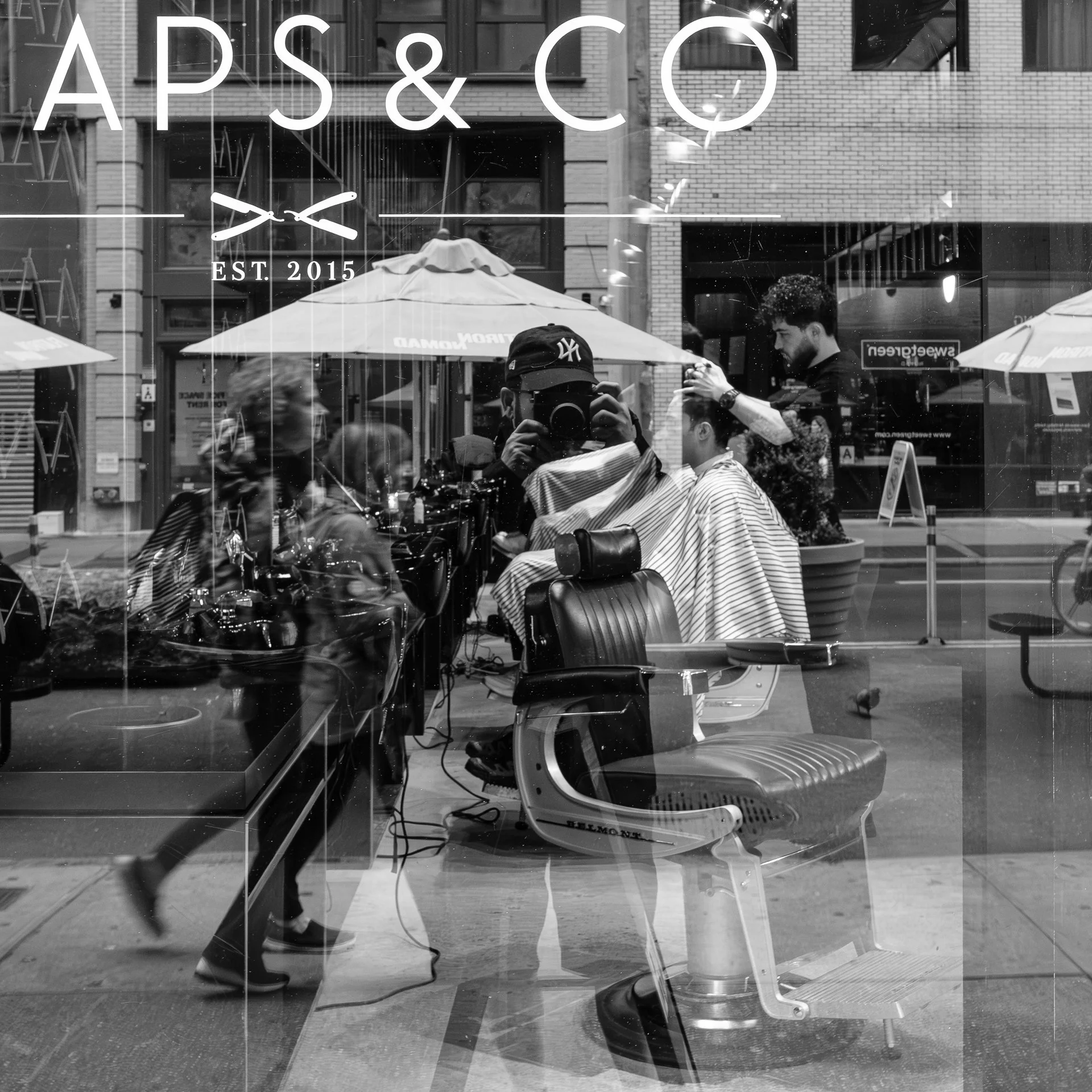
Chaps & Co, NoMad
© 2026 Jean-François Cléroux | NYC, New York, USA
A black-and-white frame built in three planes, all collapsed onto a single pane of glass. Inside the shop: a barber, bent to his work, finishing a client's cut; the client caped in stripes; a row of chairs receding along the mirrors, the nearest a beautiful old Belmont, empty and waiting. On the glass itself: the shop's lettering and the crossed-scissors mark, floating like a title card. And in the reflection: the street coming the other way — a woman in motion blur hurrying past with her bags, brick facades, café umbrellas — and you, dead centre, camera raised to your face, Yankees cap low. Three worlds — the stillness of the cut, the hurry of the sidewalk, and the act of seeing itself — held in one frame.
In my opinion, this photograph has strength, and its strength is in the layering.. The composition reads like a small theatre: foreground (your reflection, the witness), middle ground (the barber's quiet labour), background (the city streaming past). The blurred passerby is doing important work — she gives the image its sense of time, movement against the held breath of the haircut. The tonal range is rich, the lettering anchors the top of the frame beautifully, and nobody's dignity is disturbed; the barber and client are absorbed in their own moment, unwatched in any way that matters.
In the spirit of honesty: the cropped "CH" will nag at me — a half-step left and the full name would have sat complete, though the crop also gives the frame a certain found-object energy. The frame is busy; the umbrellas, lettering, chairs, and figures all ask for the eye at once, and it takes a beat to settle. And the bicycle wheel clipped at the right edge is a small loose thread. None of this unmakes the photograph. If anything, the density is the photograph — the city refusing to be tidy.
A Lineage of Workshops That Shaped My Practice
Since that first evening in 2012, workshops have become a kind of compass for me — a way of deepening my practice through the generosity and vision of others. Each photographer I’ve learned from has offered a different doorway into the street, a different way of noticing, a different relationship with the world unfolding in front of the lens.
I’ve spent time with Ian MacDonald in Vancouver, whose humanist, composition‑driven approach helped refine my instincts close to home. Ian works with a kind of quiet precision — layered scenes, clean frames, thoughtful timing. His photographs feel like street chess: patient, observant, and deeply intentional. Studying with him strengthened my appreciation for structure and balance, and reminded me that clarity often emerges from restraint.
I’ve walked the streets of Paris and New York with Valérie Jardin, whose minimalist, expressive style feels both poetic and beautifully simple. Valérie has a gift for finding extraordinary moments in ordinary life — clean backgrounds, graphic shapes, gentle gestures. Her work carries a romantic optimism, a sense that the street is full of small stories waiting to be honoured. Time with her helped me refine my own sensitivity to light, simplicity, and emotional clarity.
I’ve also spent time with Bruce Gilden at Magnum Photos in New York — a photographer whose confrontational, in‑your‑face style sits at the opposite end of the spectrum from my own. Bruce works with raw intensity: extreme close‑ups, direct flash, unfiltered expressions. His photographs are loud, gritty, and unapologetically human. Learning from him challenged me to examine my own boundaries and ethics with greater honesty, and to understand that courage in photography takes many forms — some gentle, some forceful, all revealing.
And in May, I’ll be spending six days with Peter Turnley, whose deeply humanistic style has long resonated with me. Peter photographs the heart of the street — lovers embracing, quiet tenderness, everyday humanity shaped by available light and emotional truth. His work carries the lineage of the French Humanist tradition, full of compassion, romance, and life‑affirming connection. I look forward to learning from him with a kind of quiet anticipation, knowing how profoundly a workshop can shift one’s trajectory.
Across all these experiences, one truth has remained constant: I don’t take workshops to imitate anyone’s style. I take them to expand my own — to learn new techniques, explore new approaches, and incorporate the elements that resonate with my way of seeing. Each workshop becomes a refinement, a deepening, a subtle recalibration of my voice.
There are other workshops ahead, other notable street photographers whose perspectives I hope to learn from. Each one is an opportunity to stretch, to listen, and to continue shaping a practice that remains alive, curious, and quietly evolving.
An Invitation
If you’ve been feeling the pull toward something new — a technique, a craft, a way of seeing — consider a workshop. Not as a transaction, but as an opening. A place where you can stretch, question, and rediscover the quiet joy of being a beginner.
Workshops are not about mastery. They are about momentum. They are about stepping into a space where growth is possible, and letting that possibility carry you somewhere unexpected.
I’m grateful I walked into that room in 2012. It changed my life in ways I couldn’t have predicted. And perhaps, somewhere ahead, a workshop will do the same for you.
Coming Up in The Flâneur’s Journal
Next week, we return to The Architecture of a Photographic Project with Chapter 7: The First Meaningful Shape — the moment when what might be the final shape of a project starts to (provisionally) reveal itself. We will explore how images begin to hold each other, how the first edit is an act of recognition rather than reduction, how to recognise the project's spine, and how to give the work gentle structure — scaffolding, not walls — without closing it down too soon.
Until then, keep your camera close and your attention closer. Go out and walk. Make a few quiet frames. The street is always offering — our work is simply to be there when it does. I will see you next week.