Street Poetry: A Practice of Noticing
For Street Photographers Who Want to Read — and Write — the City
Street Poetry is both older than the term and broader than any single definition. Some of it is created by the street itself — chalk lines left by strangers, torn posters that accidentally rhyme, fragments of conversation drifting through a bus shelter. Some of it is created by poets and artists who place language directly into public space. And some of it is created privately, by anyone who walks the city with enough attention to translate what they see into words.
In effect: Street Poetry is not one practice — it is four intertwined ways of noticing.
For street photographers, this matters because each of these modes sharpens the same muscles your camera depends on: patience, curiosity, ethical attention, and the willingness to be surprised. You don’t need to become a poet to benefit from Street Poetry. You only need to learn to read the city more closely — and, if you choose, to answer it with your own lines.
Street Poetry can be something you come upon, something you recognize, or something you create. It can be a literal poem on a wall, or a way of describing the city’s gestures with the same care you bring to your photographs. It is not an analogy. It is a practice of noticing — one that photographers already understand intuitively, even if they’ve never named it.
This blog post is an invitation to explore all four modes: the poetry the street makes, the poetry you find, the poetry you write from observation, and the poetry you might choose to write in response to your own photographs.
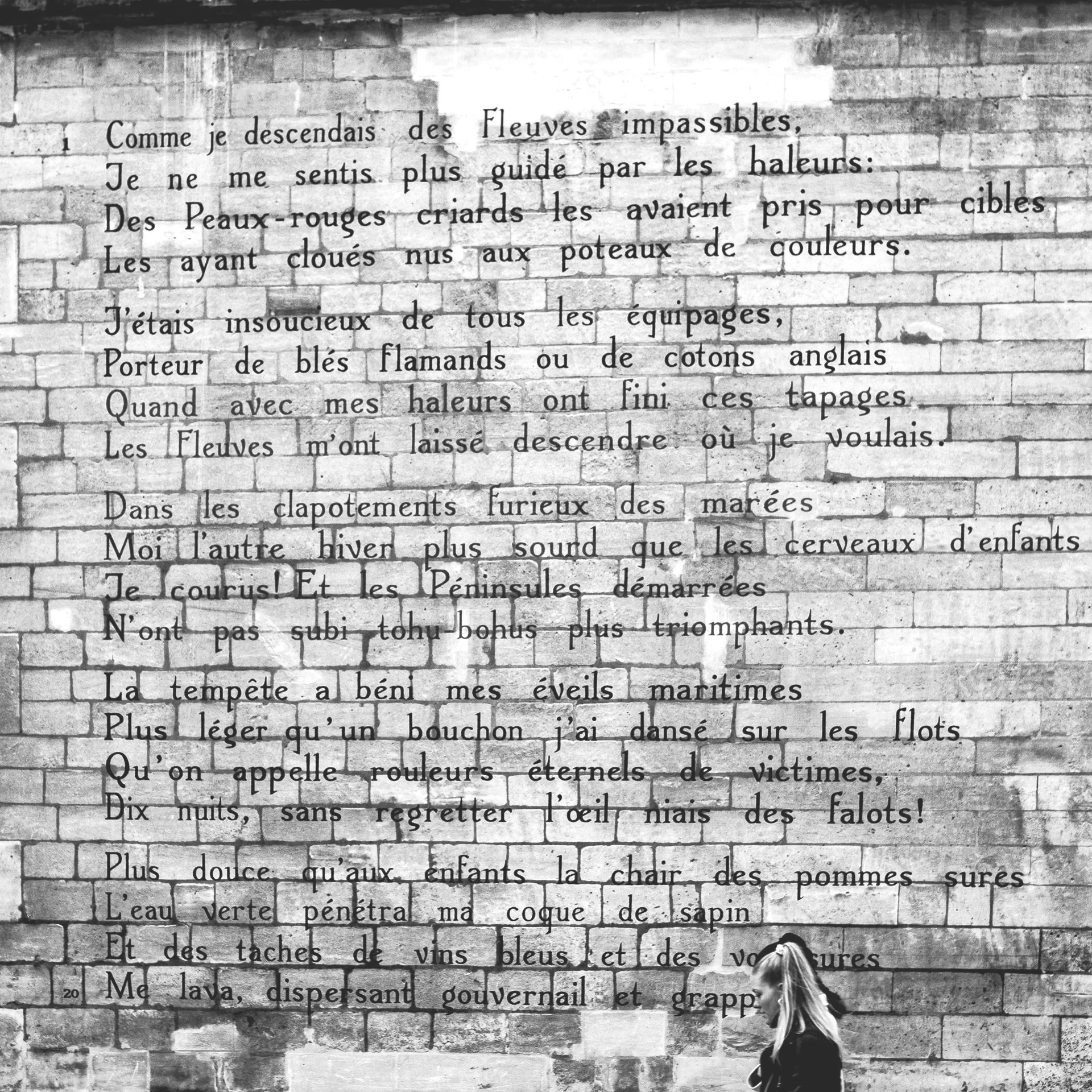
The Wall That Carries a River
© 2026 Jean-François Cléroux | Paris, France
The poem on the wall is by Arthur Rimbaud — it’s an excerpt from Le Bateau ivre (The Drunken Boat), written in 1871 when he was just sixteen.
This small, quiet street scene sits just beside the Jardin du Luxembourg and the Église Saint‑Sulpice. The wall is famous among literary wanderers — a long stone façade engraved with the opening stanzas of Le Bateau ivre. It’s one of the most beautiful intersections of poetry and architecture in the city: a poem becoming part of the street itself.
There is also a bar named Le Bateau Ivre in the Latin Quarter (40 Rue Descartes), but the engraved poem photographed is at 4 Rue Férou, not at the bar.
It’s one of the foundational poems of modern French literature: wild, hallucinatory, maritime, and revolutionary in tone. Seeing it engraved on a wall like this is a beautiful collision of street life and literary history — Rimbaud drifting through the city.
The photograph carries a quiet, cinematic gravity. The black‑and‑white treatment immediately removes it from the everyday and places it in a space of reflection. It feels like a moment caught between movement and contemplation: two passersby mid‑stride, a wall that speaks, and a city that becomes a vessel for poetry.
The figures are essential — not as subjects, but as counterpoints. Their motion animates the stillness of the engraved text. Together they become silhouettes of the modern reader, brushing past literature without necessarily stopping, yet still shaped by it.
Four Ways Street Poetry Shows Up in the City
1. The Visible Intervention
This is the work you stumble upon: a chalked line on a sidewalk, a wheat‑pasted couplet on a pole, a sticker interrupting a billboard. These pieces are quick, public, and often political. They live in the same places your photographs do — the edges, the corners, the places people pass without thinking.
2. Found Text
Some poets collect the city’s debris: classified ads, torn posters, handbills, fragments of signage. They treat these scraps as accidental poems. It’s the same impulse that makes a photographer lift a camera when a stranger’s gesture suddenly becomes a story. Found text is simply another way of reading what the city leaves behind.
3. Observational Practice
This is the quiet mode — the one closest to street photography. It’s the discipline of listening to the city and translating its gestures into language: the way rain gathers at a curb, the tilt of a shop awning, the rhythm of footsteps on a morning sidewalk. Nothing is invented; everything is noticed.
Most Street Poetry blends these modes. A wheat‑pasted poem might use found materials. A found‑text collage might be shaped by the cadence of a neighbourhood. The point isn’t to categorize — it’s to recognize the range of tools available to you.
4. Ekphrastic Street Poetry
This is the mode born directly from the photographer’s own practice. A street photographer makes an image — a moment, a gesture, a fleeting alignment — and then writes a poem in response to that photograph. The poem becomes a second act of noticing, a way of understanding the moment twice: once visually, once verbally.
It is Street Poetry because the photograph itself is a street encounter. It is Street Poetry because the poem grows from the photographer’s own seeing. It is Street Poetry because the city remains the source, even when the reflection happens later, in quiet.
This fourth mode completes the circle: the street makes poetry, the street leaves poetry behind, the street becomes poetry when observed, and the street becomes poetry again when photographed and reflected upon.
Street Poetry in Clothing
Text on clothing belongs to Street Poetry as well. A shirt, a hoodie, a tote bag — anything carried through the city that bears language — becomes a moving fragment of public text. It functions like a portable intervention: a line you didn’t expect to read, a message that enters your field of attention and shapes the moment you photograph. When a phrase on a shirt anchors a frame, as it does in Mental Fitness Club, it becomes the first line of the city’s poem. You didn’t write it, but you recognized it, and that act of recognition is part of the practice. Clothing text is found poetry, visible intervention, and sometimes the seed of an ekphrastic response — a reminder that language moves through the street on bodies as much as on walls.
The Deeper Truth
Street Poetry isn’t limited to “poems” in the traditional sense. It’s any moment where language enters the street and becomes part of how we see.
A hoodie. A billboard. A chalk line. A torn poster. A whispered sentence. A street sign. A tattoo. A handwritten note taped to a door.
All of these are Street Poetry when they shape the encounter.
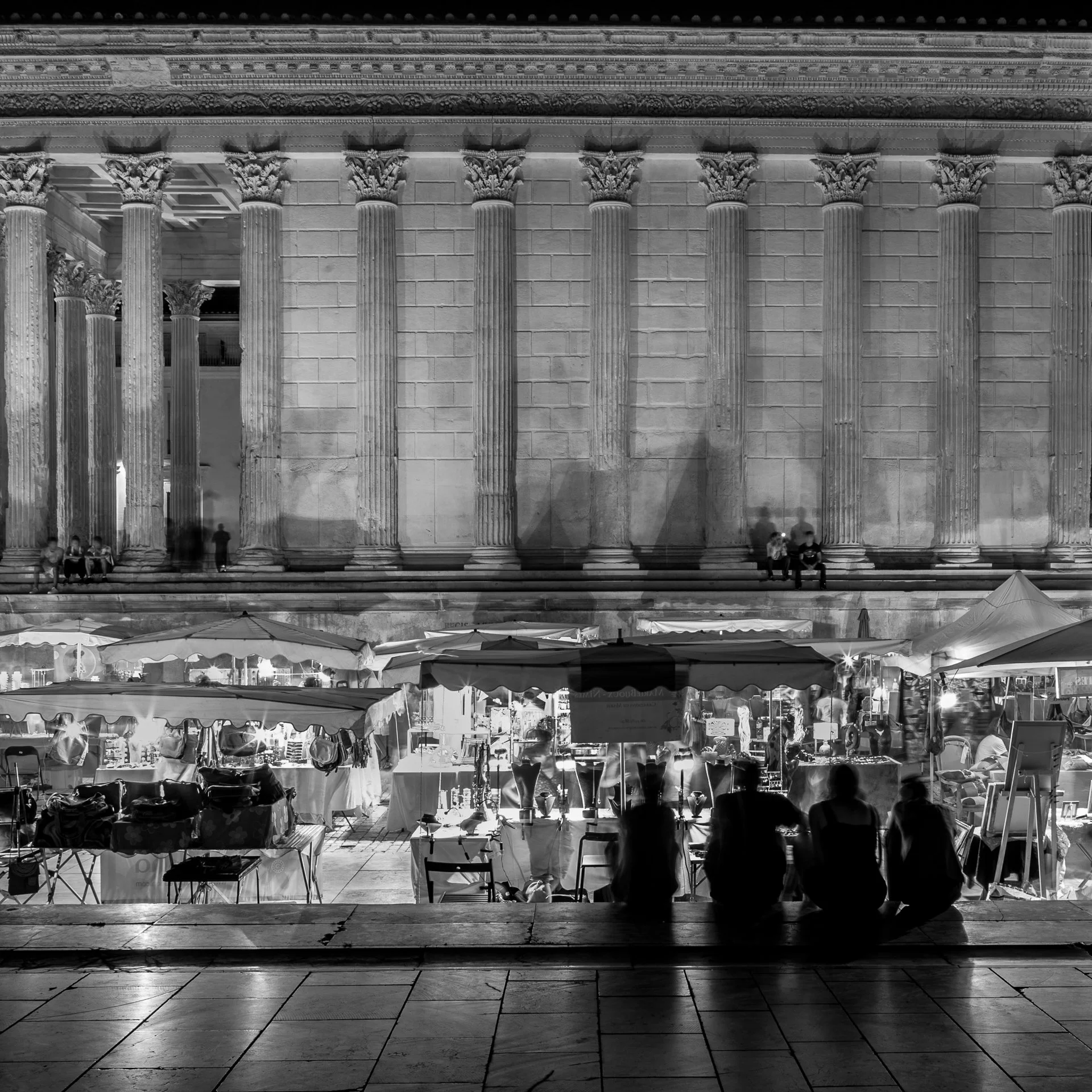
Seeing the Whispers,
Hearing the Images
© 2026 Jean-François Cléroux | La place de la Maison Carrée, Nimes, France
I walk the city as a flâneur observes and listens—
with deliberate slowness and attention,
waiting for the streets to reveal their first whisper.
Every street is a pulse,
every corner a held breath,
every passerby a fleeting stanza
in a poem too large to finish.
I am only its witness—
a flâneur drifting through its arteries,
collecting the soft confessions
that spill from neon signs,
open windows,
and the hush between footsteps.
The camera hangs at my side
like a listening instrument,
tuned not to light alone
but to the tremor beneath it—
the quiet negotiations
between shadow and intention,
between a stranger’s posture
and the story they almost tell.
Some days the city speaks in silhouettes,
other days in reflections—
faces carried in puddles,
dreams caught in bus‑stop glass,
the sky folding itself
into the chrome of a passing bicycle.
I do not chase moments;
I let them find me.
A poet knows better
than to interrupt a whisper.
A photographer knows
that the world reveals itself
only when unobserved.
So I wander—
half student, half accomplice—
learning the city’s dialect
of rust and rhythm,
its grammar of drifting leaves,
its syntax of distant sirens
and the soft click of my shutter
answering back.
And in this quiet exchange,
I become part of its memory—
a moving dot on its map,
a keeper of its small miracles,
a translator of its everyday grace.
The city is not mine.
But for a breath,
for the length of a frame,
it lets me listen.
It lets me see.
It lets me belong.
— Jean-Francois Cleroux
The Street as Text, the Photographer as Reader
To practise Street Poetry is to treat the city as a living text. Every surface carries tone: brick, tile, metal, paper. A line written on a bench outside a shelter will be read differently than the same line inside a gallery. Scale, placement, and material matter — not just aesthetically, but ethically.
Street photographers already understand this. You know how context changes meaning. You know how a gesture reads differently depending on where it happens. Street Poetry simply extends that awareness into language.
The work is not to extract metaphors from the city but to translate its specificity. To write what is actually there. To let the street set the rhythm.
Practice, Presence, and Ethics
Street Poetry is a discipline of attention. The habits are simple:
walk without your phone
carry a small card for fragments
describe what you see before you interpret it
Short lines travel well. The street rewards brevity. A passerby should be able to read your poem in a glance and carry it for a block or two.
Ethics matter. If your line concerns a recognisable person, consider what exposure means. If you place a poem near a shelter or a school, understand how context shifts the reading. Claiming space is not neutral; it affects the people who live there. The best street interventions provoke thought without exploiting vulnerability.
Surprise is powerful. Care is necessary.
Where Image and Line Meet
Street photography and Street Poetry are siblings. One compresses a moment; the other unfolds it. When they meet — in a book, on a wall, in an ekphrastic pairing — each strengthens the other. A photograph gives a poem a body. A poem gives a photograph a voice.
Good pairings come from shared attention. They also come from shared responsibility: thinking about scale, readability, placement, and how a viewer will encounter the work. A poem beside a photograph is not decoration; it’s dialogue.
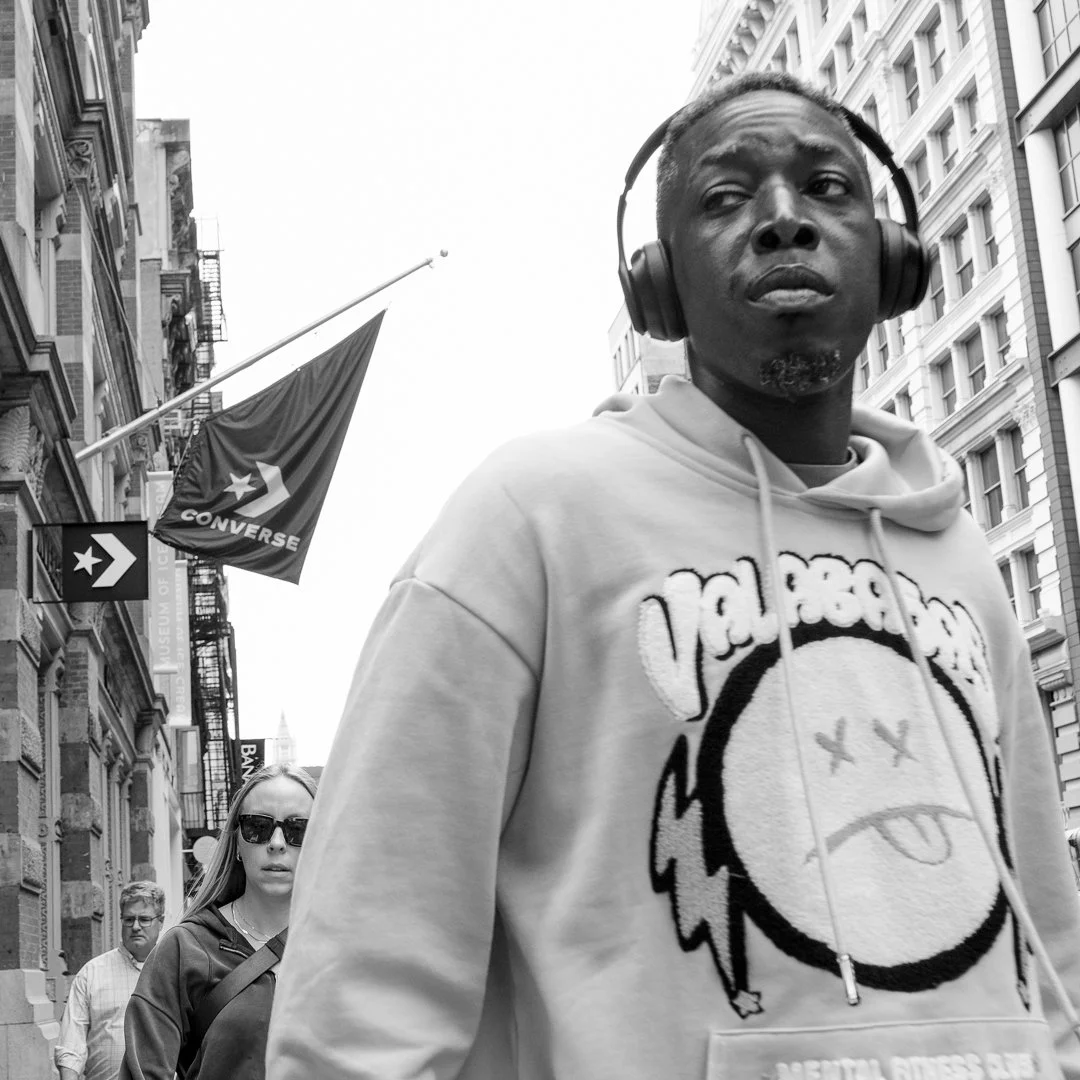
Mental Fitness Club
© Jean-Francois Cleroux | New York, NY, USA
This photograph succeeds because the viewer’s eye moves through it in a clean, circular rhythm. From the face to the bold text on the hoodie—VALABASAS / MENTAL FITNESS CLUB—anchors the frame and becomes the natural entry point. From there, the gaze drifts backward to the layered pedestrians, whose staggered positions create depth and a gentle diagonal pull into the mid‑ground.
Once the eye reaches the background, the repeating and directing Converse signage acts like a visual hinge. The flag shapes and arrow‑like angles subtly redirect the viewer back toward the foreground figure, completing a loop. This circular flow—shirt → pedestrians → signage → pedestrian → shirt—gives the image cohesion and keeps the viewer engaged longer than a typical street portrait.
The monochrome treatment strengthens this effect by reducing distraction and emphasizing shape, posture, and text. The result is a candid street moment that feels both graphic and fluid, held together by a quietly intentional visual circuit.
In Mental Fitness Club, the shirt is not just clothing — it’s the first line of the city’s poem.
An Expanded Invitation
Street Poetry is not a genre — it’s a way of moving through the world. It asks you to slow down, to notice, to answer. It invites you to treat the city as a conversation partner rather than a backdrop. And it reminds you that anything placed in public — a photograph, a poem, a fragment of text — becomes part of a shared space where meaning is shaped by everyone who passes.
If you’re a street photographer, this practice will make you better. Not because you’ll write poems (though you might), but because poetry trains the same muscles your camera depends on: patience, attention, humility, curiosity, and the willingness to be surprised.
So here is the invitation:
Walk a little slower. Read the walls. Notice the chalk. Pick up the torn poster. Listen to the overheard sentence. Let the city’s small gestures teach you how to see again.
And when you’re ready, place your own lines — or your own photographs — into that conversation. The city will fold them in, erase them, paste over them, and change them. That isn’t failure. That’s collaboration.
Street Poetry is simply a way of joining the ongoing civic exchange — one that asks us to listen more closely, speak more carefully, and treat language, like light, as a shared resource.
If you choose to answer, do so with craft, care, and the humility public attention requires.
For more information on the types of Street Poetry, please check this past blog post titled Urbopoetics, City Poetry and Street Poetry.
Urbopoetics, City Poetry, and Street Poetry
For readers who want to explore the wider landscape of Street Poetry — its lineages, related practices, and the vocabulary that connects walking, writing, and photographing the city — you may enjoy an earlier post titled Urbopoetics, City Poetry, and Street Poetry. It offers a deeper look at how poets, photographers, and flâneurs have used the city as both method and material.
Coming Up in The Flâneur’s Journal
As we step out of Street Poetry and return to the wider practice of wandering, we arrive at a question that sits quietly beneath every frame we make: What does it mean to move through the city with intention? Not intention as agenda, but intention as presence — a way of walking that shapes how we see, how we listen, and how we choose our moments.
Next week, the series turns toward Diaries Without Words: Manifesto for the Street Photographer and the Modern Flâneur — a piece about the compass behind the practice. It’s an exploration of how wandering becomes devotion, how a manifesto becomes a form of clarity, and how the discipline of drifting can deepen both your photography and your relationship with the city.
We’ll look at why street photographers need a philosophy, how a manifesto steadies the work, and how the act of walking — slow, curious, unhurried — becomes a way of writing a diary without words. It’s a continuation of the same thread we’ve been pulling: attention, ethics, presence, and the quiet courage of noticing.
If Street Poetry teaches us to listen, the manifesto teaches us to walk with purpose — to understand not just how we photograph, but why.
More soon. Keep walking. Keep noticing.