Challenging Your Visual Logic
The Evolving Photographer — Part VI on Creative Growth
and the Art of Seeing
In Part V, we stepped into the quiet, revealing work of refinement — learning to listen more closely to what our images were already trying to say. Through editing, we began to recognise the deeper threads running through our photographs, the emotional registers we trust, and the subtle patterns that shape our way of seeing. It was a chapter about clarity, intention, and the slow emergence of a voice that feels unmistakably our own.
Now, in Part VI, we enter the final movement of this series — the place where clarity meets challenge. This chapter invites you to push gently against the edges of your habits, to question the visual logic you’ve built, and to explore the unfamiliar spaces just beyond your comfort. Growth often begins where certainty softens, and where your instincts are asked to stretch, adapt, and evolve.
This is the part of the journey where friction becomes a teacher. Where experimentation becomes a form of inquiry. Where you learn not only to trust your voice, but to expand it.
Before your work can deepen, it must be tested. And challenging your visual logic is where that deepening begins.
The Conclusion of a Six‑Part Journey.
There comes a point in every photographer’s evolution when clarity is no longer the challenge — comfort is. You’ve traced your influences, studied the work that shaped you, recognised your own tendencies, and begun refining your visual voice with intention. You’ve learned to listen to your images, to understand what they reveal, and to shape your choices with a steadier hand.
But growth has one more demand: you must be willing to unsettle yourself.
Part VI is about friction — the deliberate, thoughtful kind. The kind that nudges you beyond the edges of your habits, not to abandon your voice, but to expand its vocabulary. This is where your visual logic is tested, stretched, and re‑imagined. This is where you discover what your work could become if you allowed yourself to move differently through the world.
This final chapter is not about breaking your style. It is about widening the doorway through which it can grow.
When Your Habits Become Too Comfortable
Every photographer develops a set of unconscious rules — the distances they trust, the light they return to, the rhythms that feel natural. These rules are not mistakes; they are the scaffolding of your voice. But over time, scaffolding can become shelter, and shelter can become limitation.
Challenging your visual logic begins with recognising where comfort has quietly become constraint.
Perhaps you always stand at the same distance. Perhaps you favour the same emotional temperature. Perhaps your frames resolve too neatly, or your timing has become predictable. Perhaps you avoid certain kinds of scenes because they feel too chaotic, too intimate, too uncertain.
These patterns are not problems. They are invitations.
Growth begins when you ask: What am I avoiding — and why?
Friction as a Creative Tool
Friction is not the enemy of clarity; it is the catalyst for it. When you introduce small, intentional disruptions into your practice, you begin to see differently — not because your instincts disappear, but because they are forced to adapt.
A few examples of gentle friction:
Change your distance — stand closer than you usually would, or farther than feels natural.
Shift your timing — press the shutter a beat earlier or later than your instinct suggests.
Work in unfamiliar light — embrace harsh midday sun or deep shadow if you usually avoid them.
Follow a different rhythm — walk slower, or faster, or let the city lead you instead of your plan.
Photograph what unsettles you — not to provoke, but to understand.
These are not exercises in discomfort for its own sake. They are ways of loosening the grip of habit so your seeing can breathe again.
Friction reveals possibilities that comfort hides.
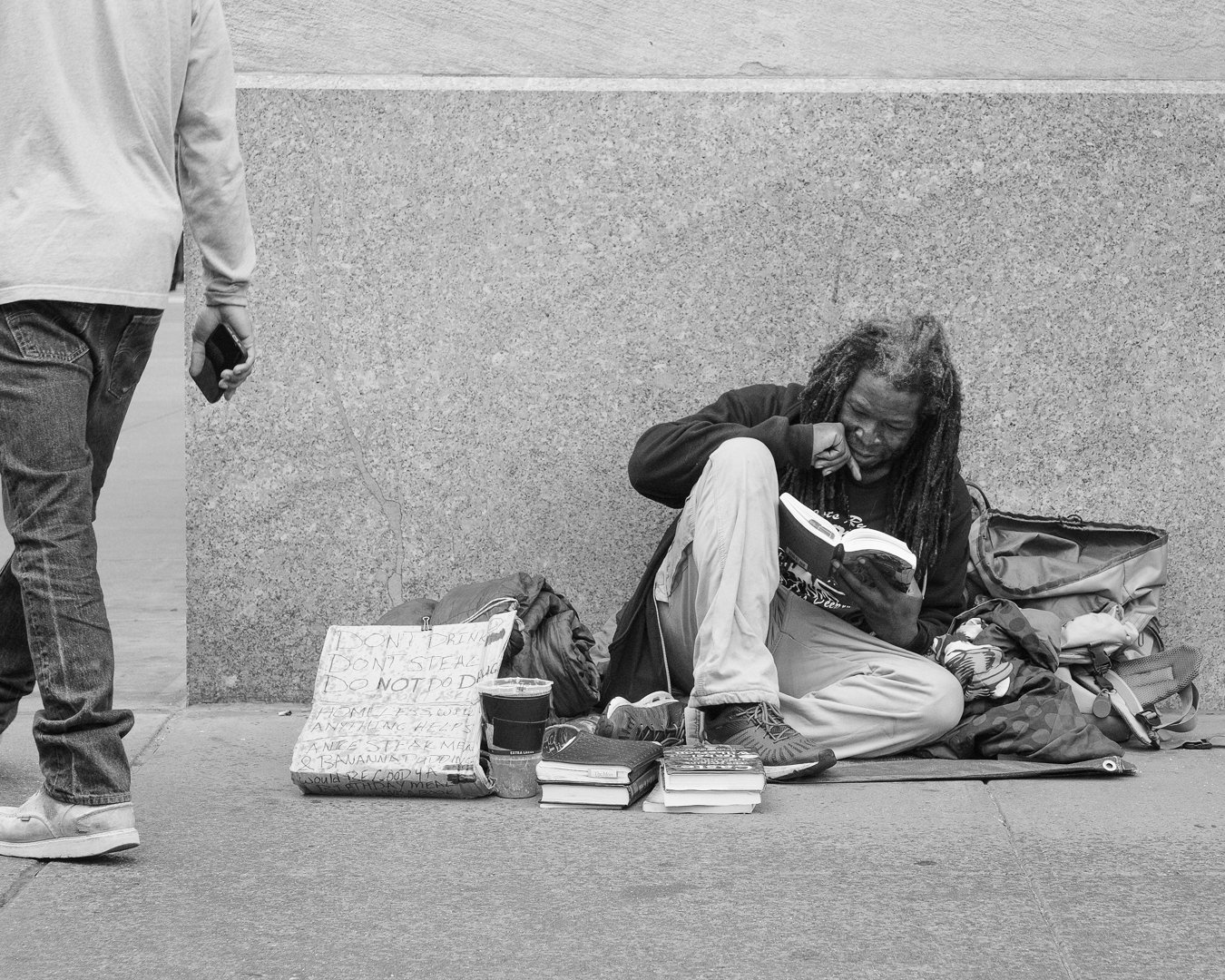
The Reader at the Edge of the Day
© 2026 Jean-François Cléroux | New York, NY, USA
There’s a tenderness in this frame — a person seated on the pavement, absorbed in a book, surrounded by the small constellation of their belongings. The stone wall behind them acts almost like a proscenium, giving the moment a sense of stillness. What anchors the image is the contrast between the reader’s inwardness and the passerby’s hurried stride, phone in hand. One life paused, one life in motion. The photograph holds that tension without judgement. If anything, I’d encourage a slightly lower angle or a half‑step closer to deepen the intimacy, but the gesture you’ve caught — concentration amid the city’s indifference — is quietly affecting.
The Productive Discomfort of Experimentation
Experimentation is often misunderstood as novelty — a search for something new. But true experimentation is quieter than that. It is the willingness to enter a scene without knowing what you expect from it. It is the humility to be surprised by your own reactions. It is the courage to let your instincts be challenged without abandoning them.
When you experiment, you are not trying to reinvent yourself. You are trying to understand yourself more fully.
Some experiments will fail. Some will feel awkward or forced. Some will produce images that do not belong to your voice at all. But each attempt teaches you something about the boundaries of your seeing — and the edges of your becoming.
Growth rarely feels graceful. It feels like learning to walk again.
Seeing Beyond Your Own Logic
Every photographer carries a visual logic — a way of organising the world, a way of interpreting gesture, light, and space. This logic is shaped by your influences, your temperament, your history, your fears, your desires. It is the architecture of your seeing.
But architecture can be expanded.
Challenging your visual logic means asking questions that unsettle your assumptions:
What if the frame doesn’t resolve?
What if tension is allowed to remain unresolved?
What if the subject is not centred — visually or emotionally?
What if ambiguity is not a flaw but a form of truth?
What if the photograph is less about clarity and more about atmosphere, or rhythm, or uncertainty?
These questions are not meant to dismantle your voice. They are meant to deepen it.
Constraint as a Pathway to Freedom
As your voice matures, constraint becomes less of a limitation and more of a compass. Working within boundaries — whether self‑imposed or circumstantial — forces your attention to sharpen. It asks you to make choices with greater intention. It reveals what matters most.
Try limiting yourself to:
One lens for a month
One neighbourhood for a week
One theme for a season
One emotional register
Constraint is not about narrowing your vision. It is about clarifying your direction.
When you remove excess possibility, your voice becomes more articulate.
Letting Your Work Surprise You
The most profound shifts in a photographer’s evolution often come from images that feel slightly out of character — frames that don’t fit neatly into your existing logic. These photographs are not anomalies; they are signals.
When an image surprises you, pause. Ask what it reveals about your instincts. Ask what it suggests about where your work might be heading. Ask whether it is pointing toward a new thread in your voice.
Surprise is often the first sign of growth.
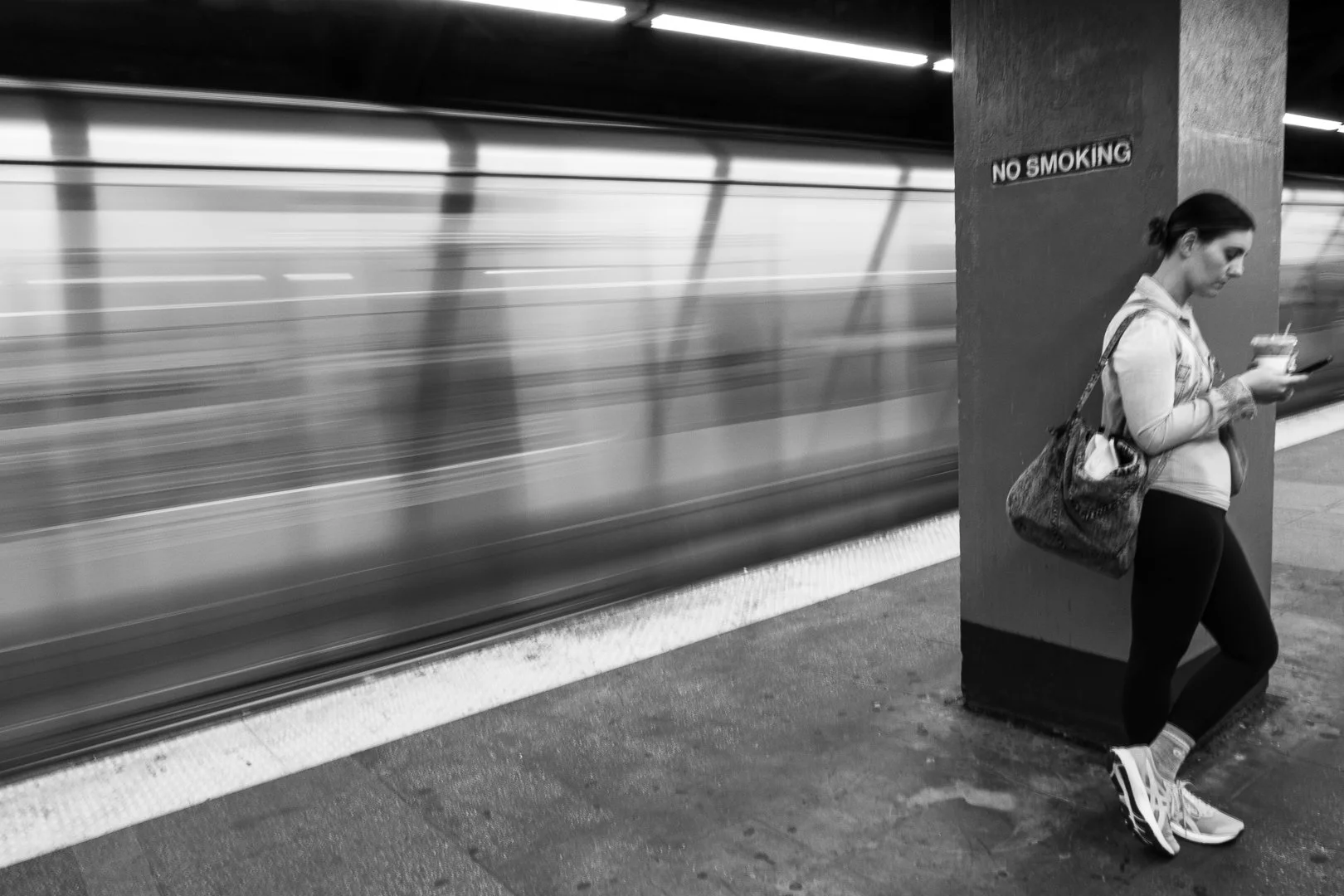
Stillness Between Trains
© 2026 Jean-François Cléroux | New York, NY, USA
What strikes me first is the clean, graphic contrast between the figure anchored to the pillar and the train rushing past in a blur. The photograph lives in that tension: one body suspended in its own small moment — drink in hand, phone glowing — while the city moves at full speed behind them. The “NO SMOKING” sign becomes an unintended visual anchor, a small square of clarity in a field of motion.
The framing is strong: the pillar divides the scene without severing it, and the blur of the train adds a sense of velocity that the figure’s stillness quietly resists. If anything, I might suggest exploring a slightly wider frame next time to give the environment a bit more breathing room — but the core gesture is already there. You’ve caught a moment where the world moves and the person doesn’t, and that contrast is the photograph’s pulse.
The Ongoing Nature of Evolution
This final chapter is not an ending. It is a threshold.
Challenging your visual logic is not a phase you complete; it is a practice you return to whenever your work begins to feel too familiar, too comfortable, too resolved. Your voice will continue to shift as your life shifts. Your questions will change as your attention changes. Your photographs will evolve as you evolve.
Creative growth is not a straight line. It is a spiral — returning, deepening, widening, clarifying.
And the art of seeing is not something you master. It is something you inhabit.
Closing Reflection for the Series
This six‑part journey of Creative Growth and the Art of Seeing has been a slow conversation with the way I move through the world and the way the world moves through me. I began by gathering the people and books that shape my seeing, then mapped the many languages of street photography so I could recognise where my instincts already lived. I learned to study the work that teaches me, to look inward and name the patterns that recur in my own frames, and to listen carefully in the quiet room of editing where those patterns begin to speak with clarity. Finally, I invited friction — deliberate experiments and constraints that unsettle habit and open new possibilities.
Taken together, these parts are less a set of rules than a practice: a way to steward attention, to translate influence into authorship, and to hold your work with both tenderness and rigour. Influence becomes insight when you study it; habit becomes voice when you recognise it; selection becomes authorship when you edit with care; and clarity becomes growth when you are willing to be unsettled.
If there is one invitation I leave you with, it is this: keep the work slow enough to hear what it says. Build a library that teaches you, a catalogue that orients you, and a habit of editing that listens. Then, when the work feels too familiar, step toward the friction. Let constraint sharpen you. Let surprise teach you. Let your voice be tested and, in that testing, deepen.
The city will keep offering its small, luminous moments. Keep showing up. Keep choosing. Keep refining. The work of seeing is lifelong, and the life it opens is quietly, insistently generous.
Coming Up in The Flâneur’s Journal
As we close this chapter of The Evolving Photographer, we return to the quiet truth that growth often happens sideways rather than forward. A shift in attention, a new way of listening, a different pace on the street—these small recalibrations shape the work more than any dramatic breakthrough.
Next week, the series steps into a different but deeply connected terrain with “Street Poetry: A Practice of Noticing.” It’s an exploration of how language and image share the same ground: the sidewalk, the storefront, the overheard fragment, the fleeting gesture. We’ll look at how poetic attention sharpens photographic attention, how the city becomes a text you learn to read, and how noticing becomes a discipline that crosses mediums.
If photography teaches us to see, Street Poetry teaches us to listen. Together, they form a practice of presence—one that keeps evolving long after the shutter closes.
More soon. Keep walking. Keep noticing.