Micro‑Missions for Better Seeing
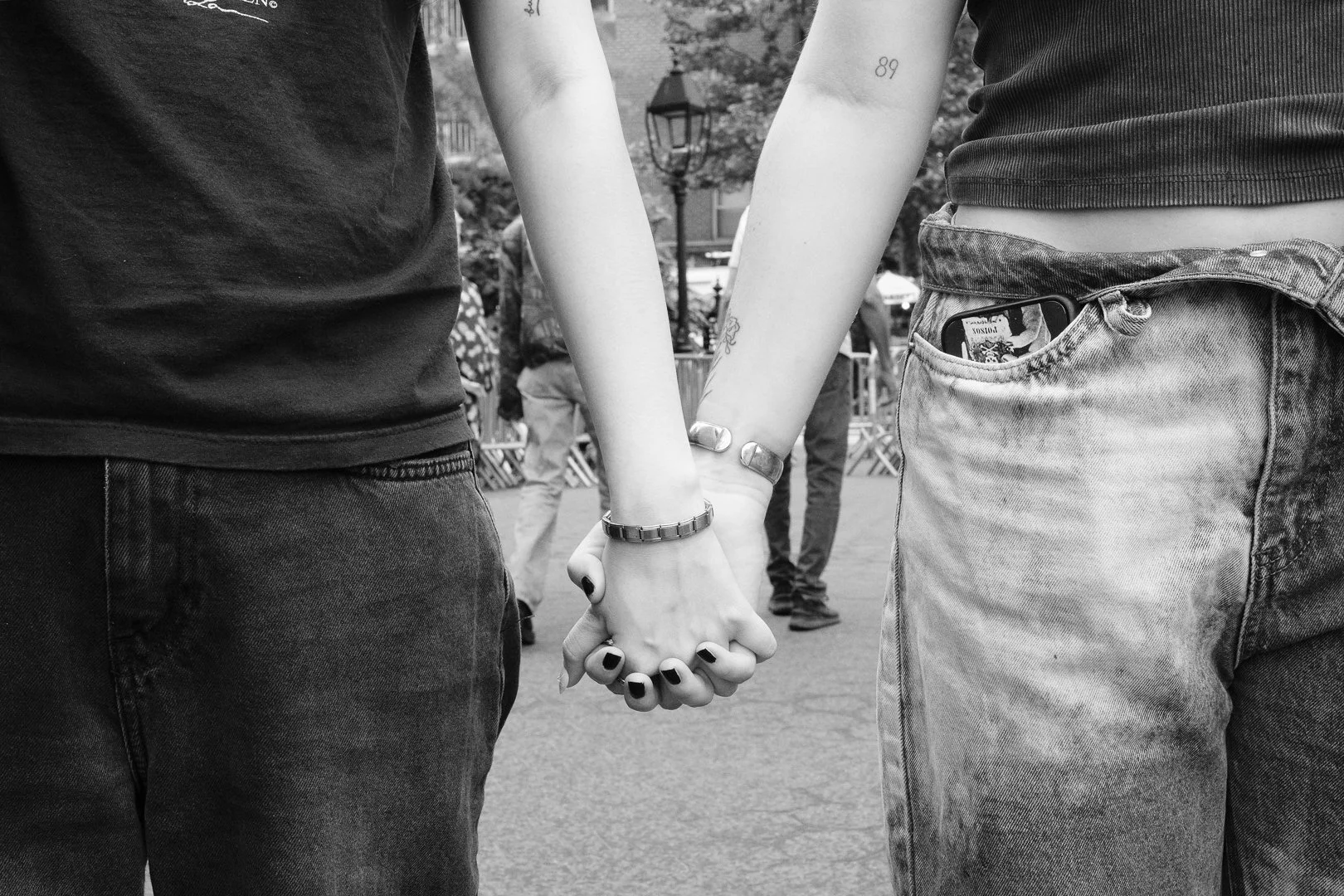
A Quiet Contract
Two hands meet at the frame’s center like a small, deliberate punctuation—an intimate verb in a sentence of public life. The black‑and‑white treatment strips color away and leaves only texture, line, and contrast: denim and skin, bracelets and tattoos, the soft geometry of fingers against the hard geometry of the street. The image reads as both a private promise and a public act, a moment of tenderness that insists on being seen without demanding explanation.
Why micro‑missions matter
Micro‑missions are short, repeatable tasks that force selective looking and reduce decision fatigue. They convert wandering into disciplined play: by narrowing the field of attention you train pattern recognition, sharpen visual vocabulary, and accelerate the instinct to recognise meaningful relationships in the street. This blog post explains why micro‑missions work, it provides concrete mission templates, describes how to run simple ten‑minute missions in a single outing, and offers variations and progressions that deepen perception over months.
A camera invites endless choices—lens, exposure, angle, subject—and that abundance produces hesitation. Micro‑missions impose constraints that simplify decisions and free cognitive bandwidth for seeing. Constraints do three things:
Focus attention — A tightly defined task—shoot hands, find reflections, capture a single shadow—does more than give you something to photograph; it trains your eye to treat a small set of visual signals as important. Repeating the same narrow search primes perception so that those forms pop out of clutter: a hand becomes a unit of meaning rather than just another object in the frame. That shift turns vague noticing into selective attention, so you begin to register subtle variations—finger tension, the way light grazes knuckles, the relationship between hand and gesture—that would otherwise be lost in a general sweep of the street.
Build pattern recognition — Over time this selective attention builds a refined internal vocabulary. Instead of seeing “a hand,” you see types of hands and the micro‑differences that make one image stronger than another: isolated against negative space, partially obscured by motion, echoing a line in the background, or interacting with an object. Those distinctions become mental shortcuts—compact rules you can apply in a second—so when you’re shooting freely you no longer need to deliberate over every choice. You notice a compositional opportunity, evaluate it against the heuristics learned in micro‑missions, and act with confidence much faster. The result is frames that are more economical (they contain only what matters), more decisive (you press the shutter for the right reason), and more expressive (small gestures carry narrative weight).
Reduce perfectionism — Short, time‑boxed exercises lower the emotional cost of failure and normalize rapid experimentation. That tolerance for imperfection makes you bolder in open situations—more willing to try an unusual angle or to accept a near‑miss as useful learning rather than a loss.
Attentional habits — Micro‑missions rewire where you look first and what you value second. Instead of scanning for obvious subjects, you begin to notice subtle cues—texture, micro‑gesture, light catching a sleeve—that often make the difference between a competent frame and a memorable one.
Integrated workflow — The mental loop of notice → decide → act → review becomes shorter and more reliable. Post‑shoot reflection on micro‑missions sharpens your internal feedback: you recognise which compositional moves worked and which didn’t, so future choices are better informed.
Over time, the habits formed in micro‑missions transfer to open shooting: you begin to recognise compositional opportunities faster and to make confident, economical frames.
Core micro‑mission subjects
Use these as starting points. Each mission is deliberately simple so you can repeat it often.
Hands — Capture hands in action: holding, pointing, resting; look for tension, line, and relationship to objects.
Shoes — Photograph footwear and the ground they move across; study posture, wear, and implied motion.
Doorways — Frame thresholds, entrances, and the gestures that occur at points of transition.
Reflections — Hunt for doubled worlds in glass, puddles, and polished metal; note how reflections complicate identity.
Textures — Isolate surfaces—peeling paint, wet pavement, rust—and place a human element in relation to them.
Silhouettes — Seek strong shapes against bright backgrounds; focus on posture and negative space.
Each template trains a different perceptual muscle: hands teach gesture, shoes teach posture and rhythm, doorways teach narrative tension.
Three 10‑minute missions in one outing
Structure an outing as three concentrated rounds; the brevity preserves energy and forces decisive seeing. Treat each round as a study in the fragment: a detail shot isolates a small, telling element of the urban scene—a hand on a railing, a scuffed shoe, a torn poster, a single window latch—so that the fragment accrues meaning beyond its literal part. Unlike wide contextual frames that map setting and relationships, a detail shot compresses narrative into texture, line, gesture, or color; its power is suggestion, inviting the viewer to imagine the world that lies just outside the frame.
Mission 1 — Warm‑up (10 minutes)
Choose a simple target (e.g., hands). Walk the chosen area slowly, making only observational frames. Aim for quantity with attention: 10–20 quick frames.
After ten minutes, pause and note one recurring pattern you observed.
Mission 2 — Constraint (10 minutes)
Change the constraint (e.g., doorways). Now add a compositional rule: include at least one strong diagonal in each frame or keep the subject in the left third. Make 6–10 deliberate frames.
After the round, review mentally which frames read clearly and why.
Mission 3 — Experiment (10 minutes)
Choose a hybrid target (e.g., shoes + reflection) and one technical experiment (low angle, slow shutter, or shallow depth). Make 4–6 considered frames that test the hypothesis.
End with a quick selection: choose a single image to keep and distill its value into one precise sentence. This can be the hardest part: finding the words to describe what the frame actually does. Learning to express yourself—and to use a concise visual vocabulary to name light, gesture, and compositional intent—may not come naturally, but that difficulty is the work. Practice the one‑sentence justification until it becomes a habit; the discipline of naming will refine your eye as surely as any hour on the street.
Practical cues when you “shoot hands”
Isolation — Look for moments when a hand is visually separated from competing elements. That separation can come from light (a hand caught in a shaft of sun), shadow (a palm emerging from darkness), or depth of field (a sharply focused hand against a soft background). Isolation makes the hand read as a subject rather than a detail; when you see it, try tighter framing or a shallower aperture to emphasize that separation.
Gesture — Attend to the quality of motion or posture: is the hand tense, relaxed, reaching, pointing, or resting? Small changes in finger curl, wrist angle, or muscle tension alter the emotional tone—an open palm can read as invitation, a clenched fist as resistance. Wait for the moment when the gesture resolves into a clear shape; often the most expressive instant is the fraction of a second before or after an obvious action.
Relationship — Notice how the hand connects to other elements: a face, an object, a surface, or another body. A hand touching a cheek tells a different story than the same hand holding a cigarette; a hand near a child’s shoulder implies care, while the same hand against a railing can suggest solitude. Compose so the relationship is legible—move to include the contextual cue that gives the hand meaning, or exclude distracting context to keep the hand’s action ambiguous on purpose.
Rhythm — Watch for repetition, contrast, and pattern. Multiple hands in a frame create visual rhythm; a single hand breaking a repeated pattern becomes a focal point. Look for echoes—lines, shapes, or gestures that repeat across the frame—and decide whether to reinforce that rhythm or to isolate a hand as a counterpoint. Rhythm helps you decide where to place the hand within the frame and whether to emphasize symmetry, interruption, or flow.
Quick practice tips
When you spot a promising hand, pause for one breath and ask: is it isolated, gestural, relational, or rhythmic?
Try two frames: one tight on the hand, one wider to show context; compare which tells the story better.
Use short bursts (10–20 minutes) to keep attention sharp and to collect many small variations.
This structure balances exploration, constraint, and experimentation—three modes that together accelerate learning.
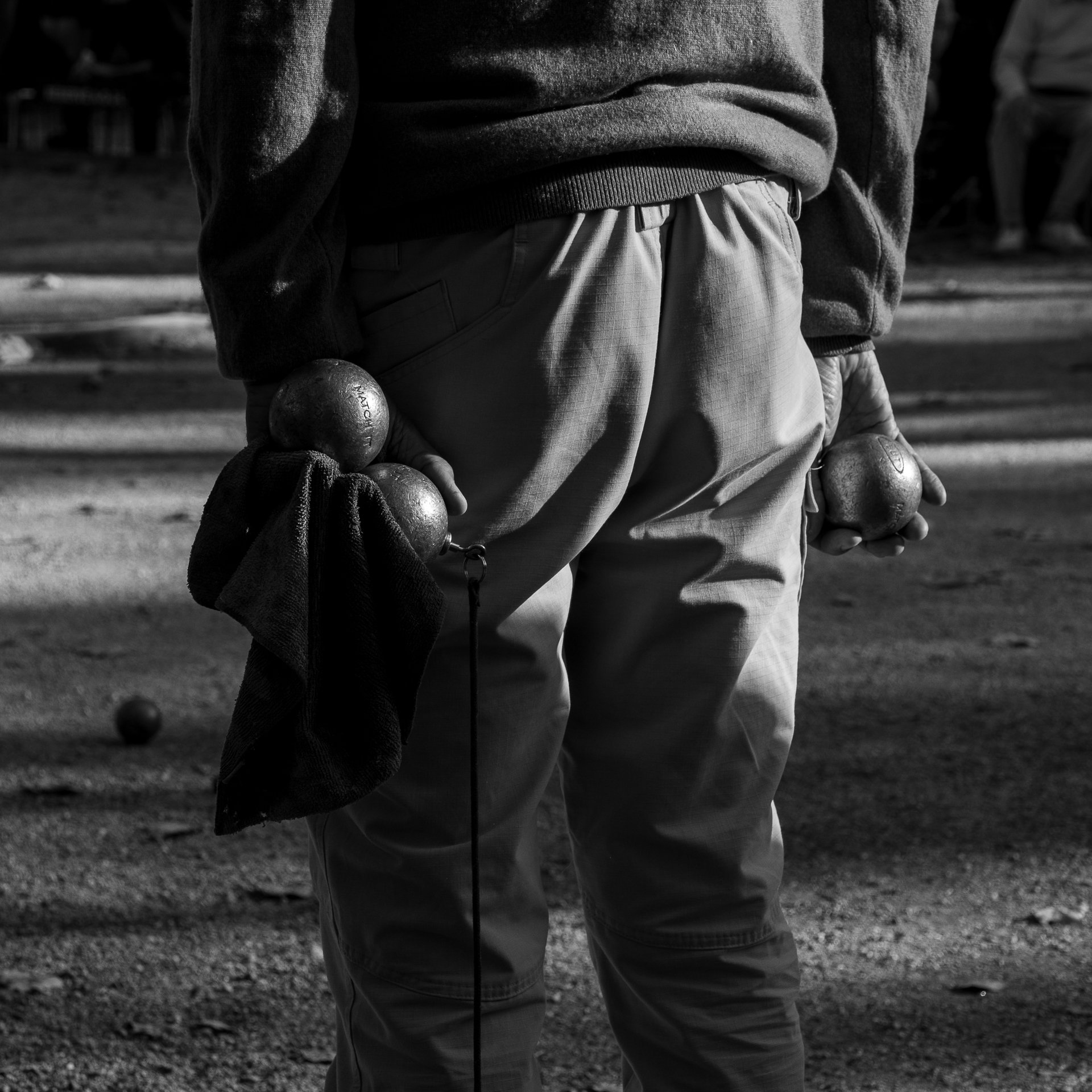
Evening Measure
His weathered hands hold the game like a small, private liturgy: three worn pétanque boules cupped in skin that remembers seasons. The late light slips across metal and knuckle, turning scuffs into a map and the faint dents into punctuation marks of past throws. In that narrow plane between palm and ball the world contracts—years of aim, laughter, argument, and patience—until the object is less a tool than a biography you can hold.
How micro‑missions build visual vocabulary
Repeatedly isolating a single element trains you to see its variations and expressive range. After ten sessions of a “hands” mission you will begin to recognize:
Gesture archetypes — the handful of hand shapes that recur and what they tend to signify.
Lighting preferences — which light best sculpts hands in your style.
Compositional instincts — where to place a hand in the frame for maximum narrative clarity.
That vocabulary becomes a mental library you can call on in open shooting: when you see a hand, you already know the likely compositional solutions and can act quickly.
Editing and feedback rituals
Micro‑missions are only useful if followed by disciplined review.
Immediate triage — within an hour is best but at the very least try to get it done that evening; delete obvious failures and mark three candidates for deeper review.
One‑image justification — for each candidate, write one sentence explaining why it works (gesture, light, contrast). If you cannot justify it, remove it.
Monthly pattern audit — after four missions, look for recurring strengths and weaknesses; adjust future missions to address gaps.
Pairing missions with short, structured editing trains both capture and curation muscles.
Variations and progressions
To avoid habituation, rotate constraints and raise the difficulty gradually.
Time compression — reduce mission length to five minutes to force faster decisions.
Single‑lens rule — use one focal length for the entire outing to encourage movement and framing invention.
No faces — make a session without showing faces to sharpen reading of posture and context.
Color focus — limit yourself to scenes dominated by a single color to heighten chromatic sensitivity.
Sequence mission — instead of single frames, make a three‑image sequence that reads like a micro‑story.
Progression should feel like a ladder: each new constraint builds on the perceptual gains of the previous ones.
Common obstacles and fixes
Decision fatigue — if you feel overwhelmed, reduce the number of missions per outing to one and repeat it weekly.
Over‑editing — avoid polishing every frame; keep a “work in progress” folder for experiments.
Repetition boredom — introduce a playful rule (shoot only reflections that include a red object) to re‑ignite curiosity.
Performance anxiety — practice missions in quieter neighborhoods or during off‑peak hours until confidence grows.
These fixes keep the practice sustainable and creatively generative.
Outcome: sharper, faster visual decisions
After consistent practice, micro‑missions yield visible, measurable change: you make stronger compositional choices with greater speed, you recognize meaningful patterns at a glance, and your editing becomes markedly more decisive. The repeated narrowing of attention trains both eye and hand so that framing, exposure, and timing become instinctive rather than tentative; what once required deliberation now arrives as a confident, almost automatic response. As your visual vocabulary grows, the camera stops functioning as a safety blanket for indecision and becomes instead an instrument of inquiry—a tool you use to test hypotheses about light, gesture, and place.
Which three micro‑missions will you schedule for your next outing, and which constraint will you add to make the second mission more challenging?