How to approach a scene without forcing it.
Street Photography as an Act of Allowing
In street photography, the biggest mistake is believing you’re there to take something from the scene. You’re not. You’re there to meet it.
When you force a moment—chasing it, over-directing your attention, tightening your grip on what you hope to find—you stop seeing what’s actually happening. The world becomes a checklist instead of a conversation.
The better approach is to treat each scene like a stranger you’re quietly getting to know.
Start by letting go of the shot you think you want. Expectations act like blinders; they narrow your field of possibility. If you loosen them, you’ll notice details you would have walked right past—reflections, gestures, juxtapositions, humor, loneliness, light.
Instead of rushing toward where the action is, pause and scan. What’s the rhythm here? What’s naturally unfolding? A scene will usually tell you what it wants to give if you’re patient enough to listen.
Blend in. Perhaps wear the appropriate clothing to blend in and not stand out. Match the pace of the street. Breathe with it. When you move like you belong, people stop reacting to you—and that’s when authenticity begins.
Great street shots rarely come from technical perfection; they come from alignment: light, gesture, mood, a glance, a shadow, a collision of elements that last for half a second. Your job is simply to be present enough to catch the moment when everything falls into place.
You’re not hunting. You’re witnessing. Every moment is a small human story with a beginning, middle, and end—and you’re just trying to find the frame where the emotion peaks.
Street photography works best when you don’t force the world to perform for you.
The art is in seeing—not taking.
Approach gently, with curiosity.
Let the scene lead.
And the moment will almost always find you first.
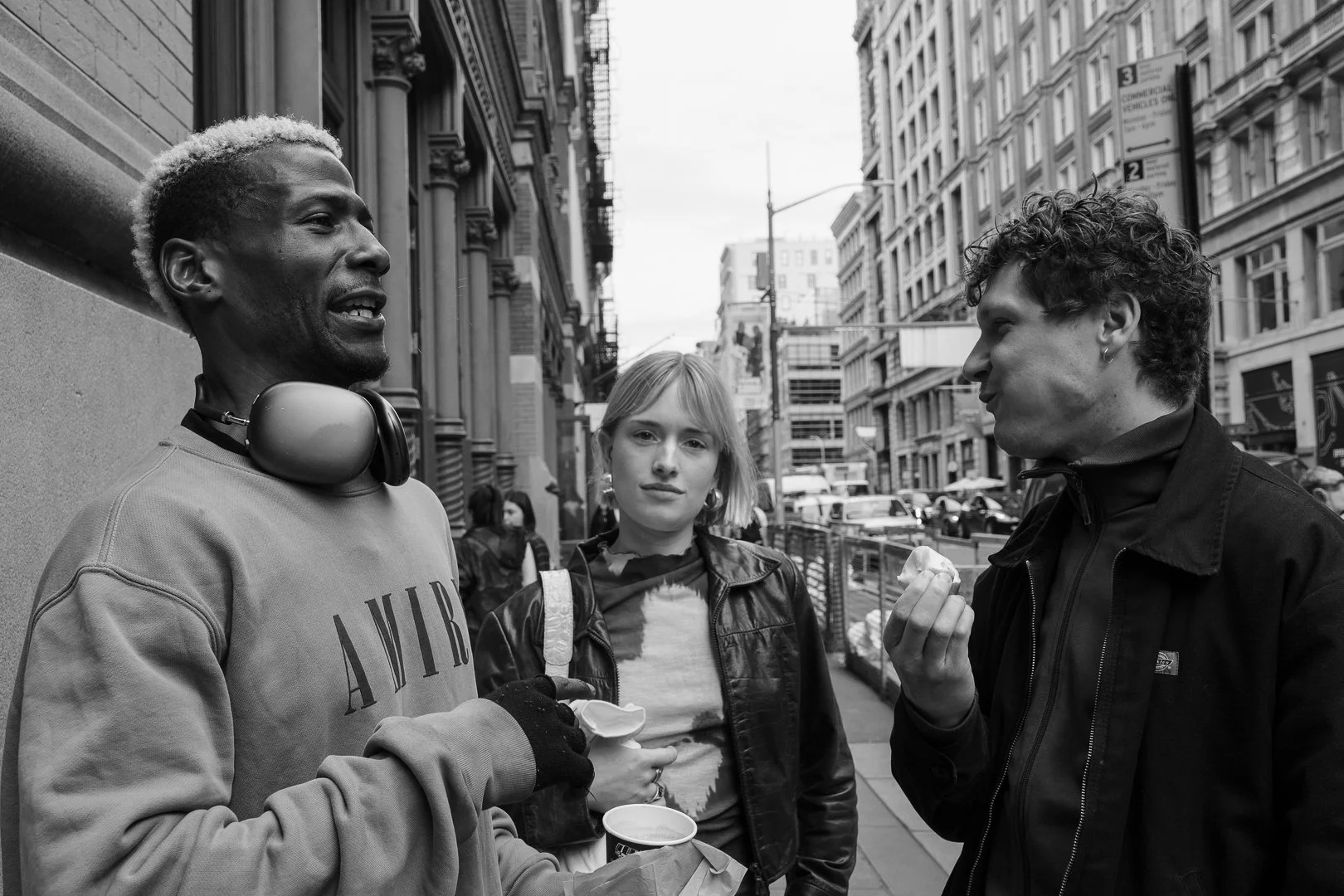
Casual company, private thoughts
The photograph balances sociability and solitude. The casualness of the two men suggests familiarity and comfort in public space; the contemplative look of the person in front introduces introspection, turning an ordinary street encounter into a small, human story about presence and distance in the city.
The trio occupies the foreground against a backdrop of tall buildings and moving traffic, creating depth between intimate human scale and urban architecture. The two gentlemen project casual ease through slouched shoulders and loose gestures; the central figure’s stillness contrasts with their motion. The image reads as candid: a shared pause in the flow of the street, part social exchange, part private thought.
On Meeting a Moment
I learned not to chase the moment,
but to stand still enough for it to recognize me—
and step quietly into my frame.
by Jean‑François Cléroux
Photography Challenge — Practicing the Unforced Frame
There is a particular kind of tension that creeps into street photography when we begin to force the frame. You can feel it in the shoulders, in the breath, in the way the camera becomes a tool of pursuit rather than a companion for noticing. The city senses it too. Moments shrink away when chased. The frame stiffens. The photograph becomes something extracted rather than received.
Learning not to force the frame is less a technique and more a way of being. It’s a practice of loosening, listening, and letting the world arrive on its own terms.
Slowing the Tempo of Seeing
Most forced frames begin with impatience. We want the moment now, the image now, the proof of the walk now. But street photography deepens when we slow our perceptual rhythm. Walking at half-speed, pausing at corners, or lingering in places with no obvious subject allows the eye to settle. The city reveals itself in layers, and those layers only appear when we stop insisting on them.
A simple exercise: stand in one spot for ten minutes. Don’t hunt. Don’t anticipate. Just observe. Let the scene breathe until something within it calls to you.
Letting Constraints Do the Quiet Work
Paradoxically, limitations create freedom. When you reduce your choices—one focal length, one block, one kind of light—you shift from “What should I shoot?” to “What fits within this frame of attention?” The pressure to manufacture a moment dissolves. You begin to respond to what’s actually there.
A constraint is not a cage; it’s a tuning fork. It helps you hear the moment more clearly.
Listening Instead of Directing
The street resists control. The more we try to impose our will on it, the more the images feel strained. Practicing receptivity—watching how people move, how shadows stretch, how light pools—teaches you to let the frame form itself. Subjects drift into your orbit. Gestures align without your intervention. The photograph becomes a collaboration with the world rather than a conquest of it.
This is the flâneur’s posture: wandering without agenda, trusting that the city will offer something if you’re patient enough to see it.
Letting Intuition Lead the Hands
Intuition is built from repetition—thousands of small observations that accumulate quietly. The more you walk, the more your eye learns to recognize emerging compositions without strain. Over time, the frame begins to assemble itself before you consciously reach for it.
Try this: don’t raise the camera until the moment feels inevitable. If you feel yourself trying to make the shot, pause. Reset. Let the scene settle again.
Honoring the Missed Frame
Forcing often comes from fear: fear of missing something, fear of not producing, fear of wasting time. But missed moments are part of the practice. They teach trust. They remind you that the next frame will come, and that your job is not to capture everything but to be present enough to recognize the few that matter.
When you loosen your grip on the outcome, your images loosen too.
Street photography is not a hunt. It’s a conversation. The frame is not something you seize; it’s something you receive. And the more gently you move through the world, the more the world seems willing to offer you its quiet, unguarded moments.
A Question to Carry Into the Month
Every practice asks something different of us, and this one—learning not to force the frame—asks for a kind of soft discipline. It asks you to loosen your grip on expectation, to trust the street a little more than you trust your plans, to let the photograph arrive when it’s ready rather than when you want it to.
So I’ll leave you with a question to walk with:
What part of this practice do you think will feel most challenging for you when you’re out walking with your camera?
Hold that question lightly. Let it accompany you through your wanderings. Notice when the urge to control appears, when impatience tightens the frame, when fear of missing something pulls you out of the moment.
Doing exactly this—observing your own tendencies without judgment—is your quiet goal for the month. Not to perfect anything. Not to produce more. Simply to notice. To soften. To let the frame come to you.