Within the Frame: Cradle & Trigger
Within the Frame #01 - Cradle & Trigger
As the inaugural entry—“Cradle & Trigger”—in Within the Frame, this series invites you to learn how to read what lives inside an image. From a photographic standpoint, we’ll look at technical qualities—lighting, composition, and the kind of feedback you might hear in a club critique—but we’ll also go further: What does the picture say? Does it speak to you? Is it poetic? What story does it tell? Lessons Within emphasizes discovery inside each frame: how an image communicates through gesture, background, and detail.
This photograph has earned awards and praise, yet even in my first professional critique session, it revealed details I had overlooked. Asking why I missed them—and how to see more clearly—is what sparked a light in me and help create this series.
Pen and Paper Time:
Pen and paper. Study the photograph again and list its compositional strengths, then record everything it reveals about the two men and the mural’s hand — do a content, narrative, thematic, and interpretive analysis. Writing is the best way to learn (more on that in a future post). When you’re finished, compare your notes with mine below: did you notice the same details, miss something, or add an observation I didn’t? That gap is where the real work begins.
Composition Notes
Overall compositional reading
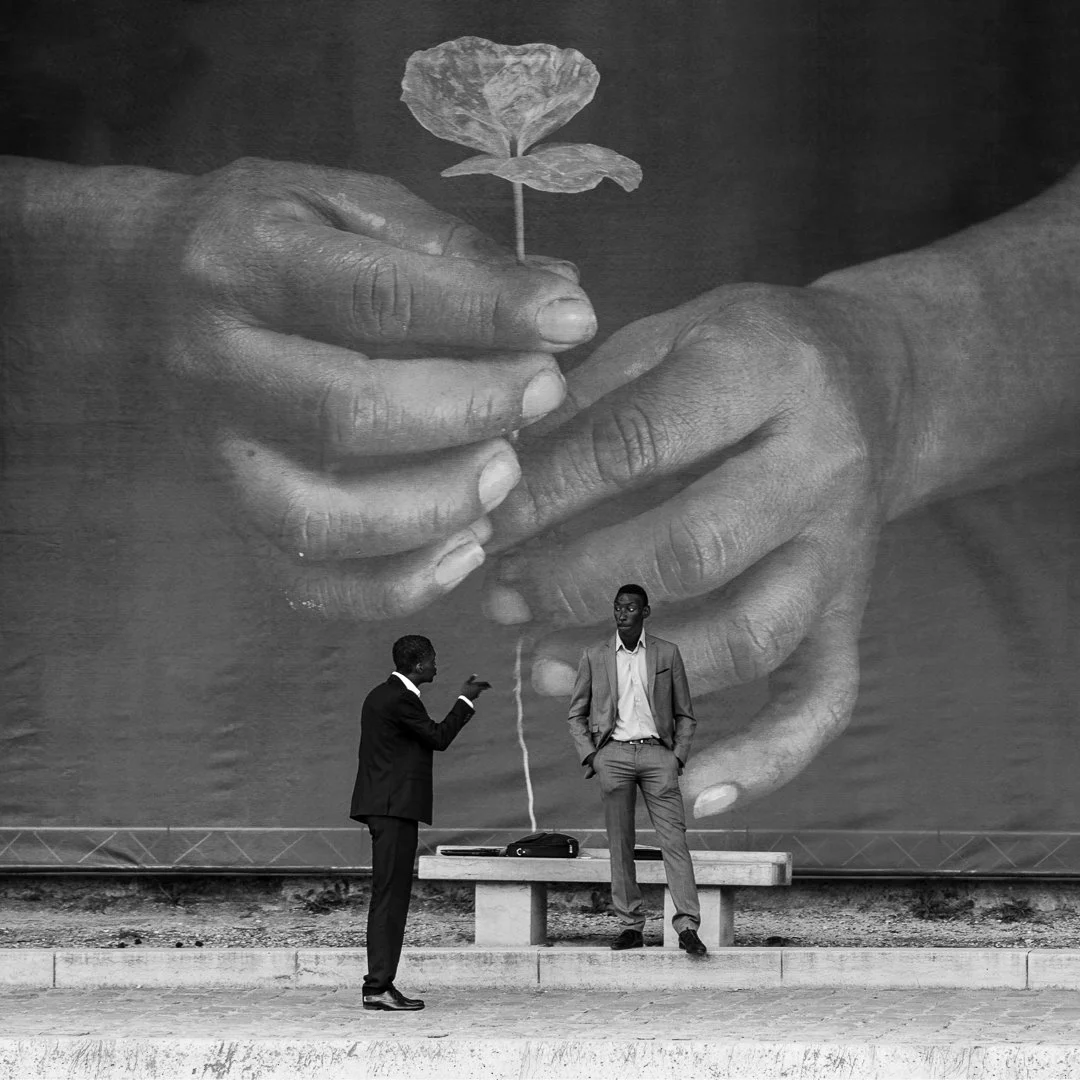
The photograph uses a centered, vertical axis as its organizing principle. That axis — the stem of the flower in the mural — divides the frame and becomes the visual spine that holds the scene together. Centering here signals formality and intent: the image feels deliberate, staged, and stable, which makes any deviations from that stability (gestures, contrasts, tonal differences) more meaningful.
Foreground / background layers and scale contrast
Two layers are in clear dialogue: the small, human-scale foreground (the two men) and the oversized, symbolic background (the hands and flower).
Scale contrast magnifies meaning: the mural’s giant hands make the men appear vulnerable or contained, turning an ordinary conversation into a tableau about care, power, or protection.
Depth cues are created by overlap (men in front of the mural) and by tonal separation; this gives the image a clear spatial hierarchy and a sense of staged depth rather than a flat snapshot.
The centered “stem” as axis and symmetry
The stem functions as an axis of symmetry. The two men are placed on either side of it, which produces a near-symmetrical composition. Symmetry here does three things:
Balances the frame visually, giving it a calm, formal quality.
Creates a mirror-like opposition between the figures, inviting comparison.
Focuses attention on the vertical line, which reads as a dividing or unifying element depending on interpretation.
Tonal framing and character reading
The “villain” framed in black
High-contrast clothing against the lighter mural makes him read as a silhouette or a visual anchor. That strong tonal weight gives him dominance and a sense of isolation or authority. The black framing acts like a vignette that isolates his gesture and posture, making his presence more emphatic and potentially menacing.
The other man “caressed by the hand”
The mural’s hand overlapping or visually touching the area around the second man creates a softer, protective association. This is a compositional device that links the background’s nurturing motif to the foreground subject, suggesting vulnerability, support, or being under influence.
Balance versus tension
Is the image compositionally balanced? — Yes, but with purposeful tension.
Formally, the centered axis and symmetrical placement produce balance.
Tension arises from unequal tonal weight (one figure in dark clothing, the other lighter and visually connected to the mural), contrasting gestures (assertive hand versus receptive posture), and the scale disparity between mural and people. Those contrasts prevent the symmetry from feeling static; instead it feels charged and narrative.
Technical and visual devices at work
Leading line: the stem draws the eye vertically and anchors the composition.
Framing: the mural’s hands act as a secondary frame around the figures, especially the one “caressed.”
Contrast: black-and-white emphasizes shape, texture, and tonal relationships over color, sharpening the symbolic reading.
Scale and proportion: the oversized mural converts a mundane scene into allegory.
Negative space: areas of lighter mural around the dark figure increase his visual weight.
Interpretive takeaways
The centered composition gives the photograph a formal, almost staged quality that invites symbolic reading.
The mural functions as both backdrop and actor: it exerts influence on the foreground figures through scale and implied touch.
The image balances symmetry with asymmetrical tonal and gestural cues, producing a stable yet narratively charged frame.
Emotionally, the photograph can read as a study of power and protection, confrontation and care, depending on which visual cue the viewer privileges.
Narrative and Interpretive Notes
The Scene: Conflict and Shock
The photograph’s central drama is the confrontation between two men in suits. The gun-like hand gesture is a potent symbol—at once playful, threatening, and ambiguous. The other man’s wide-eyed reaction heightens the sense of danger and surprise. Those emotional and symbolic layers transform the photograph into something far more charged and narratively rich.
The Conflict and shock introduces key emotional elements:
Tension: The body language and facial expressions suggest a moment of escalation, a split-second where words have failed and gestures take over.
Shock and vulnerability: The wide-eyed response is not just fear, but a kind of exposure—a raw, unguarded reaction.
Urban anonymity: The suits and street setting evoke a film noir sensibility, where everyday civility can quickly unravel into confrontation.
This tension is the heart of the photograph.
The Mural: Hands and Flower as Symbol
Behind the men, the mural’s imagery is rich with meaning. Enormous hands cradle a fragile flower, its roots visible—a visual metaphor for care, nurture, and the delicate balance of life.
Symbolic readings:
Hands as protectors: In art, hands often symbolize action, intention, and connection. Here, their size and posture suggest guardianship, tenderness, and the potential for healing or harm.
Flower as fragility and hope: Flowers in art are almost universally associated with beauty, transience, and vulnerability. The visible roots add a sense of groundedness, continuity, and the unseen support systems that sustain life.
Contrast with foreground conflict: The mural’s message of care and fragility stands in stark opposition to the human drama before it, creating a powerful visual and thematic tension.
The Interplay: Contrast and Irony
The juxtaposition of the mural and the argument is not accidental. It is a classic use of contrast—a literary and visual device that highlights difference to create meaning.
Violence vs. care: The gun gesture and the protective hands are opposing forces—destruction and nurture, threat and solace.
Human frailty vs. aspiration: The men’s conflict is immediate and raw; the mural’s flower is aspirational, a symbol of what could be.
Irony: The mural’s message is undermined by the scene before it, or perhaps it is the scene that is exposed by the mural’s silent commentary.
Symbolism and Metaphor: Hands, Flowers, and Gestures
Hands: The Silent Storytellers
Hands in art and literature are endlessly symbolic. They can be:
Bridges between souls: Connecting people emotionally or physically.
Gardens of intention: Cultivating care, action, or even violence.
Anchors of presence: Grounding the moment, holding or releasing.
Keys to compassion: Unlocking empathy, offering solace.
In this mural, the hands are both protective and vulnerable—large enough to shield, gentle enough to cradle a flower. They stand in contrast to the hand in the foreground, which mimics a weapon.
The Flower: Fragility, Hope, and Roots
Flowers in art are layered with meaning:
Fragility and beauty: Easily crushed, yet resilient.
Hope and renewal: Blossoming even in harsh conditions.
Roots as connection: Suggesting unseen strength, history, or belonging.
The flower in the mural is not just a decorative element; it is a statement about what is at stake in human conflict—the delicate, living things that can be destroyed in an instant.
The Gun Gesture: Violence and Play
The hand shaped like a gun is a loaded symbol:
Threat and aggression: A universal sign of violence.
Play and mimicry: Sometimes used in jest, but always with an edge.
Power and impotence: A gesture that can wound, but is ultimately empty.
In the context of the mural, the gesture is doubly ironic—it is a hand that could protect, now turned to threaten.
Lessons Learned
I didn’t take it all in at first. There’s a lot packed into this image, and it kept teaching me long after I photographed it. Many of the elements I named above were already familiar to you—just unnoticed until I pointed them out. Familiarity exists because our conscious and subconscious minds are trained from a young age by repeated exposure, embodied habits, perceptual learning, and cultural conventions to recognize symbols and metaphors in logos, ads, art, poetry, media, and everyday life. Simple shapes and tones carry meaning long before we learn the vocabulary for them. The more you study photographic language—composition, symbolism, iconography, metaphor, and visual grammar—the clearer your visual intentions become, and the stronger you’ll be as a photographer or artist.
You may notice I didn’t address technical details here. That’s deliberate: in street photography, perfection isn’t the point. There are basic technical standards, but unless an image is badly blurred or badly exposed, it’s usually technically acceptable. I’ll write more about technical considerations in a future post.
All of these elements—composition, symbolism, iconography, metaphor, and visual grammar—come together to form the Language of Photography. Use this vocabulary to move fluidly between what a photograph shows and what it means. That’s how you begin to describe not only the composition, but the story.
This full analysis may feel overwhelming at first glance—that’s intentional. I wanted you to experience all the small but meaningful details. In future Lessons Within, I’ll keep things simpler and focus on the most essential elements.
I hope this has been a thoughtful learning experience—one that opens your eyes to the intricacies and nuances that shape the Language of Photography.