Within the Frame #02: Tension in Transit
A series on learning to read photographs
About Within the Frame — This series is designed to teach you the language of photography by slowing you down. Each post presents a single image and invites you to look, think, and articulate what the frame is doing — compositionally, emotionally, and narratively. Over time, these exercises train your eye to recognize gesture, rhythm, tension, and visual syntax. The goal is simple: to help you see more, say more, and trust your own interpretive instincts.
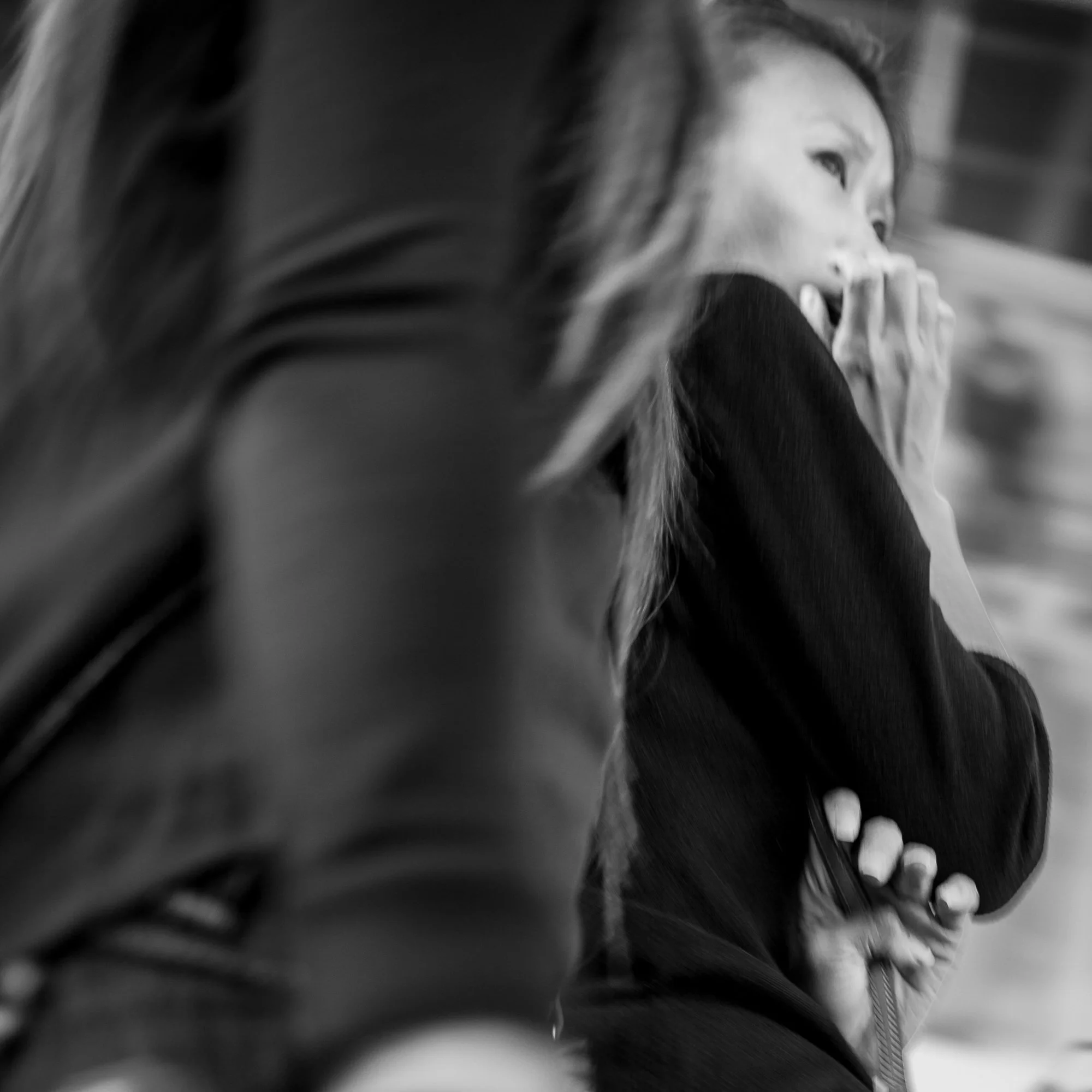
© Jean-Francois Cleroux | Vancouver, BC, Canada
Pen and Paper Exercise
Before reading further, take a moment with the photograph. Grab a pen and paper and write down:
The compositional strengths you notice
Everything the image reveals about the woman
Any gestures, tensions, or rhythms that stand out
This step matters. Writing first helps you discover your own visual instincts before you encounter mine. When you’re ready, compare your notes with the critique below.
The Critique
The frame arrests a fleeting, charged moment: a middle‑aged woman stepping off a bus, her hand pressed to her face while the other grips her purse strap with equal tension. That double clutch becomes the photograph’s fulcrum — an economy of gesture that compresses anxiety, resolve, and motion into a single readable sign.
The hurried stride and slight blur speak of transit and haste. The tight crop and restrained tonal palette strip the scene to its essentials: skin, fabric, and the taut diagonal of the strap. These elements form a small but potent visual vocabulary. Nothing is spelled out, yet everything is legible through the choreography of hands and the implied rhythm of the street.
This is where the language of photography does its work: Gesture becomes meaning, Tension becomes narrative, Economy becomes clarity, Movement becomes meter.
There is a quiet poetry in that restraint. The image turns a commonplace commute into a stanza about endurance — hands as verbs, movement as punctuation. The woman’s clenched posture suggests a private interior life moving through public space, and that tension makes the photograph both intimate and civic. It asks us to witness without intruding. The result is a mood that is taut yet tender, a small human drama rendered with minimal means.
Background: The Photograph That Hooked Me
There is more to this image once you know its backstory. It was the photograph that pulled me into street photography.
I had taken a three‑hour introductory workshop in Vancouver: a brief classroom primer, an hour shooting on the street, then a short recap. Most of my attempts felt clumsy, but one frame kept returning to me. At a bus stop I noticed a middle‑aged Asian woman stepping down and walking briskly with the crowd. Her hands — one pressed to her face, the other clenched on a purse strap — read like shorthand for tension. I followed that gesture and tried to translate it into a photograph.
With the camera at my waist, I hurried to her right, threaded past another pedestrian, and made the shot. That evening I was disappointed by the blur, but the image had captured the anxiety I’d seen. That felt like a small victory.
In the days that followed, the blur mattered less than the questions the frame provoked. Was this a momentary rush or the trace of a life lived under pressure? Did habit harden her posture, or did something urgent press on her that day? All I could do was hope she was all right. That mixture of curiosity, concern, and empathy — born from a single observed gesture — kept me returning to the streets.
Afterthoughts
Does knowing she had just come off a bus change how you read the image? Did the title imply some of that context, or does the backstory shift your interpretation?
These questions matter because they test whether a photograph stands on its own or relies on external information to be fully understood. They also reveal how titles, context, and narrative shape our reading of an image.
I hope you took the exercise seriously — looking closely, noting gestures, and listening for the quiet story the frame offers. Your attention turns solitary looking into a conversation. If something in the frame lingered with you, I’d love to know which detail stayed and why.