Why a Good Image Title Matters
A title is the first conversation a viewer has with an image. It frames attention, sets tone, and supplies a minimal context that steers interpretation without replacing the photograph itself. In street photography—where ambiguity, ethics, and small human gestures matter—titles do more than label; they act as an ethical and aesthetic nudge that can deepen empathy, complicate assumptions, or, if careless, flatten a subject into a stereotype.
Photographers bring different values, aesthetics, and thresholds to their work; street practice has never been governed by a single code. Yet when we title a photograph that contains another person, we enter a shared ethical terrain. A title shapes how a subject is seen—or misseen—and that responsibility is not simply a matter of personal preference. We can already see the consequences of eroded trust and changes laws: in places like Quebec and France, public discomfort and privacy rulings have narrowed the space for street photography, often in response to images and captions that have demeaned or misrepresented the people they depict. When a street photographer abandons that responsibility and uses sensational titles to steer interpretation, the work stops witnessing the world and begins exploiting it; the subject becomes a device rather than a person, and the practice itself loses public trust.
What follows are practical guidelines for titling that honour the diversity of photographic practice while affirming the ethical obligations that must remain constant in street photography.
How a title shapes interpretation
Context — A title can locate time, place, or event, turning an anonymous moment into a specific witness.
Effect: “Jerusalem, Morning Market” invites historical and geographic reading; “Untitled” keeps the scene universal.Tone — Word choice invites the viewer to read the image as tender, ironic, political, or reflective.
Effect: “Ledger of Small Things” primes reverence; “Child Vendor” reads clinical.Narrative — Narrative — Titles can suggest a before‑and‑after or a relationship between elements in an image, nudging viewers to imagine a story beyond the frame.
Effect: “Waiting for the Noon Crowd” implies duration and expectation.Ethics and agency — A careful title can restore subjectivity (using names, roles, or quotes) or, conversely, objectify by reducing people to symbols.
Effect: “Ahmad, 9, Tends His Stall” returns a name and personhood; “Street Child” risks abstraction.Memory and value — Poetic or archival titles turn images into testimony—records to be remembered rather than curiosities to be consumed.
Effect: “Ledger of Small Things” treats the frame as an entry in a wider shared memory.
Practical Guidelines for crafting titles
Titling is a small act with outsized influence: a few words can shape how a viewer approaches the image, the subject, and the story they believe they are seeing. A title also determines how a photograph enters the world—what tone it carries, what assumptions it invites, and how the people within it are first encountered. These guidelines are not rules but practices of care—ways of naming that respect the subject, clarify intent, and keep the work grounded in the dignity that street photography depends on.
Decide your intent first — Are you clarifying, honouring, provoking, or leaving space? Let that intent guide tone, specificity, and the emotional register of the title. A title without intent is more likely to drift into cliché or inadvertent harm.
Prefer clarity over cleverness when ethics are at stake — Clever titles can be delightful, but they can also obscure who is pictured and why. When a subject’s dignity or vulnerability is involved, clarity is the more responsible choice.
Use names when possible and safe — A given name restores agency and acknowledges personhood. But omit names if disclosure risks harm, exposure, or unwanted identification. When in doubt, err on the side of protecting the subject.
Choose specificity or openness deliberately — Specific titles anchor meaning; open titles invite projection. Both are valid, but each carries consequences for how the subject is framed. Be intentional about which one serves the image—and the person—best.
Avoid sensationalizing language that reduces dignity — Terms like “victim,” “exotic,” or “primitive” flatten people into categories. Unless the subject self-identifies in those terms, avoid them. A title should never do violence the photograph itself does not do.
Match platform and audience — Short, punchy titles work on social feeds where attention is brief. Longer, reflective titles suit galleries, books, and essays where viewers linger. Let the context shape the form, not the other way around.
Test the title aloud — Hearing it spoken reveals tone more clearly than reading it silently. If it sounds exploitative, patronizing, or glib when spoken, rewrite it. A title should feel accountable to the person in the frame.
These principles come into focus most clearly when we look at how a single photograph can be reframed by the words attached to it. A photograph may hold many truths at once, but a title selects one thread and hands it to the viewer. The following image and title examples show how five different approaches—each grounded in a different intention—can shift tone, meaning, and ethical stance.
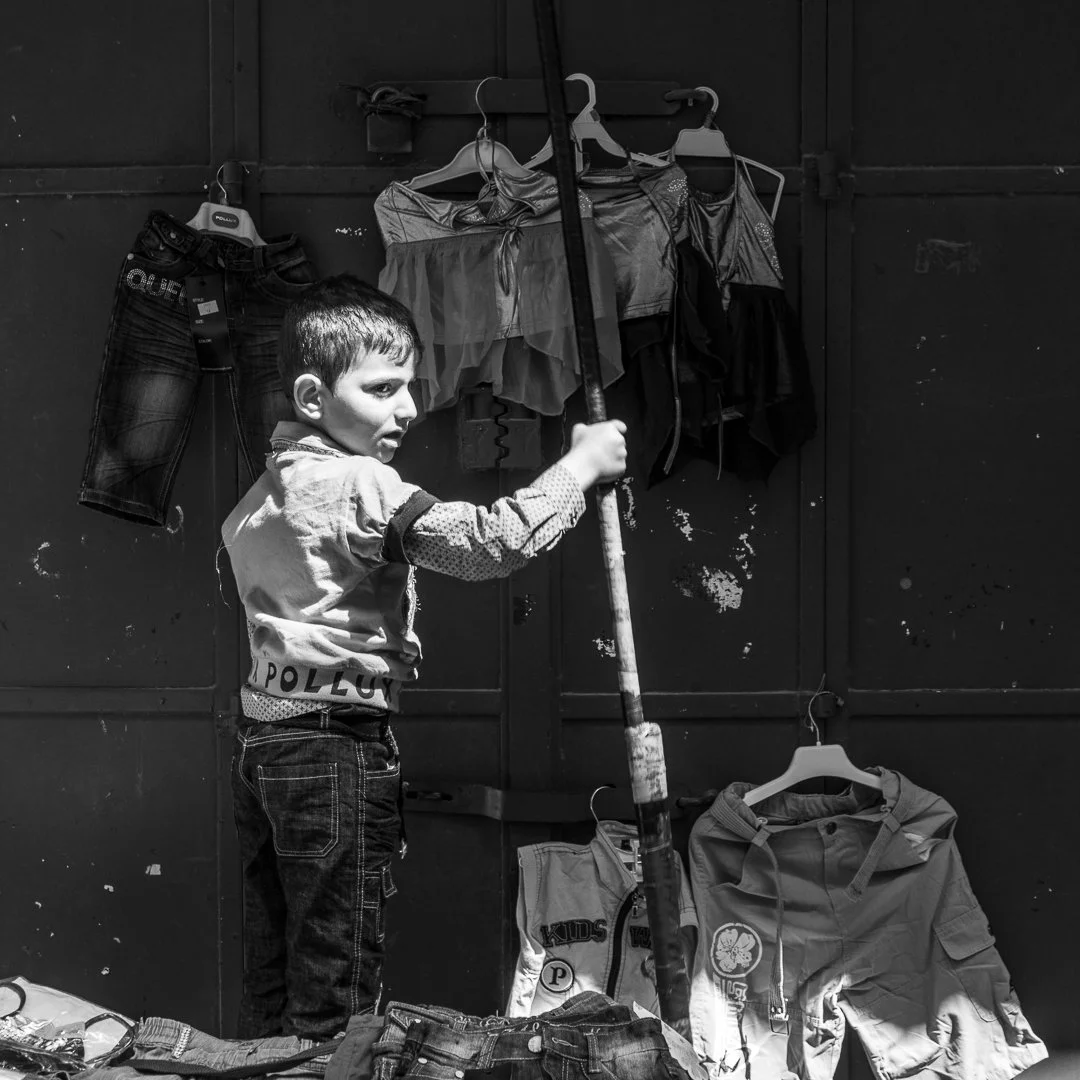
Ledger of Small Things
© Jean-Francois Cleroux | Jerusalem, Israel
A very young Palestinian boy sits behind a makeshift stall in Jerusalem, arranging second‑hand garments with a care that feels almost ritual. He works there every day, calling softly to passersby, arranging shirts and sweaters as if each fold matters; sunlight finds him in the stall and lifts him from the street, which is what first drew my eye.
I admired the steadiness of his hands and the attention he gave to each piece, and that admiration sat beside a deeper sorrow: childhood should belong to classrooms and play, to scraped knees and afternoons with friends. Seeing him at work is a quiet reminder that many children carry burdens no child should bear. The photograph stayed with me as a witness—not an accusation, but a record of what I saw and could not look away from—and a small vow to remember and to let his presence shape how I look at the city.
One image, five titles, multiple readings
A single photograph can hold many truths at once; the title you give it is the lens you hand a viewer.
Clinical or Descriptive — “Child Vendor, Jerusalem” → Emphasizes role and place; neutral, documentary, focused on fact rather than feeling.
Reverent — “Ledger of Small Things” → Invites reflection, memory, and ethical attention; treats the moment as part of a wider shared memory.
Narrative — “Before School, He Folds” → Suggests a before‑and‑after and prompts questions about why he’s not in class; nudges the viewer toward imagining circumstance.
Poetic — “Ritual of Small Hands” → Foregrounds mood and interiority, asking the viewer to feel the steadiness and quiet dignity of the gesture.
Civic or Ethical — “Lessons He Shouldn’t Have to Learn” → Frames the image as witness and prompt, directing attention toward questions of justice, labour, and context.
Each title pulls a different narrative thread—fact, feeling, story, or consequence—and in doing so reshapes what details register, which questions arise, and how long the image lingers in the mind.
Layered onto that editorial steering is the viewer’s own history: people bring their private archives of feeling—sympathy, anger, tenderness, suspicion—and those memories refract the photograph in different ways. The same frame can open into many distinct emotional readings, not because the image changes, but because the encounter does.
Quick exercise — Titling the Street Image
Titling is a craft best learned through practice, and the quickest way to understand its power is to try it yourself. This exercise slows the process down just enough to reveal how observation, language, and intention interact—how a shift in tone, a single concrete detail, or a change in rhythm can redirect a viewer’s attention and alter the emotional register of a photograph. By working through these steps, you begin to see titling not as an afterthought but as a deliberate act of framing, one that shapes how an image is received and how the people within it are first encountered.
Objective: Practice creating concise, evocative titles that sharpen a photograph’s meaning and invite the viewer to look with intention.
Duration: 15–25 minutes
Materials: One street photograph (print or on‑screen), a notebook or notes app, a timer.
Steps
Observe (3 minutes)
Sit with the image without writing. Note three concrete details (what you see), one mood word (how it feels), and one small narrative possibility (what might be happening).
List anchors (4 minutes)
Write 6–8 single words drawn from your observations: two nouns, two verbs, one adjective, one place/time word, and one sensory word. These become your building blocks.
Draft titles (6–10 minutes)
Using your anchor words, write 12 short titles. Aim for variety: four literal, four poetic, four ambiguous. Keep each title under seven words to encourage clarity and precision.
Refine (3 minutes)
Choose your top three and tighten them. Remove filler, prefer strong nouns and verbs, and test rhythm and cadence aloud.
Select and justify (2 minutes)
Pick one final title and write a one‑sentence justification explaining how it changes or deepens the viewer’s reading of the image.
Examples (before → after)
Literal weak: Boy at Market → Stronger: Ledger of Small Things
Why: Replaces a generic label with a title that names the photograph’s quiet accounting of care and labor.Vague: A Quiet Scene → Sharper: Hands That Fold the Day
Why: Moves from bland atmosphere to a concrete, active image that centers the boy’s ritual and the passage of time.Overwrought: An Unfortunate Child Working in the Streets of Jerusalem, a Testament to Lost Childhood → Tighter: A Child’s Quiet Ledger
Why: Trims moralizing language and restores dignity by offering a restrained, evocative frame that invites reflection rather than judgment.Sentimental: Poor Little Boy, So Brave → More Respectful: Sunlight on the Stall
Why: Removes pity and replaces it with an observational detail that honors the scene’s light and the boy’s presence.Abstract: Urban Burdens → Concrete: The Boy Who Counts Shirts
Why: Swaps sweeping abstraction for a specific, image‑rooted phrase that opens narrative possibilities.
Variations and constraints
Constraint: Make a title that avoids any proper names.
Constraint: Use only two words.
Variation: Write a title that contradicts the obvious mood (ironic tilt).
Variation: Create a subtitle (title + 3‑word line) to add context.
Quick tips
Favour specificity over abstraction; a concrete detail anchors imagination.
Let the title be a doorway, not a summary—invite questions rather than close them.
Test for tone: does the title match the photograph’s register (wry, tender, clinical)?
Avoid captions that merely restate the obvious; aim to reframe, not repeat.
In the end, titling is less about finding the perfect phrase than about cultivating a way of looking—one that honours the people in the frame and acknowledges the power we hold when we name them. A thoughtful title doesn’t seal an image shut; it opens it, offering the viewer a path into the photograph while leaving room for their own questions and humanity. If we approach this small act with attention and humility, we not only strengthen our photographs but also contribute to a culture of street photography rooted in dignity, curiosity, and trust.

Issue #03 - May 2026
Look for Frame & Verse #03 at the beginning of May for an extended exploration of why titles matter—and how they shape the way photographs are seen, felt, and remembered.