The First Meaningful Shape
The Architecture of a Photographic Project — Chapter 7
Every project reaches a moment when the architecture begins to gather into something more tangible.
Not finished. Not defined. But visible. The emotional centre has strengthened. The internal logic has begun to clarify. The work is no longer a constellation of possibilities — it is becoming a place with its own gravity.
This is the moment when a project begins to ask for shape.
Not the final shape. Not the public shape. But the first meaningful shape — the early structure that helps you understand what the project is becoming, and how to stay close to it without closing it down.
If the last chapter was about recognising clarification, this one is about gathering it.
When Images Begin to Hold Each Other
In the early stages, images gather loosely — clusters, moods, repetitions. But as a project clarifies, something shifts. The images begin to hold each other. They create a quiet tension between them, a subtle balance, a sense of belonging that feels less provisional and more grounded.
I notice it first in the body — a small tightening of attention when two frames sit side by side and something passes between them. A gesture in one answers a silence in the other. The work starts to breathe as a group.
You may notice:
A small group of images that feels unmistakably central.
A rhythm emerging — a way the images breathe together.
A coherence that is no longer fragile, but quietly confident.
A sense that the project is beginning to stand on its own legs.
This is not the final edit. This is the first meaningful shape — the architecture becoming visible.
Your role is to recognise this moment without rushing into definition.
The First Edit (Which Is Not Really Editing)
Many photographers misunderstand the first edit. They treat it as a decisive act — a narrowing, a selection, a commitment. But in the architecture of a project, editing is not reduction. Editing is attention.
I have learned to approach the first edit in my Street Photography the way I approach the street itself: not hunting, but attending. Not deciding, but noticing.
The first edit is simply:
Bringing the strongest images into one place.
Letting them speak to one another.
Noticing the relationships that form naturally.
Recognising the emotional centre that holds them together.
You are not choosing what belongs. You are noticing what insists.
The first edit is not about exclusion. It is about recognition.
It is the moment when the project begins to show you its spine — the line of coherence running through the work, even if you cannot yet articulate it.
Understanding the Project’s Spine
Every project has a spine — a central line of coherence that holds the work together. It is not thematic. It is not conceptual. It is not something you can easily describe. It is simply the emotional and visual thread that gives the project its integrity.
You may recognise the spine through:
A recurring emotional temperature.
A way of responding to light.
A particular distance or proximity.
A rhythm in the way people move through the frame.
A tension that feels essential to the work.
The spine is not the project's meaning. It is the project's coherence.
Once you recognise it, the project begins to deepen. You understand what the work needs — and what it does not. You begin to see how the images relate to one another, the way vertebrae relate along a back: distinct, yet held by a single line.
The spine is not something you create. It is something you discover.
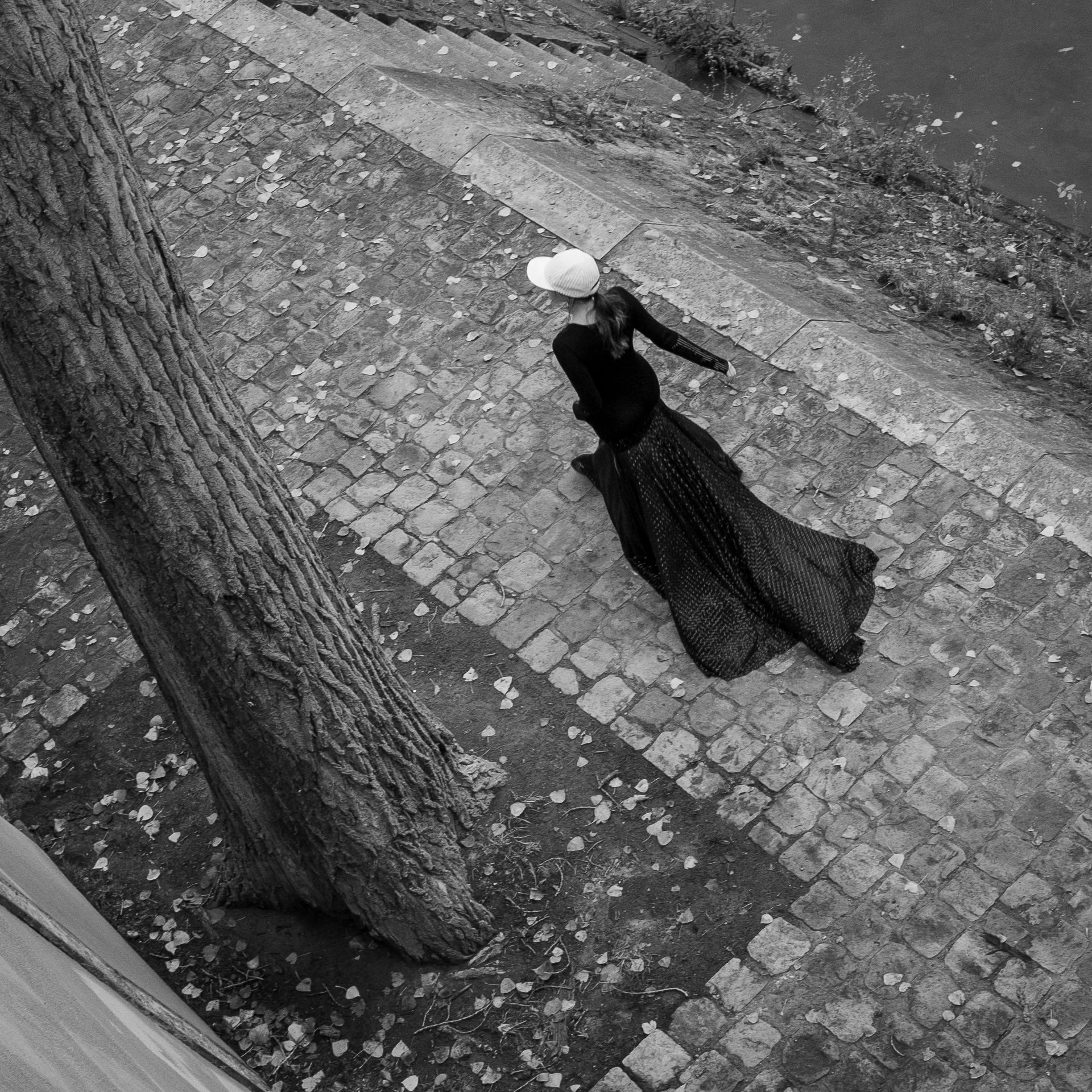
The White Cap
© 2026 Jean-François Cléroux | Paris, France
Shot from above, a woman crosses a cobblestone quay beside the Seine, her long dark skirt catching the wind behind her. She wears a white cap — a single bright note in a dark composition — and walks alone through scattered leaves, one arm drifting slightly outward as if balancing on the moment. A great tree trunk rises along the left edge, anchoring the frame, while the stone steps of the quay and the water wait at the top of the image. Everything about it feels suspended: a figure in motion, held still.
This is a quietly beautiful frame, and its power is in the restraint. The elevated viewpoint turns the quay into a stage, and the white cap does exactly what a bright accent should — it gives the eye a place to land first, then releases it to wander the cobblestones, the leaves, the flowing skirt. The tree trunk is doing honest compositional work as a repoussoir, pushing the eye back toward the figure and lending the whole image its diagonal energy. The tonal range is lovely, and the turned-away face is a gift: she remains a mystery rather than a portrait, and the photograph is better for it.
My gentle notes: the trunk is a bold guest, occupying much of the left third; it earns its place, but it's worth knowing the image leans on it. And she is small in the frame — intimacy traded for composition — though that very distance is what makes the moment feel dreamlike rather than observed. A keeper, without hesitation.
Letting the Work Narrow Itself
As the spine becomes visible, the project begins to narrow — not through your decisions, but through its own coherence. Certain images feel essential. Others feel peripheral. Some feel like early steps that helped you arrive here but no longer belong to the project's centre.
This narrowing is natural. It is healthy. It is part of the architecture.
Your role is not to narrow the project. Your role is to let the project narrow itself.
This means:
Trusting what feels essential.
Letting go of what feels distracting.
Allowing the project to refine its own voice.
Staying close to the emotional centre that has emerged.
Narrowing is not exclusion. Narrowing is clarity.
It is the project becoming more itself.
The Discipline of Gentle Structure
At this stage, the project needs gentle structure — not rigid, not final, but enough shape to deepen the work without constraining it.
Gentle structure might look like:
A small sequence of images that feels coherent.
A provisional order that reveals the project's pulse.
A set of images that anchor the work.
A folder that now feels like a living space rather than a collection.
This structure is not a blueprint. It is scaffolding — temporary, flexible, porous. I often pin a working sequence to the wall and live with it for days, letting it enter my peripheral vision the way a street enters it: sideways, slowly, truthfully.
Gentle structure helps you:
See the project more clearly.
Understand what the work is becoming.
Recognise what the project needs next.
Stay close to the spine without forcing direction.
Structure is not control. Structure is care.
When the Project Begins to Speak Clearly
Eventually, something shifts. The project begins to speak more clearly — not loudly, not definitively, but with a coherence that feels unmistakable.
You may find yourself:
Knowing instinctively when an image belongs.
Recognising when a photograph strengthens the spine.
Feeling when the project is drifting — and when it is deepening.
Understanding what the work is asking you to see next.
This clarity is not conceptual. It is embodied. It arrives through repetition, through patience, through the slow accumulation of attention.
Your role is to follow this clarity without trying to complete it.
Exercise: Finding the First Meaningful Shape
60–90 minutes at the table, then a week of living with what you make
This exercise gives the project's coherence its first provisional form. Nothing here is final — you are building scaffolding, not walls.
1. Gather the essential frames — 15 minutes.
Choose twelve to twenty images that feel essential to the project's spine. Not your favourites — the ones that feel alive, the ones that insist.
2. Make a provisional sequence — 20 minutes.
Arrange them in a breathing order. Not a final sequence — a first one. Notice how the images speak to one another, where the rhythm quickens, where it asks for rest.
3. Name the spine — in pencil.
Write one sentence about the emotional or visual thread holding the sequence together. Keep it simple. Keep it provisional. Then return to the line you wrote in Chapter 6's exercise — does it still hold, or has it deepened?
4. Set aside what distracts.
Notice the images that feel louder than the sequence, or written in a different hand. Let them rest elsewhere. Do not discard them.
5. Let it breathe — one week.
Pin the sequence where you will see it sideways — a wall, an open folder, a printed contact sheet on the table. Revisit it after three or four days. Notice what still holds and what has loosened. A first shape needs time to settle, the way a photograph needs time in the developer.
6. Write what has become visible.
A few sentences, no more: the coherence, the mood, the pulse. Do not define the project. Simply recognise what is taking shape.
Closing Gesture
The first meaningful shape is a turning point, the moment the project's spine comes into view: its coherence, its architecture. Nothing is final. Nothing is fixed. But something in the work is becoming clear enough to guide you.
This is not the moment to finish the project. It is the best moment to deepen it.
Soon — but not yet — you will begin shaping the work more deliberately: refining the sequence, strengthening the spine, recognising the deeper architecture that will eventually hold everything together.
That is the terrain of Chapter 8, the final chapter of this series.
For now, stay close to what is shaping itself. Stay close to what is gathering coherence. Stay close to the project's pulse.
A project finds its shape through attention. And you are already attentive.
Coming Up in The Flâneur’s Journal
Next week, we step briefly outside the series for a standalone reflection — Colour in Street Photography: Notes from a Reluctant Student — on beginning again, on learning to see in a language I never spoke in Street Photography, and on Fred Herzog, the early kind of urban flâneur who walked these same Vancouver streets with Kodachrome sixty years before me.
In two weeks, we return to The Architecture of a Photographic Project with Chapter 8: Returning With New Eyes — the final chapter, completing the arc from the first walk to the finished work, and asking what the long discipline of a project gives back to the photographer.
Until then, keep your camera close and your attention closer. Go out and walk. Make a few quiet frames. The street is always offering — our work is simply to be there when it does. I will see you next week.