An Evolving Library of Inspiration: Photographers Who Shape My Way of Seeing
The Evolving Photographer - Part I on Creative Growth and the Art of Seeing
Part I — Street photography is more than a genre — it is a way of moving through the world, a discipline of attention, and a lifelong evolution of seeing. This series is designed as a guided journey for photographers who want to deepen their practice, sharpen their instincts, and understand the forces that shape their creative voice. Building on the ideas introduced here in Part I: An Evolving Library of Inspiration this six‑part exploration offers a structured path toward genuine artistic growth. Each chapter invites you to look inward, study outward, and engage with your work in a more intentional, reflective way. Whether you’re discovering your influences, clarifying your style, or challenging the boundaries of your visual logic, this series will help you become a more thoughtful, self‑aware, and evolving photographer.
Why Every Photographer Needs an Evolving Map of Influence.
Every photographer benefits from keeping a living list of influences — not as a hierarchy or a measure of worth, but as a map of the visual and emotional territory that shapes our way of seeing. The artists we study help us understand our own instincts: what we notice, what we respond to, and what we return to again and again. Over time, this list becomes a kind of creative compass, reminding us where we’ve been and pointing toward where we might go next.
Studying the classic photographers — the ones who defined the visual language of the medium — grounds us in the fundamentals: composition, timing, patience, and the art of truly paying attention. Just as painters learn from the old masters, photographers grow by understanding the lineage they’re stepping into. These artists teach us discipline and intention; they show us how much can be said with light, shadow, rhythm, restraint and a single decisive moment — a concept Henri Cartier‑Bresson articulated so powerfully.
Equally important is learning from the photographers working today. Contemporary voices reveal where the medium is heading — how culture, technology, and new ways of moving through the world are reshaping what street photography can be. They challenge us to stay fresh, to experiment, to question our habits, and to remain open to new forms of expression.
And there is tremendous value in looking beyond your own stylistic preferences. Studying photographers whose approach differs from yours — whether more abstract, more humorous, more conceptual, more chaotic, more restrained, more minimalist, more narrative‑driven, or more experimental — opens your eyes to possibilities you might never have considered. Their work can spark unexpected ideas, shift your perspective, or even lead you toward new projects you wouldn’t have imagined on your own. Influence doesn’t have to mirror your style; sometimes the most transformative inspiration comes from the artists who see the world in ways you don’t.
The photographers below represent a constellation of sensibilities that resonate deeply with my own — artists who pay attention to the small gestures, coincidences, moods, and rhythms that make street photography feel alive. Some lean into humour, others into atmosphere or graphic tension, others into quiet poetry. Together, they challenge me, inspire me, and expand the possibilities of my practice.
I encourage you to create your own list as you grow. Revisit it often. Let it evolve. Return to these photographers’ websites when you need a spark, and keep seeking out new voices who might shift your perspective or open a door you didn’t know was there. Inspiration is not a fixed archive — it’s a living, breathing part of the creative process.
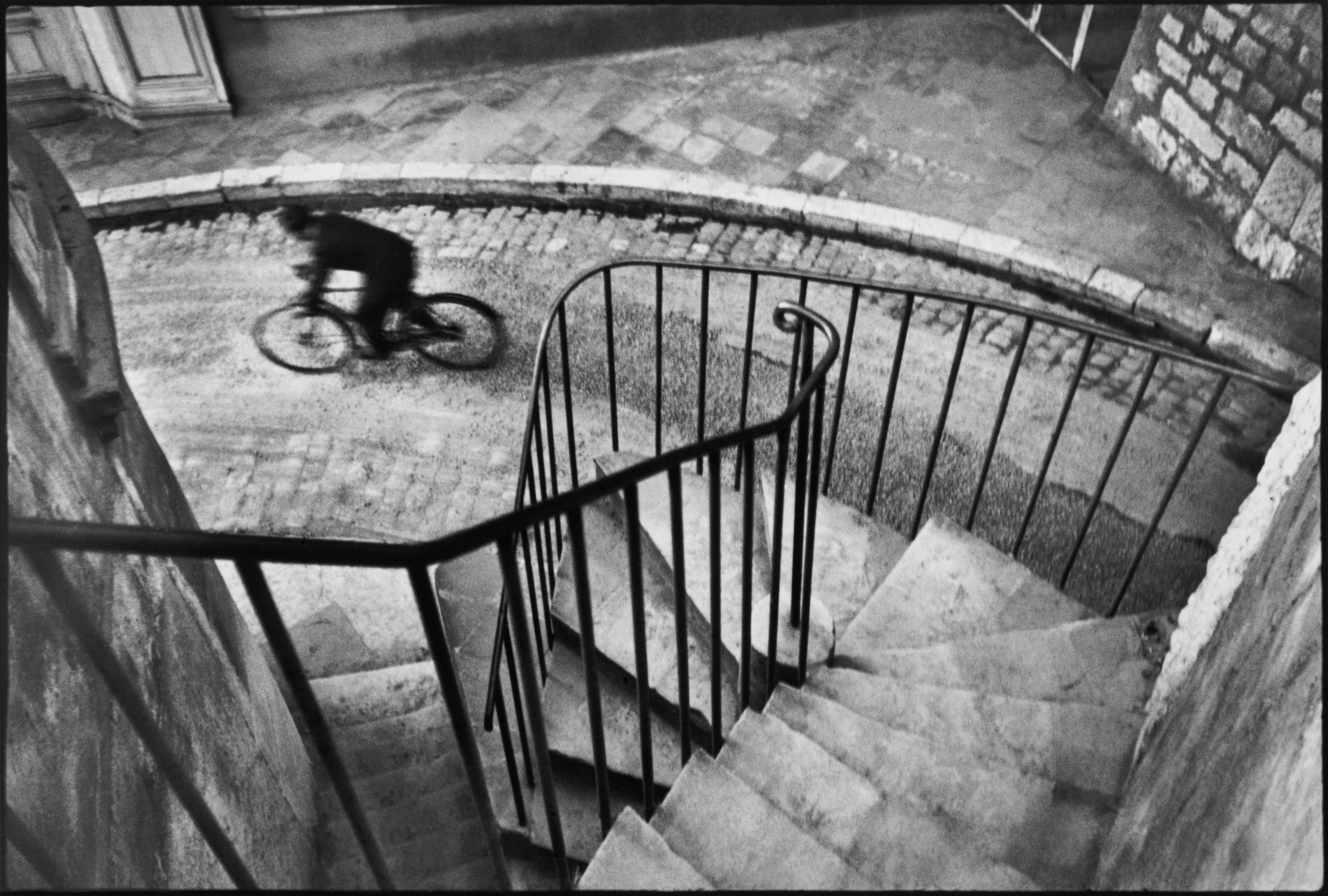
Hyères, France
© Henri Cartier-Bresson — Hyères, France. 1932. | Magnum Photos
Cartier‑Bresson was standing at the top of a spiral staircase, looking down at the elegant curve of the railing and the cobblestone street below. What struck him first wasn’t the cyclist — it was the geometry. The composition came before the subject.
He framed the scene, fixed his position, and then — crucially — waited.
He knew that the photograph needed a human presence to activate the composition, to give the geometry a sense of life and motion. So he held the frame, anticipating the right moment. Eventually, a cyclist entered the scene, and Cartier‑Bresson released the shutter at the exact instant the rider aligned with the curve of the staircase.
This is one of the earliest and clearest examples of what he later articulated as the decisive moment — not luck, not reaction, but preparation meeting patience.
Photographers Who Guide My Eye
1. Henri Cartier‑Bresson
Widely regarded as one of the foundational figures of modern photography, Cartier‑Bresson shaped the very language of the medium through his intuitive sense of timing, geometry, and human presence. His idea of the decisive moment continues to influence generations of photographers, reminding us how meaning can crystallize in a fraction of a second when composition, gesture, and intention align.
Website: https://www.magnumphotos.com/photographer/henri-cartier-bresson/
2. Saul Leiter
For his lyrical use of reflections, layering, and the poetry of the everyday. Leiter photographed the city as if it were a poem unfolding in colour and shadow — something I also strive for in both images and words.
Website: https://www.saulleiterfoundation.org
3. Elliott Erwitt
Not just for his humour, but for his ability to capture tenderness and irony simultaneously.
Website: https://www.magnumphotos.com/photographer/elliott-erwitt
4. Vivian Maier
Not for the mythology, but for her instinctive flâneur’s eye — wandering, observing, collecting moments of human truth.
Website: https://www.vivianmaier.com
5. Bruce Gilden
Bruce Gilden’s work sits at the opposite end of the spectrum from my own, yet that contrast is exactly what changed me. When I first encountered his photographs, my own work was very formal — careful, restrained, almost too polite. Spending a week studying with him at the Magnum offices in New York was genuinely life‑changing. His unapologetic approach, his insistence on presence and commitment, pushed me to question everything I thought I knew about street photography. I don’t work the way he does, but his influence continues to echo in how I think about courage, proximity, and intention.
Website: https://www.brucegilden.com
6. Melissa O’Shaughnessy
Elegant layering, subtle humour, and refined street compositions.
Website: https://www.melissaoshaughnessy.com
7. Valérie Jardin
What draws me to Valérie Jardin’s work is the quiet romanticism that runs through her images — a softness in the way she reads light, gesture, and the small human moments that unfold in passing. Her photographs feel both disciplined and tender, shaped by a way of seeing that honours the everyday with a kind of gentle affection. There’s a clarity and kindness in her approach that I find deeply resonant.
Website: https://www.valeriejardinphotography.com
8. Matt Stuart
Playful timing, visual wit, and clever street coincidences.
Website: https://www.mattstuart.com
9. Alan Schaller
High‑contrast black‑and‑white with strong graphic tension. His work distills the street into bold, architectural forms, revealing the drama of light and shadow with remarkable clarity.
Website: https://www.alanschaller.com
10. Dimitri Mellos
Lyrical, quiet, poetic street scenes — very aligned with my sensibility.
Website: http://www.dimitrimellos.com
11. Joshua K. Jackson
Moody, atmospheric, colour‑driven street photography.
Website: https://www.joshkjack.com
12. Tatsuo Suzuki
Raw, energetic, emotionally charged street work from Tokyo.
Website: http://www.tatsuosuzuki.com
13. Diane Wehr
Diane Wehr’s work is still evolving, but her developing projects show a strong sense of curiosity, emotional presence, and a willingness to explore the quieter edges of everyday life. What draws me to her photography is the way she builds projects rather than isolated images — each series feels like a thoughtful inquiry into place, mood, and human experience. There’s an honesty and openness in her approach that I find refreshing, and I appreciate watching her visual language take shape as she continues to refine her voice.
Website: https://www.dianewehr.com
14. Roman Fox
An emerging street photographer with a sharp instinct for timing, gesture, and visual coincidence. His images carry a playful curiosity and a growing sense of project‑driven intention, making him an exciting voice to watch as his style continues to develop.
Website: https://www.snapsbyfox.com
15. Rohit Vohra
A leading contemporary street photographer whose work blends bold composition, emotional immediacy, and a deep sensitivity to human behavior in public space. His images often balance intensity with elegance, making him an inspiring figure for anyone exploring the evolving possibilities of candid street work.
Website: https://www.rohitvohra.com
16. Florence Oliver
Creates tender, atmospheric street photographs often made by reflections or through layers of glass. These surfaces soften the scene, blur edges, and introduce a dreamlike distance, giving her images a quiet emotional resonance. Her work feels intimate yet slightly removed — as if we’re witnessing the city through memory rather than observation.
Website: https://www.instagram.com/mabelmorrison/
17, Jean-Francois Cleroux
I’ve also included myself in my list — not out of comparison, but as a way of marking my own creative evolution. Looking back at my images helps me understand how my eye is changing, how my projects are taking shape, and how my voice as a modern flâneur, street photographer, and poet continues to grow. Including myself on my list is simply a reminder that we are all works in progress, and that our influences include not only the masters we admire, but the paths we carve for ourselves.
I am a modern flâneur whose work lives at the intersection of observation and lyricism. My photographs grow out of long, unhurried walks through cities like Vancouver, Paris, and New York — images that listen as much as they look, attentive to subtle gestures, shifting light, and the quieter emotional textures of everyday life. My developing projects reflect a commitment to visual storytelling that is both poetic and grounded, often carrying a sense of stillness within motion. Paired with my writing — reflective, spacious, and shaped by the rhythms of the street — my work forms a practice of noticing that feels personal in its origins yet quietly universal in its intent.
Website: https://www.cleroux.com
A Creative Exercise: Find Your Three
Before you move on, I’d like to offer a small task — one that can quietly transform the way you see. Take a moment to identify three photographers whose work most closely reflects your own instincts. They don’t need to appear on my list. They don’t need to be famous. They don’t even need to work in the same genre. What matters is that something in their images feels familiar to you — a shared rhythm, a way of noticing, a sensibility that echoes your own.
Once you’ve chosen your three, write down their names. Then take a little time to look closely at their work and note what creates that sense of connection. What do you see in their images that you also recognise in your own? Is it their use of light? Their sense of timing? Their compositions, moods, or recurring themes? These small cues matter. Learning to identify them is the beginning of understanding your own visual language.
This exercise is more important than it might seem. When you recognize the artists who mirror your way of seeing, you begin to understand your own visual DNA. You start to notice the patterns in your work, the themes you return to, the moods you gravitate toward, the kinds of moments that make you lift your camera without thinking. These three photographers become a kind of creative anchor — a reference point you can return to when you feel lost, uninspired, or unsure of your direction.
And as your work evolves, your three will evolve too. That’s the beauty of it. This is not a fixed list but a living reflection of your growth. Revisit it often. Let it change as you change.
Your Turn: Who Helps You See?
This list is more than a collection of names — it’s a living document of influence, a reminder of the artists who sharpen my eye, expand my imagination, and help me grow. It’s a resource I return to when I need clarity, direction, or simply the joy of rediscovering why I fell in love with photography in the first place. And as my vision evolves, so will this list, becoming a quiet record of my creative journey.
I’d love to hear about who inspires you. If there are photographers, projects, or emerging artists you feel belong on a list like this — or whose work might spark something for other readers — please share them. Not just for me, but for the small community gathering here. Inspiration is a communal resource, and we all see a little further when we look together.
Next Week in The Flaneurs Journal
I hope this first part of this series Creative Growth and the Art of Seeing offered something useful — a spark, a question, a shift in how you think about your own influences. But the real growth begins when you do the work. These exercises are not busywork; they are the scaffolding that helps your style take shape. The more seriously you engage with them, the more clearly your voice will emerge.
Next week, we’ll step into The Quiet Language of Silhouettes — a study in shape, mystery, and restraint. It is not part of this series,
And in two weeks, Part II of this series — A Working Catalogue of Street Photography Styles — will open the door a little wider. The series will continue every second week, giving you time to practise, reflect, and return with a deeper sense of your own way of seeing.
There is much more ahead, and each step builds on the last. Stay with it. Let the work gather meaning. Let your seeing deepen.