What the Image Keeps Silent
An inquiry into what a single photograph does not tell the viewer.
As a critic and judge I am often asked whether I misread an image or why I scored a photograph as I did—usually because the maker believes it deserved a higher mark. That conviction typically comes from the photographer’s private archive of sensations: perfect light, a warm dinner accompanied by the perfect bottle of Sancerre, and all that, in holiday mood. Those memories make a frame feel irrefutably right to its maker, but the photograph itself contains only what is visible: composition, light, posture, texture, and context. When you select a single image for print or exhibition, it must stand on those visible elements alone; the viewer will not have your backstory.
Communication, selection integrity, and audience trust hinge on that discipline. A single image that depends on your unseen knowledge risks being misread, confusing, or emotionally flat to strangers. Test each candidate with a blank mind: describe literally what any stranger would see; note the strongest emotional reading that image can plausibly carry without explanation; decide whether a brief caption is necessary to supply essential context or whether the image should be replaced by one that communicates more clearly on its own.
The Listening Room
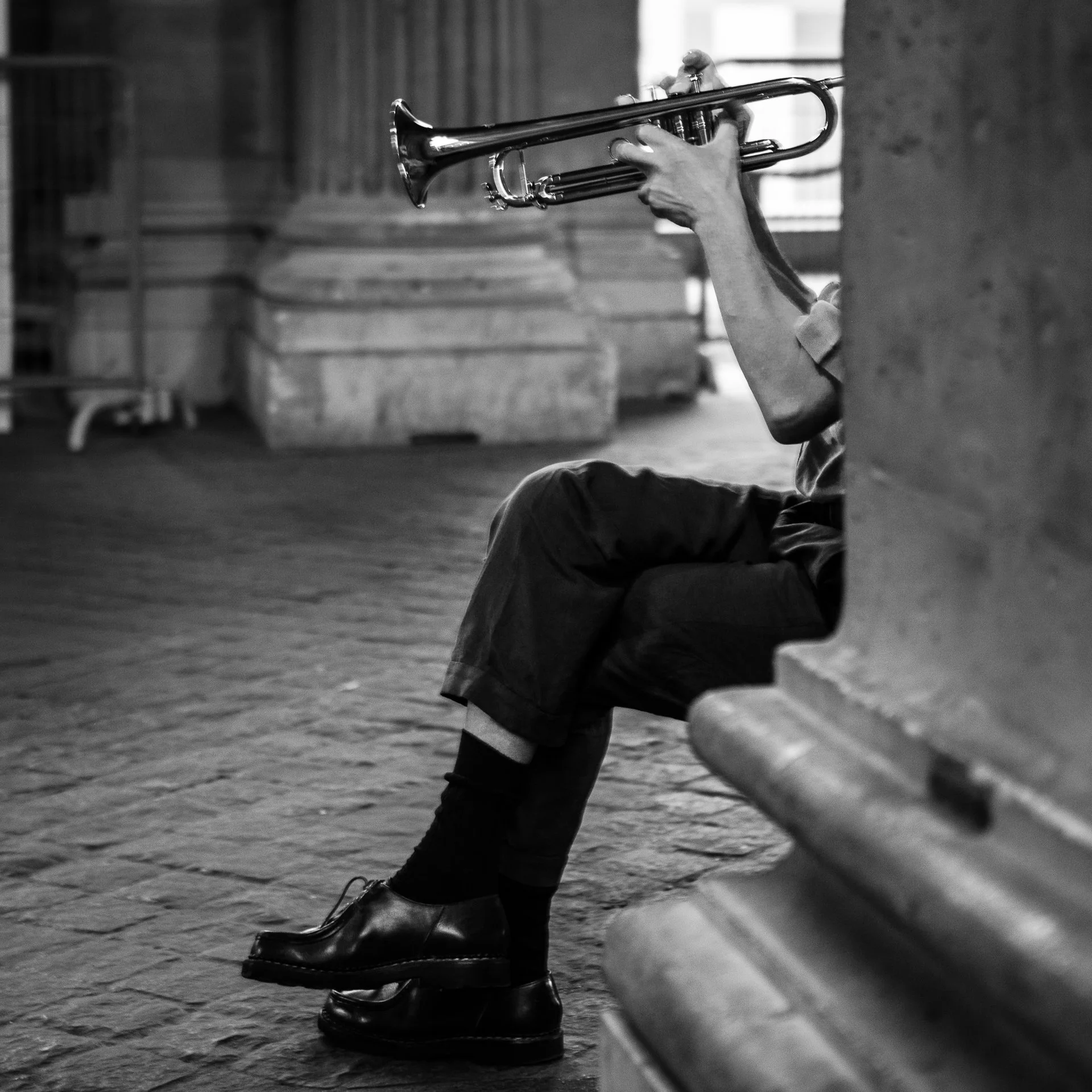
A breath held under stone: the trumpet’s arc becomes a private river of sound in a public threshold. The figure sits half‑hidden, a silhouette of motion whose absence of face turns the frame into a listening room. Light and shadow carve the scene into a quiet score—columns as rests, cobbles as a slow metronome—so the photograph reads less like a portrait and more like a stanza about presence, craft, and the way music makes architecture breathe. The photograph literalizes listening: posture and instrument stand in for tone, breath, and phrase, asking viewers to imagine the music rather than merely see it. The image feels like a memory you can almost hear—a single, sustained note that lingers after the shutter.
A Breath Under Stone
A breath held under stone
trumpet threads the silent arch
single note lingers
by Jean-Francois Cleroux
What the Image Keeps Silent
Context and interpretation
Knowing this was shot at the Louvre entrance and that a real musician was playing beautiful music supplies specific context that enriches interpretation: the image becomes not only a study of gesture and light but a moment where street practice meets institutional grandeur, where a live phrase might have filled the archway. Those facts invite listeners to supply timbre, tempo, and biography; they turn the photograph into a scene you can almost hear and place on a map, and they sharpen political and cultural readings (public art vs. elite space, busking as labour).
Extra‑visual facts versus the image itself
Despite how they alter our imagination, these extra‑visual facts remain extra‑textual: the photograph itself contains only light, form, posture, and context. Viewers who haven’t been told must infer everything from visual cues—shoes, hands, architecture, shadow—so the image’s meaning must stand on what is visible, not on what the photographer knows. In other words, the photograph provokes stories; it does not contain them. The photographer’s knowledge can guide interpretation but cannot be assumed by every viewer as part of the image’s formal grammar.
The photographer’s mood and the invisible residue of experience
The photographer’s mood—curiosity, reverence, impatience, delight, or fatigue—shapes what they notice, when they press the shutter, and which moments they choose to keep. That interior state often leaves only subtle traces in the frame: a tighter crop, a tilt of the horizon, a preference for shadow over highlight. Yet the mood itself rarely survives translation; it is felt by the maker in the moment and then lost to viewers who see only the result. This gap matters because the image is both an artifact and a residue: it records an encounter but not the photographer’s heartbeat, the cold on their hands, the way a phrase made them pause. A caption or short note can reintroduce some of that experience, but more often the maker’s mood remains an invisible layer—felt by the author, imagined by the audience, and recoverable only through context or testimony rather than the photograph alone.
Note to the photographer
Treat each image as if it will meet a viewer who knows nothing about the shoot. Look at the frame with a blank mind: no backstory, no sound, no location tags, no memory of the moment you felt. Ask only what the photograph shows and what a stranger will likely take from those visible cues—gesture, light, texture, context, and the relationships between elements. This discipline forces you to test whether the image works on its own terms rather than relying on the extra‑visual facts you carry with you.
Why this matters
Clarity of communication — a photograph intended for print or gallery must convey its argument through the frame alone; outside knowledge should be optional, not required.
Audience trust — viewers bring their own memories and assumptions; if the image depends on your private knowledge, it risks misreading or indifference.
So as you can see, the photograph keeps a deliberate silence: the facts you supply—Louvre steps, a live musician, the hum of busking—enrich the story but remain extra‑visual, additions that live beside the frame rather than inside it. The image itself offers only light, posture, texture, and the relations between elements; viewers who lack your backstory must infer meaning from those visible cues alone, and that necessity is precisely the photograph’s power. The maker’s mood—curiosity, reverence, impatience—may shape the moment of capture, leaving subtle traces in crop and tone, yet that interior state rarely survives translation; it becomes an invisible residue the audience can only imagine or be told about. Treating each frame as if it will meet a stranger’s eye forces clarity: does the composition argue on its own, or does it rely on your private knowledge to be legible? For work destined for print or exhibition, that discipline protects audience trust and strengthens the image’s communicative claim; for the maker, it is a test of whether the photograph truly contains what it intends to say. What will you allow the frame to say, unaided, when the extra‑visual is stripped away?